

A long prehistory
In the nineteenth century, the railways were what artificial intelligence (AI) is today: a technology that everyone felt would change the world, while nobody could properly judge how much money could be made from it. Both technologies had a long run-up. In 1709, Abraham Darby succeeded in smelting iron ore with coke on a commercial basis, which made larger-scale steel production possible, but the first cast-iron rails were not cast until 58 years later. The technological origins of AI can be traced back to the 1830s and 1840s, when Charles Babbage designed the Analytical Engine, a programmable mechanical calculator. You can see the outlines of AI emerging in the findings of Ada Lovelace, who suggested in 1843 that such a machine could also process symbols and even produce music, provided the rules for doing so could be defined. The technical lineage of neural networks begins in 1943, when McCulloch and Pitts described how simplified artificial neurons can work together to perform logical operations.
In 1847, investment in the British railways rose to well over 7 per cent of British gross domestic product (GDP). Investors jumped on the bandwagon and so created the first Railway Mania. Railway share prices doubled, but the bubble burst and a financial panic followed. A quarter of a century later, after the end of the Civil War in 1865, America was caught up in its own version of Railway Mania around the construction of the first transcontinental railways, which were meant to link the developed American East with the Wild West. In 1869, the first transcontinental rail link was opened by Union Pacific and Central Pacific. The Northern Pacific Railway was set up later. Jay Cooke played a key role in this. He was once one of the richest men in America, but has since been all but forgotten. He made his fortune during the American Civil War by selling war bonds to the general public. After the war, he applied the same recipe to the railways, giving the still young corporate bond market a firm push. European investors also eagerly bought American railway bonds. Their interest was the start of the globalisation of the financial system.
The battle between gold and silver
Meanwhile, in 1872, fraud came to light at Union Pacific. The scandal undermined confidence in railway bonds. When, to make matters worse, the Vienna stock exchange crashed in 1873 and European investors pulled out their money, Cooke could no longer sell his American railway bonds anywhere in Europe. On 18 September 1873, his bank collapsed. A financial crisis followed, the stock market plunged and the economy slid into recession.
That financial and economic disaster was made considerably worse by the American Coinage Act of 1873. The Coinage Act aimed to put the American monetary system in order. Among other things, the law stipulated that anyone who owned silver no longer had the right to have it minted into standard silver dollars. Anyone who owned gold kept this right. The Coinage Act thus ended the bimetallic standard, in which silver and gold had the same monetary status, and thereby created a de facto gold standard.
But the timing was unfortunate. In the 1850s and 1860s, enormous gold discoveries were made (think of the California gold rush), which put enough gold into circulation to meet the demand for credit needed to finance economic expansion (under the gold standard, money creation was tied to the monetary gold reserve). In the 1870s and 1880s, however, there were few major gold discoveries, which led to a credit shortage. The recession degenerated into what was then called the 'Great Depression', later renamed the 'Long Depression' after the depression of the 1930s. It lasted six years and is therefore still the longest recession in American history. It was characterised by deflation, just like the later depression of the 1930s. The silver price had remained stable for seventy years before 1873 at 1.32 dollars per troy ounce, but lost half of its value. Agricultural prices also collapsed, which made life very hard for American farmers, who were often already in debt.
The demonetisation of silver also gave rise to a fierce political battle that would dominate America for years to come. The Silver Movement, led by the zealot William Jennings Bryan, waged a holy war to remonetise silver. He called the Coinage Act 'The Crime of 1873' and went down in history for his appeal 'You shall not crucify mankind upon a cross of gold' ('Gij zult de mensheid niet aan een kruis van goud nagelen') at the Democratic convention on 9 July 1896.
That political battle was later caricatured in the book and the film of the same name, The Wizard of Oz, in which the Cowardly Lion stands for William Jennings Bryan, the Scarecrow for the much-troubled American farmer and the Tin Man for the equally troubled American factory worker. Dorothy (Judy Garland) symbolises American innocence. She wears ruby-red slippers in the film, but in the book she wears silver slippers, which symbolise the silver standard. She walks along a road paved with yellow (read: gold) bricks to the Wizard of Oz. Oz is the abbreviation of 'ounce', as in 'troy ounce'.
The Silver Movement lost the argument because of an enormous gold discovery in South Africa in 1886, which ended two decades of gold scarcity. That put an end to deflation, so the Silver Movement lost its main argument. The gold standard had won! But society paid a high price for the battle between silver and gold. The supporters of silver made Jews the scapegoat for the economic depression. The Western world was swamped by a wave of virulent antisemitism, which had already been latent for a long time. It helped lay the groundwork for the later Holocaust.
The crisis of 1873 would be the first in a whole series of new financial crises that would plague America over the following decades. 1893 brought a second financial crisis, linked to the bankruptcy of railway companies. J.P. Morgan (the man himself) seized on the bankruptcies to consolidate the chaotic American railway sector into a smaller number of larger groups, which were run with tighter financial discipline and whose debt he refinanced more cheaply. At the same time, together with friendly parties, J.P. Morgan managed to gain control of the railway companies involved, an approach that became known as morganisation. This pattern would repeat itself with every later bubble around technological infrastructure: a period of overinvestment was followed by sector consolidation in the form of an oligopoly. With AI, that consolidation has not happened so far, but it could.
Railway Mania = AI Mania?
There are obvious parallels between the Railway Mania and today's AI Mania. Is the bet on AI just as big? Stijn Van Nieuwerburgh, professor at Columbia Business School, estimates American investment in AI infrastructure between 2025 and 2032 at 9,000 billion dollars, an average of 3.2 per cent of GDP per year: one percentage point more than the average during the American Railway Mania. Van Nieuwerburgh warns that the big investment waves have always led to a stock market crash.
But will AI really become as big as the railways? American railway investment peaked at almost 5 per cent of GDP in the early 1870s. Goldman Sachs estimates American AI investment for 2026 at 1.8 per cent of GDP. That means AI is still well below the railway peak today. And the outcome of the American midterms and the growing public opposition to new data centres will probably dampen the AI investment wave.
The biggest difference lies in the financing. The Northern Pacific Railway financed construction mainly through the issuance of bonds and raised only a limited share of its funding from operating income. The railway companies thus built up enormous debts and constantly had to be able to turn to the capital markets to refinance them. The first AI investment wave, by contrast, could draw on the enormous free cash flows of Big Tech. Van Nieuwerburgh also points to accounting practices in which tech giants keep debts off the balance sheet. Meta, for example, has 84 billion dollars of debt on its balance sheet, but according to Van Nieuwerburgh its true financial obligations amount to 373 billion dollars. And then there is the dubious circular financing model, in which chip makers, hyperscalers and AI platforms scratch each other's backs.
These are undoubtedly reasons for concern, but the financing tide could well turn in favour of the AI hyperscalers. According to Phi-advisor's estimates, the combined free cash flow of the hyperscalers would hit a low of minus 180 billion dollars in 2027. But by 2031, free cash flow would become clearly positive again, at 550 billion dollars:
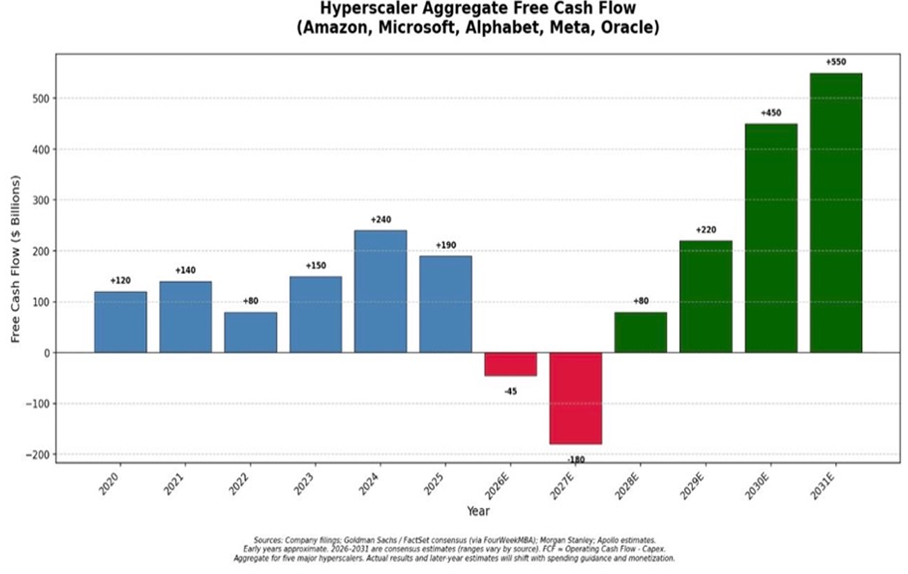
Phi-advisor may be too optimistic, but the AI bonanza does not necessarily have to end in a stock market crash and a financial crisis. The history of the railways does show that a revolutionary technology does not automatically mean that every investment in that technology will be successful. For investors, this above all underlines the importance of diversification. Broad passive investments can limit dependence on individual AI winners, while physical gold bullion can play a complementary, diversifying role if things go wrong with AI.
What can the 19th-century Railway Mania teach us about today's AI hype? On railway bonds, the battle between gold and silver, and why diversification pays off.

Jan Longeval is an author, speaker, independent adviser and co-host of the GoldRepublic podcast. For GoldRepublic, he writes financial and economic analyses focusing specifically on Belgium within a broader European context. He has written several books on investing, gold and bitcoin. With master's degrees in both economics and real estate, and as a certified financial analyst, adjunct professor of finance at Vlerick Business School and former head of investments at Degroof Petercam, Jan is a sought-after speaker and independent adviser. He regularly keeps his many thousands of followers informed through highly analytical articles and blogs.