


The Democrats have won convincingly. For investors, that removes a major source of uncertainty. The US debt bill, however, changes a lot less for now.
The Democrats have taken both the House of Representatives and the Senate. A huge sweep, reaching deep into Republican territory. Even Texas has delivered a Democratic senator and governor. The last Democratic win in a Senate race there dated back to 1988. Anyone who thought America’s political map was more or less set in stone has some explaining to do.
But what does this mean for investors, who have just taken quite a beating? Do they now need to completely revise their expectations for taxes, government spending and corporate profits? For individual sectors, the change of power can make a big difference. We saw that straight away, with chipmakers and AI stocks taking a hefty hit. For the broader market, something else may weigh more heavily: the fact that there is a clear outcome at all.
Sometimes knowing there is a winner matters more than who wins. That sounds sobering after months of campaign bombardment, endless analyses and a genuine mini-crash, but an investor doesn’t have to like the result to benefit from the clarity.
Uncertainty comes at a price
Kam Fong Chan and Terry Marsh researched this in ‘Asset prices, midterm elections, and political uncertainty’, published in 2021 in the Journal of Financial Economics. Over a period of no less than 145 years, they examined equity risk premiums, flows into investment funds, corporate investment and premiums on government bonds. Their question: what pattern emerges around US midterms, and how does political uncertainty fit into it?
The findings are striking. In the months following midterms, the average equity risk premium was 15.41% on an annualised basis, compared with 2.98% in other months. The equity risk premium is the return above the supposedly risk-free rate. In other words: how much extra return equities delivered compared with that risk-free investment. Inflows into equity funds and growth in corporate investment were also stronger, while premiums on government bonds were lower.
At the same time, political uncertainty and risk aversion declined. That pattern held up across various measures, including indices of economic policy uncertainty and partisan conflict. In their analysis, midterms even play a more important role in price formation than presidential elections. The results are consistent with a falling political risk premium and higher valuations once uncertainty recedes.
This is also where the link lies with another study of politics and financial markets, by Ľuboš Pástor and Pietro Veronesi from 2013, likewise published in the Journal of Financial Economics. Their model clearly shows that investors demand extra compensation for political uncertainty. That uncertainty also increases volatility and the extent to which stocks move together (correlation), especially when the economy is weak. That last point is exactly what you don’t want, because it means the protection offered by diversification within an investment portfolio diminishes.
If part of that uncertainty disappears, the extra compensation investors demand can fall too. Investors then pay more for a share with the same expected corporate earnings. The mere reduction of uncertainty can therefore justify higher prices, even before those newly in power have implemented their policies.
That doesn’t make every election a guaranteed stock market rally, as we have seen first-hand. But it does explain why political disappointment and a rising portfolio can go together perfectly well.
Different winners, the same deficits
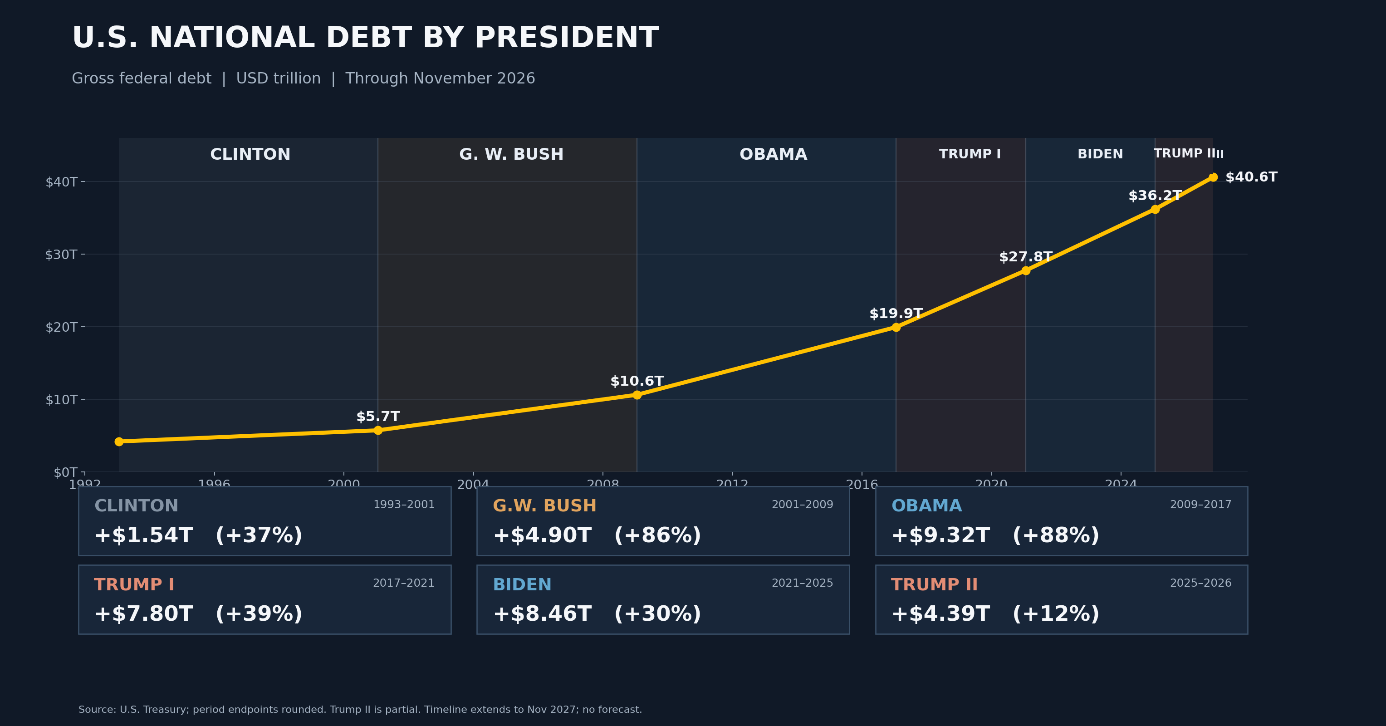
Do you know what probably changes far less after this political landslide? The trend in US budget deficits. In that area, cooperation between Republicans and Democrats has been remarkably successful for years. Unfortunately, mainly at passing the bill on.
One party defends tax cuts, the other government spending. Both believe their own plans largely pay for themselves. Meanwhile, interest, pensions, healthcare and, not least, defence still have to be paid for. Even when the election promises disappoint.
Under current legislation, the Congressional Budget Office projects a budget deficit of 5.8% of GDP in 2026, rising to 6.7% in 2036. Incidentally, the budget deficit already exceeded 6% of GDP in 2024 and 2025. Federal debt held by the public will rise from 101% to 120% of GDP over the next ten years. For 2056, the CBO arrives at a staggering 175%, with annual interest costs of almost 7% of the economy.
Of course, politicians and their new policies can change those projections. That is even what they are elected for. Change. But a different majority is not the same as fiscal consolidation. An ageing population pays little attention to party manifestos, and creditors don’t skip an interest payment because Washington has to negotiate again.
Interest rates remain a political battleground
That means the wrangling over interest rates continues too. The larger the debt, the greater the political interest in lower financing costs. At the same time, inflation may actually force the central bank to keep rates high. That conflict won’t disappear with a different make-up of Congress.
I still expect the pressure to lower real interest rates, that is, after inflation, to keep building. Lower nominal rates help with that, and so does higher inflation. The latter reduces the real value of existing nominal debt. However, what brings relief for the government erodes the purchasing power of money and of nominal bond payments.
So the election result may change something about equity valuations, without removing the structural reason to protect your wealth against currency debasement. That distinction should weigh more heavily for all investors than the political colour of the winner.
That is also precisely why you keep coming back to scarcity: physical gold, bitcoin and shares in quality companies with pricing power. Different investments, different risks, but all more relevant than the hope that Washington will suddenly become frugal after these elections.
The result is in. The bill is still to come.
The Democrats take the House and the Senate. Political uncertainty fades, but US budget deficits remain. What does that mean for your wealth?

Jeroen Blokland has over 20 years of experience as a professional investor and was formerly Head of Multi-Asset at Robeco, where he was responsible for a client portfolio of over five billion euros. After leaving Robeco he founded True Insights, an independent investment research platform, and has since built a following as a columnist, YouTuber and sought-after speaker. With over 100,000 followers on X, he is one of the most prominent voices in Dutch finance. For GoldRepublic he writes on macro-economics, markets and the role of gold in a diversified portfolio.