

After last week's correction, the gold price has climbed back above $4,000. A clear battle is currently raging in the gold market between two groups of investors. On one side are short-term speculators. On the other are long-term investors who are using the lower prices to add to their gold holdings.
For now, the two groups are keeping each other in balance. To improve the technical picture, however, gold would need to break convincingly through the $4,230 per ounce level. That level acted as support from August to September, before turning into resistance, see the yellow line.
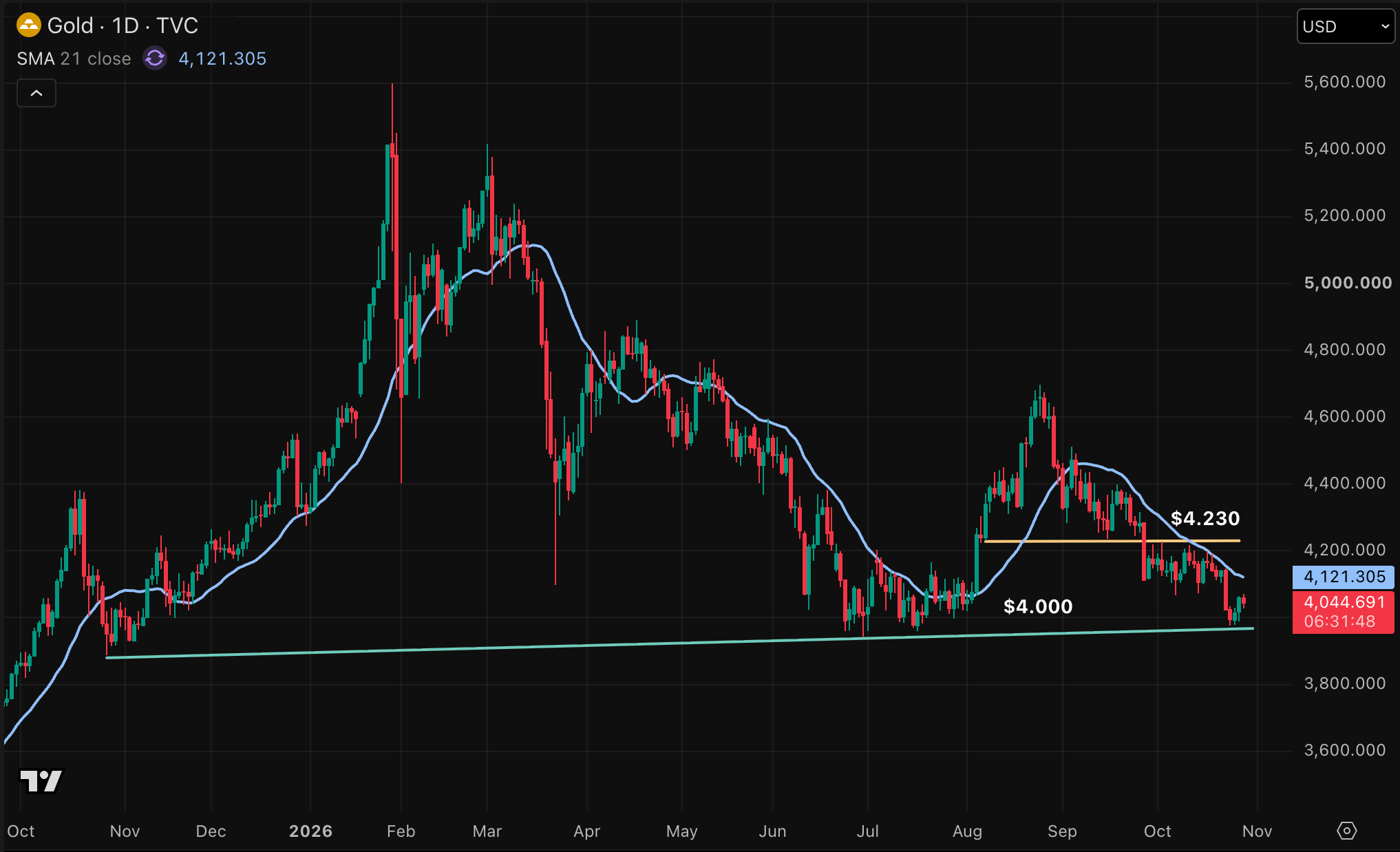
At the bottom, the green line around $4,000 per ounce has been an important support level for gold since October 2025. For now, that support appears to be holding, despite the enormous macroeconomic headwind of rising real interest rates. The market is clearly signalling that at this price, gold is an attractive long-term investment.
The Federal Reserve's rate decision
Next up is the US Federal Reserve, which presented its latest interest rate decision yesterday evening. As far as the decision itself goes, the Fed did exactly what the market expected: rates were left unchanged.
By now, the Fed's strategy under its new chair, Kevin Warsh, is clear. Raise rates. Pause. Then raise again if the data still call for it. Yesterday's decision was one of those pauses.
Gold reacted somewhat erratically, but ultimately settled around $4,050 per ounce.
Since the decision, the US two-year yield has fallen by around 0.08 to 0.09 percentage points. The market therefore appears to be cautiously interpreting the decision as dovish. In other words, it now sees the Fed as slightly less hawkish than before.
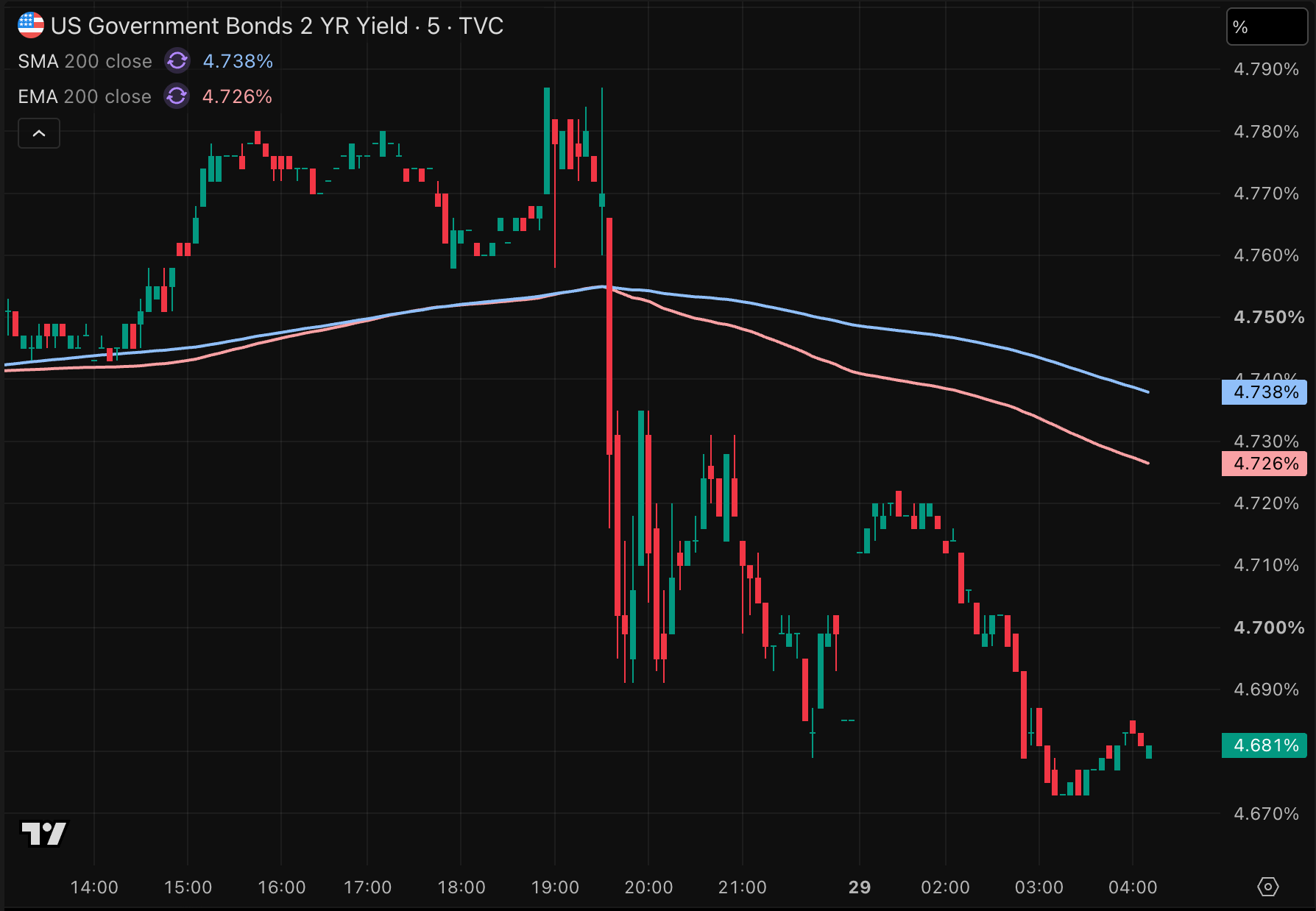
There is no significant shift, however. Nor can or should we probably expect one from the Fed under Kevin Warsh. He is not in favour of giving much away in advance about future rate meetings, so that the Fed can continue to make decisions based on incoming data.
That said, there is a clear leaning towards looser policy. After all, inflation has been above the 2.0% target for six years, while the Fed currently describes the economy as "strong".
If the economy is strong and inflation has been too high for six years, that would in theory be a reason to raise rates more aggressively. The fact that the Fed is not doing so is a signal.
Not a huge signal, as it is raising rates step by step, but it shows that it is less determined to fight inflation than its communication suggests.
A rate hike in December still looks like the most likely scenario, and a hike at the March meeting also remains on the table. But nothing in Warsh's press conference suggested that the Fed currently believes it will need to keep raising rates well into 2027.
After all, financial conditions have already tightened considerably over recent months, as Warsh himself acknowledged during the press conference.
In economics, financial conditions mainly refer to credit conditions: the availability and price of credit. Think of rising bond yields in the United States, but also in France. By now, it is a global phenomenon.
Warsh acknowledged that this brake on the economy and inflation is already starting to take effect, but not yet sufficiently. The Fed seems to want to wait for that process to play out, and there is something to be said for that.
In the chart below, we can see that financial conditions have indeed tightened again since August. This is the Chicago Fed NFCI, an index made up of more than 100 indicators of financial conditions. A rise means that credit conditions are becoming tighter.
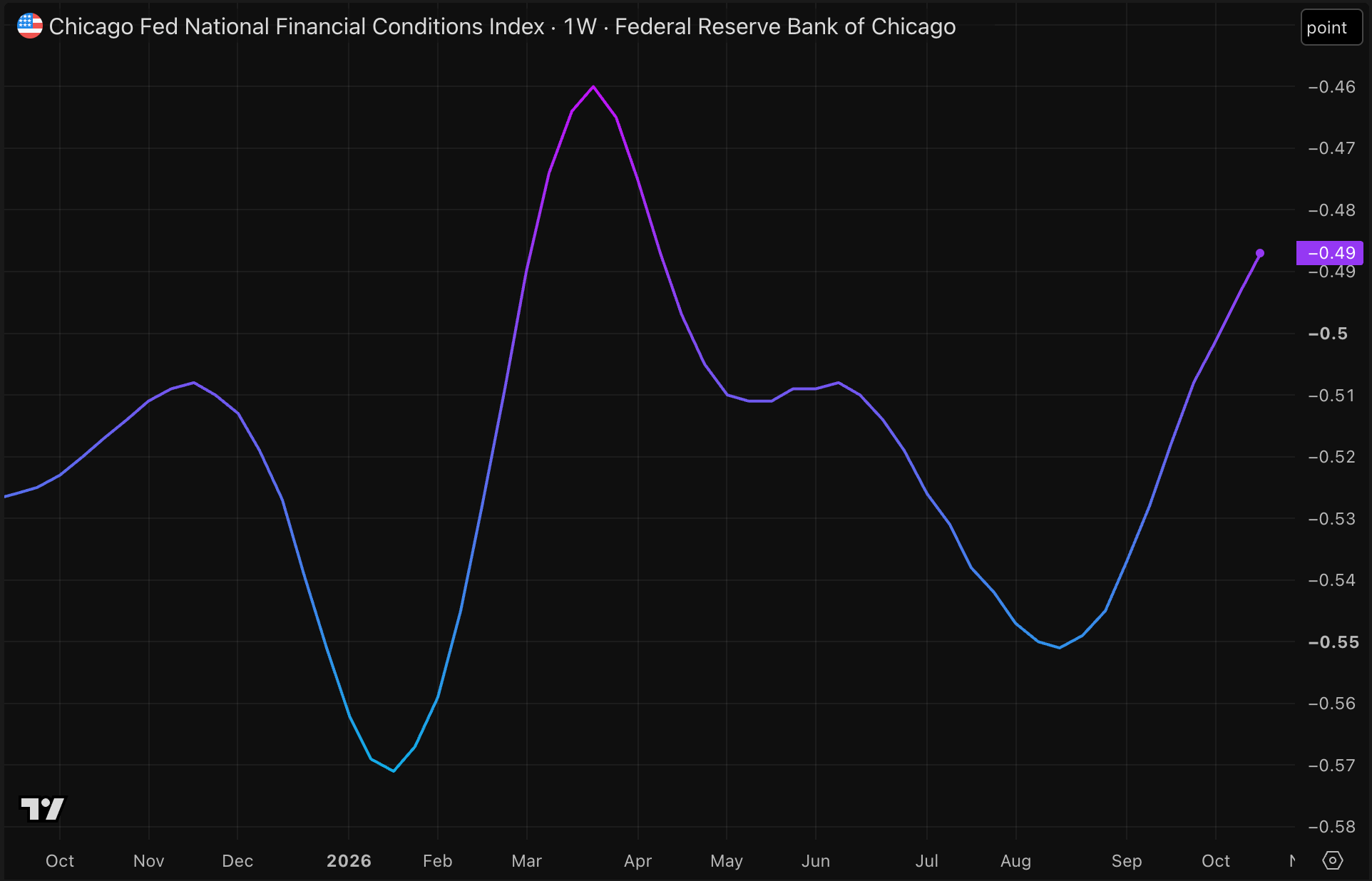
That, however, is the short term. If we zoom out and look at the bigger picture, there is actually very little sign of that rise.
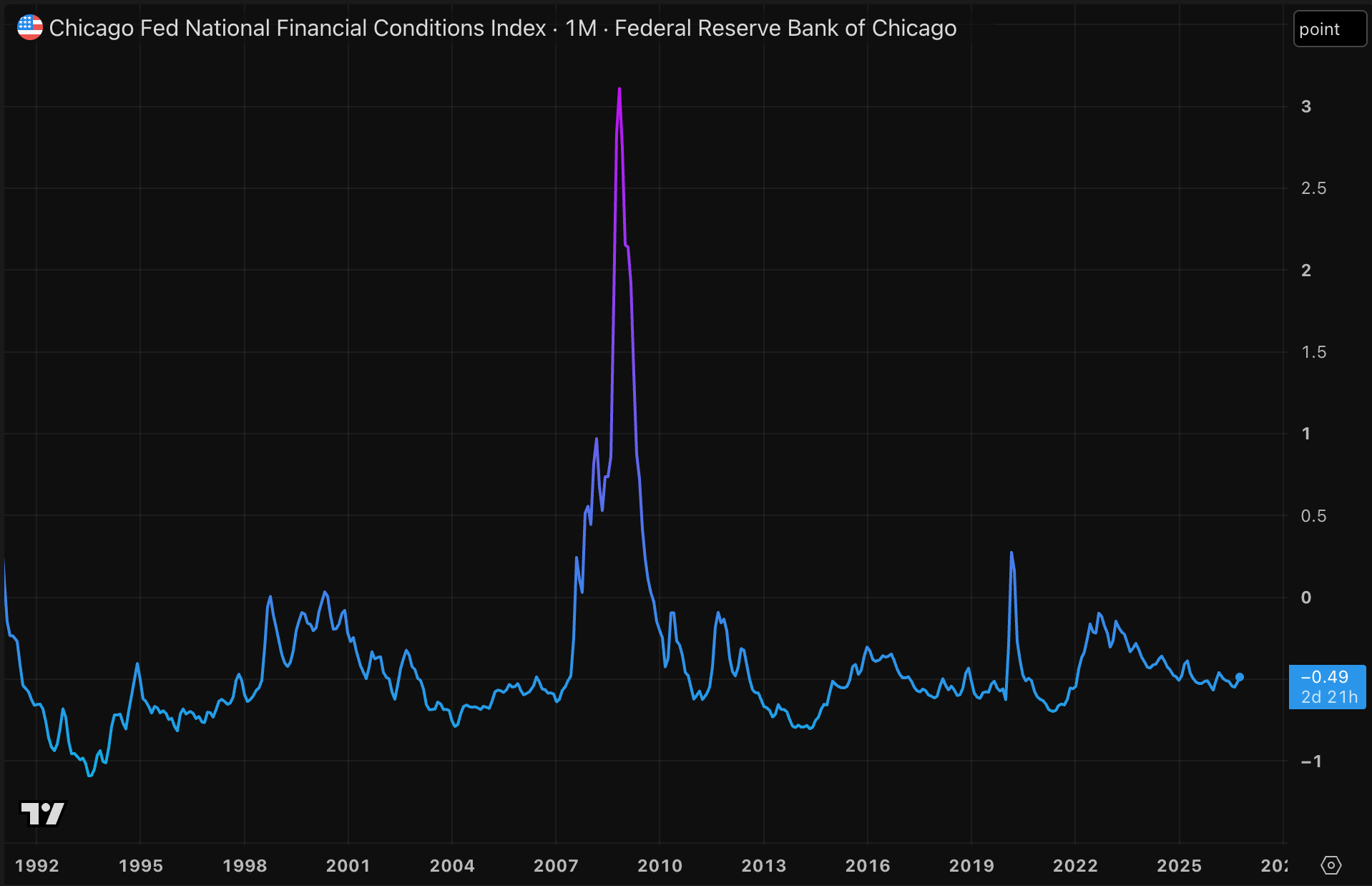
This is the same indicator going back to the 1990s. In that sense, it is questionable how seriously we should take Warsh's comments. From a historical perspective, credit conditions today cannot be described as tight.
What does this mean for the gold price?
For now, gold is in a phase where it is getting less attention from investors. Since the peak in January, Wall Street's focus has been on AI shares. That does not look set to change any time soon, apart from growing concerns about how the AI investment cycle is being financed.
AI companies are increasingly financing their investments with debt. Combined with sharply higher bond yields, this means those investments need to deliver more and more to remain profitable.
Loans have already been taken out, and are being taken out at an increasing rate, while revenues remain uncertain.
The flotations of model developers Anthropic and OpenAI are drawing capital out of the market. That money has to come from somewhere. The same applies to the share issues many tech giants are carrying out to raise extra capital for AI investments. The battle for capital is intensifying.
The US midterm elections could come as a shock to Wall Street if the Democrats win and start getting in the way of AI companies. They are scheduled for next week.
And this is only part of the growing list of reservations investors have about AI shares. That does not mean the technology has no future, or that these companies are all doomed to fail, but real enthusiasm is currently lacking.
In principle, that gives gold an opportunity to draw investors' attention back over time.
At some point, the AI cycle will come to a halt, at least temporarily. That is probably also the moment when governments and central banks step in with support. Typically, that is a phase in which investors realise that gold could well be an attractive form of protection.
At the same time, we can see that the gold price is already finding strong support around $4,000. After all, that level has been a support for gold since 2025. In that respect, many investors appear to be building the foundation of their portfolio already, for a period in which attention to gold will increase.
Attention in financial markets often shifts from asset to asset. Right now, this may feel like a dull period for gold. But these are usually precisely the periods in which it pays to stay sharp. Bull markets are great, but they are even better if you had already bought during the phase when things were going less well.
The Federal Reserve's rate decision barely moved gold, while doubts about the AI bull market are growing. Meanwhile, gold is quietly building the foundation for its next bull run.

Thom Derks writes for GoldRepublic on gold, macro-economics and geopolitics. He studied Law in Leiden and Economics in Amsterdam. His personal fascination with scarcity and store of value through both bitcoin and gold brought him into the world of financial journalism. Through his own newsletter De Geldpers on Substack, he reaches over 5,800 subscribers with analyses on markets, geopolitics and the monetary system.