

On Friday, the gold price broke through a crucial support level around $4,000 per ounce. This happened as the sell-off in AI-related stocks gathered pace. At the same time, oil prices rose again amid fears of new US strikes on Iran.
That naturally feels strange, as gold is known as a safe haven. And it is one. It is important to understand, however, that this kind of price reaction is normal in a crisis. In moments of intense fear and large-scale liquidations on the financial markets, investors pull capital out of all assets.
The market's first reaction is always a flight to cash and, in some cases, government bonds.
Only when governments and central banks step in with support measures do gold and silver often come back into favour. That is the moment the market realises the financial world will once again be flooded with capital.
Silver fell by almost 6 percent, an even sharper move than gold. That is because silver is not only a monetary metal, but also plays an important role in, for example, chip production. Concerns about the AI investment cycle therefore hit silver through that channel too.
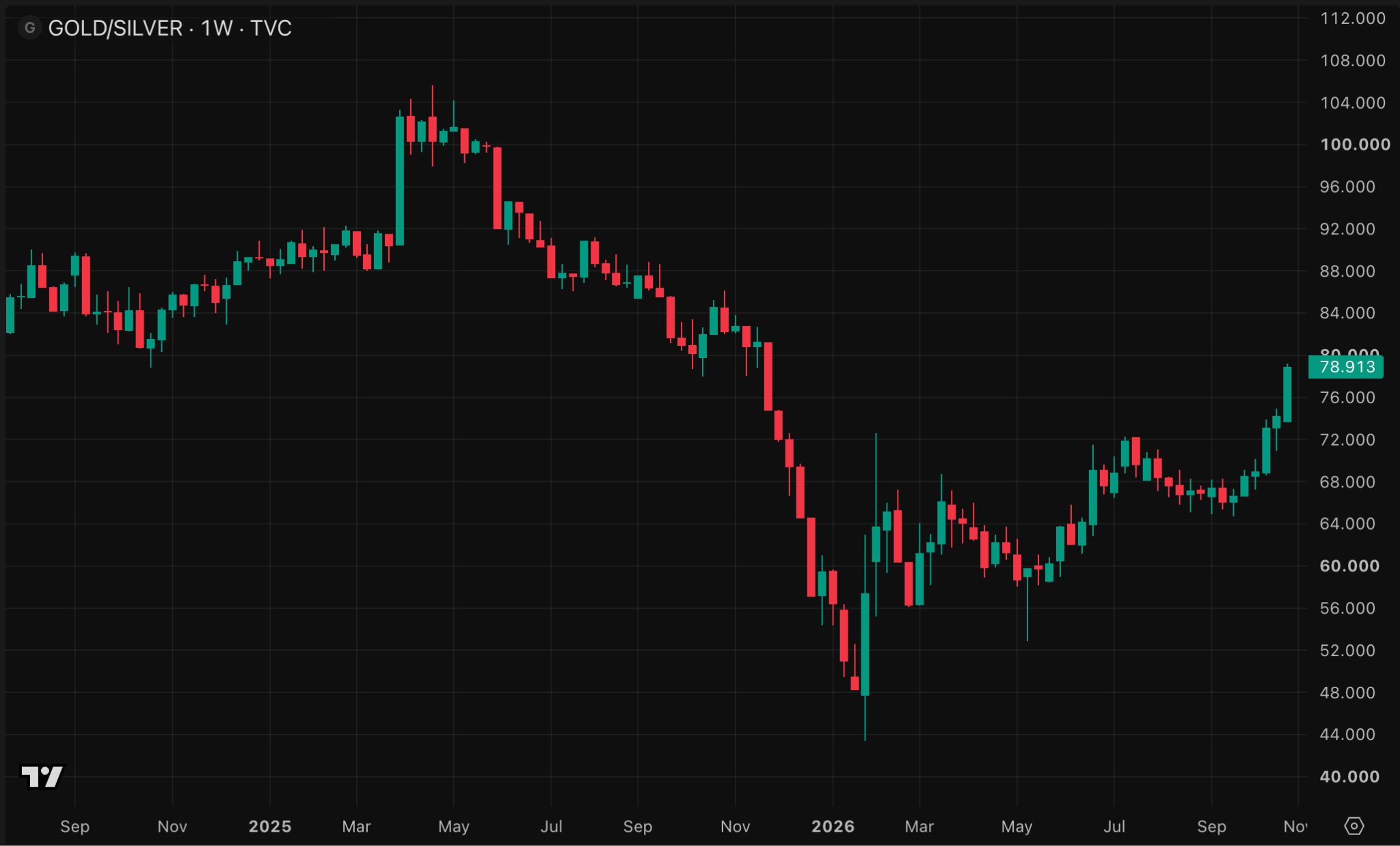
Silver's weakness is also visible in the chart below, which shows the gold/silver ratio. It is now heading back towards 79, its highest level since November 2025. Amid doubts about the economy, gold is clearly gaining momentum relative to silver.
Gold closes at its lowest level in a year
On Friday, the gold price closed below $3,900 per ounce, its lowest level in a year. At the same time, the 12.7 percent decline in October marked the worst October since the great financial crisis of 2008.
With that decline, gold lost the support around $4,000 that had played an important role since October 2025. Interestingly, though, the fall stopped around the 100-week exponential moving average (green line). Gold last lost that level in 2023, and back then it did mark a bottom. In 2022, the gold price last touched the 200-week exponential moving average (red line), and the decline continued.
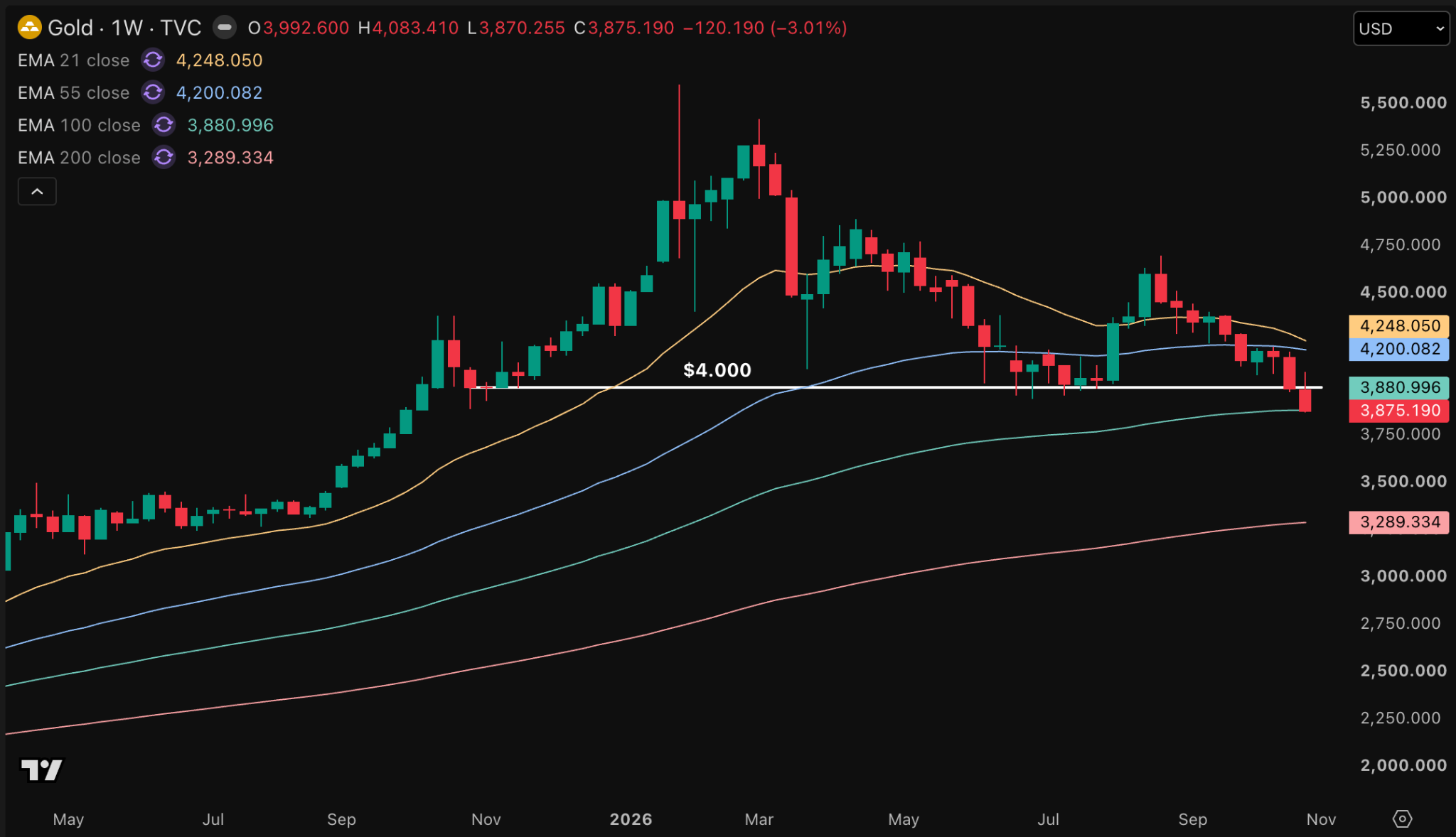
For now, traders with a short investment horizon remain in control of the gold market. Upward momentum is fading and sellers are now clearly in control of the gold price.
Last week, gold ETFs saw an outflow of six tonnes. Although we would have preferred to see the ETFs hold firm, as they are long-term buyers, the outflow is modest compared with the inflow of around 150 tonnes of gold since July.
Even so, an important test is now coming for ETF investors. Those who bought recently are now sitting on paper losses. It will be interesting to see whether they stay the course and don't let themselves be swayed by short-term moves in the gold price.
You can see this phase as a test of these investors' conviction.
Interestingly, GoldRepublic customers are still buying more gold than they are selling. There is a small caveat, though: this is mainly down to savings plans, from people who are truly convinced of gold, as those purchases simply continue. Among one-off transactions, we saw more sales than purchases.
Long-term arguments for gold remain intact
Amid all the market turmoil, it is important as an investor to keep your eye on the long term. At times like these, investment funds and traders are often forced to liquidate positions or even face margin calls. That typically affects all assets, as these market players rush into cash en masse.
These are investors who look at the markets differently. They are far more focused on the short term and have to perform every month to keep their investors and capital on board. "Ordinary" investors with a longer time horizon are, in principle, not affected by these developments.
In fact, the case for holding gold in your portfolio has only grown stronger in recent months. Rising interest rates are deepening concerns about government debt. At the same time, geopolitical powers have increasingly turned against each other in recent years. And the US dollar's dominance on the world stage is slowly weakening.
For now, however, that is not enough to offset the turmoil on Wall Street in the short term.
There are two scenarios in which calm could return to the gold market. In the first, confidence in the AI cycle returns and the financial markets start to climb steadily again from here. An end to the war with Iran could help: falling energy prices would bring interest rates down and reduce the financing costs of the AI investment cycle.
The second scenario is darker. A deeper correction in the stock market, which would probably drag the gold price down further as well, would eventually trigger a response from the US Federal Reserve and other central banks.
So far, the stress on Wall Street has already led the market to expect only two rate hikes from the Federal Reserve instead of three. If the correction persists, that could eventually turn into rate cuts and renewed purchases of government bonds, known as quantitative easing.
The structural reasons to hold gold have not gone away. The problem is that the market is currently highly unstable. Momentum has completely vanished and sentiment has soured considerably. That needs to change. A first step in the right direction would be for gold to reclaim support at $4,000.
Gold lost almost 13% in October and fell below a key support level. Is a bottom in sight, or is the gold price set to fall further?

Thom Derks writes for GoldRepublic on gold, macro-economics and geopolitics. He studied Law in Leiden and Economics in Amsterdam. His personal fascination with scarcity and store of value through both bitcoin and gold brought him into the world of financial journalism. Through his own newsletter De Geldpers on Substack, he reaches over 5,800 subscribers with analyses on markets, geopolitics and the monetary system.