

Hopeful signals for gold: is this the beginning of something beautiful?
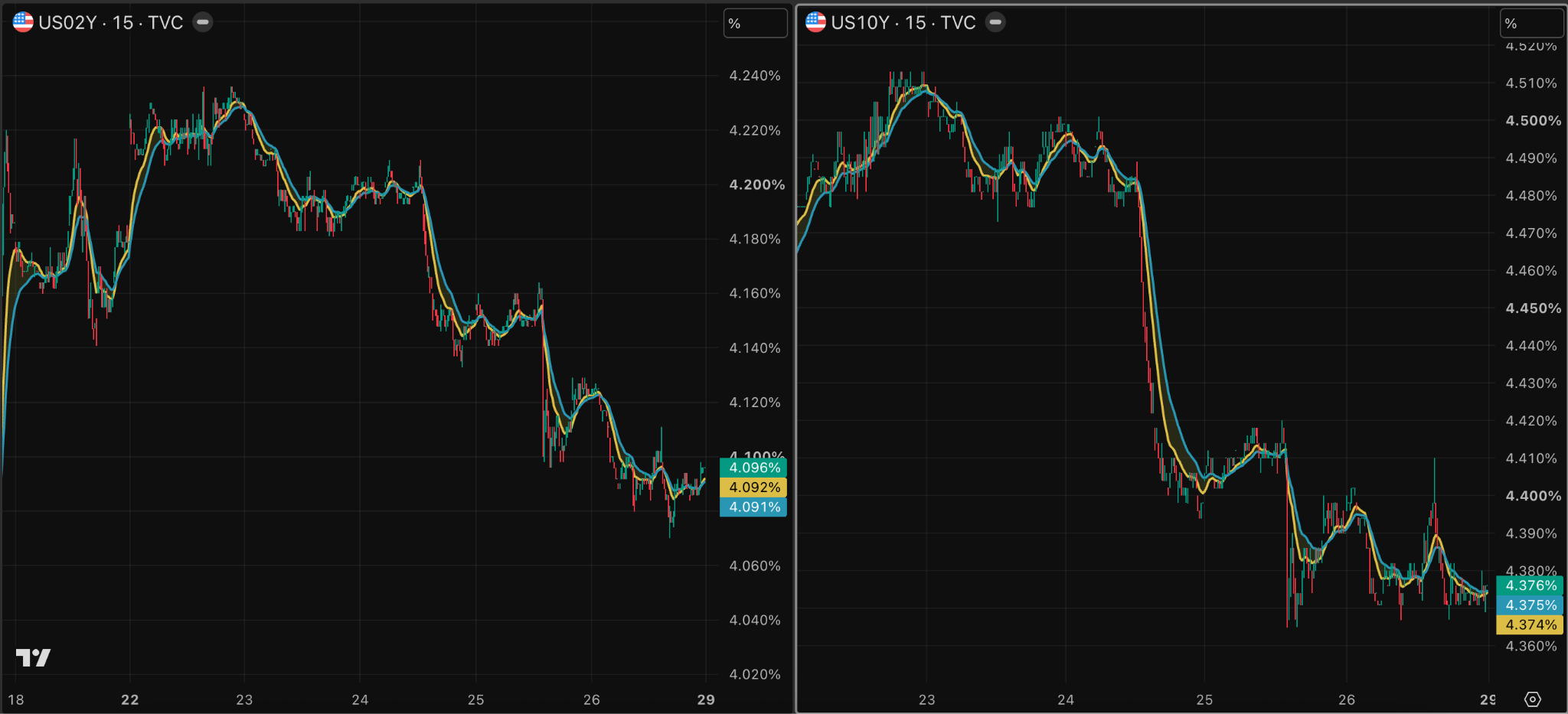
Although the gold price has been going through a difficult phase since the record high of January 2026, increasingly positive signals are emerging. In the United States, yields on 2- and 10-year government bonds are falling, while the US dollar has also cooled somewhat over the past few days.
In addition, oil prices have fallen back to their lowest level since the start of the Iran war. Meanwhile, gold is holding the important support level around $4,000 for now. This makes the picture cautiously more constructive.
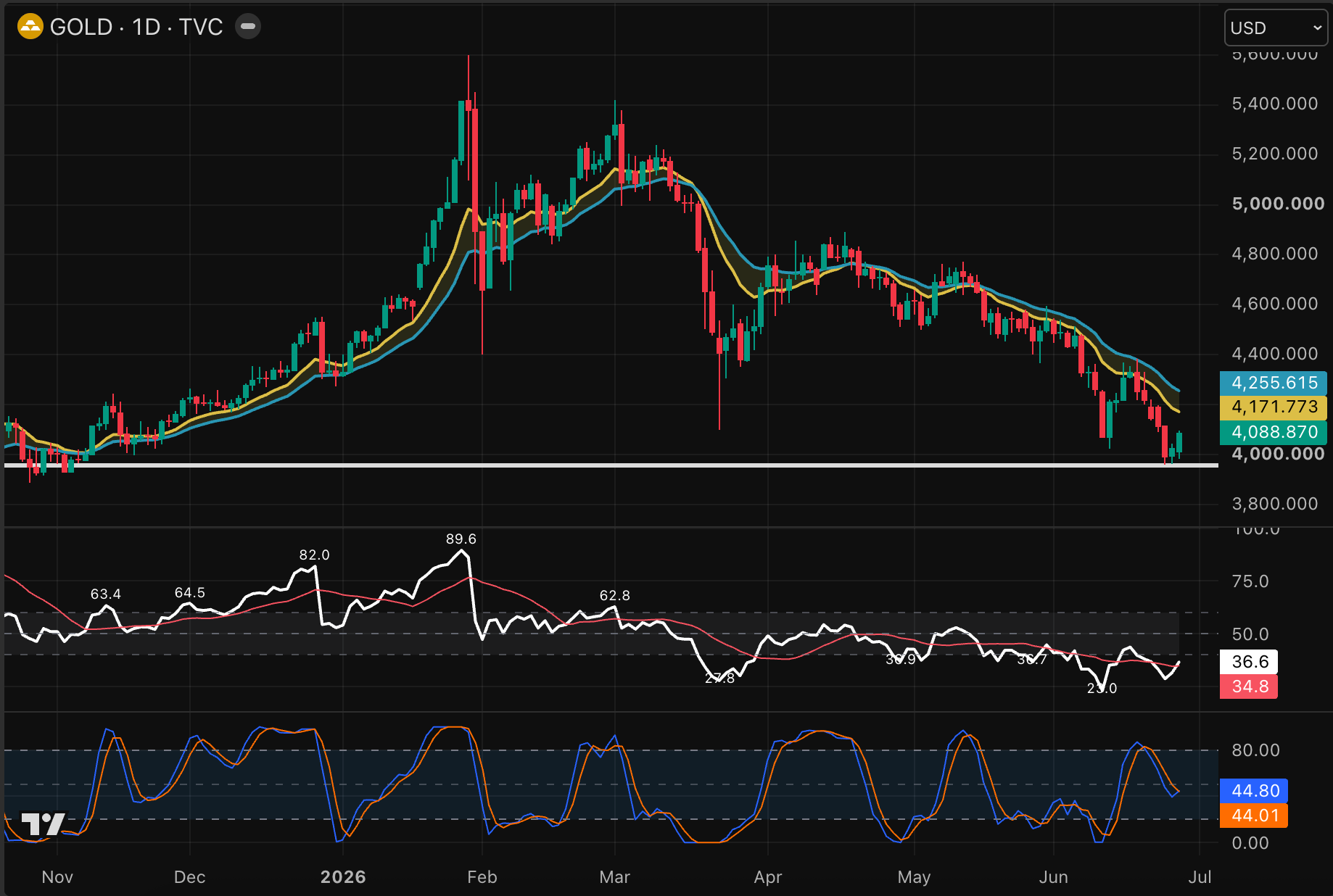
Alongside the support at $4,000, the same chart shows a bullish divergence forming. While the price made a lower low, the Relative Strength Index (RSI) actually recorded a higher low. This is visible in the middle panel of the chart above.
This is generally a signal that downward momentum is easing. Prices are still moving lower, but conviction is fading. If this picture continues to combine with falling US Treasury yields and a cooling dollar, that could prove positive for gold in the period ahead.
Rotation may create room for gold
It won't have escaped your notice that attention in financial markets has recently been focused primarily on AI stocks. Last week, however, we saw a number of interesting signals for gold around this theme.
First, OpenAI decided on Friday to likely postpone its IPO until at least 2027. The plan had previously been to go public later this year. This further increased concerns about AI funding, infrastructure investment, and crowded positioning within the sector.
That pressure persisted throughout the entire trading day. The PHLX Semiconductor Index ultimately fell 5.3% and closed out its worst week since March 2025. Micron's stock lost more than 6%.
Investors appear to be shifting capital away from AI winners toward other companies within the major stock indices. The S&P 500 and Nasdaq 100 both fell for the fifth consecutive session on Friday, marking their longest losing streeks since January and August.
The signal, however, came from the Russell 2000 and the equal weighted S&P 500, which managed to close at record highs. Capital is therefore not flowing entirely out of the market, but is cautiously searching for new opportunities. The Russell 2000, for example, is a stock index containing relatively small companies that are more sensitive to changes in bond yields and thus benefited from the decline in rates.
The fact that gold also finished in the green on the last two days of the trading week, reclaiming the important $4,000 level in the process, is a positive signal for the precious metal. Gold could theoretically become part of that rotation for instance, because investors believe the metal is starting to look attractive again at current prices.
One swallow does not make a summer
That said, it's important not to celebrate too early. One swallow does not make a summer, and based on the current combination of signals, we cannot yet speak of a convincing trend reversal. For that, gold must first provide more evidence.
In that context, it will be interesting to watch the cloud of the 12 day and 21 day exponential moving averages. At the time of writing, this sits between $4,171 and $4,255, represented by the yellow and blue lines in the chart below.
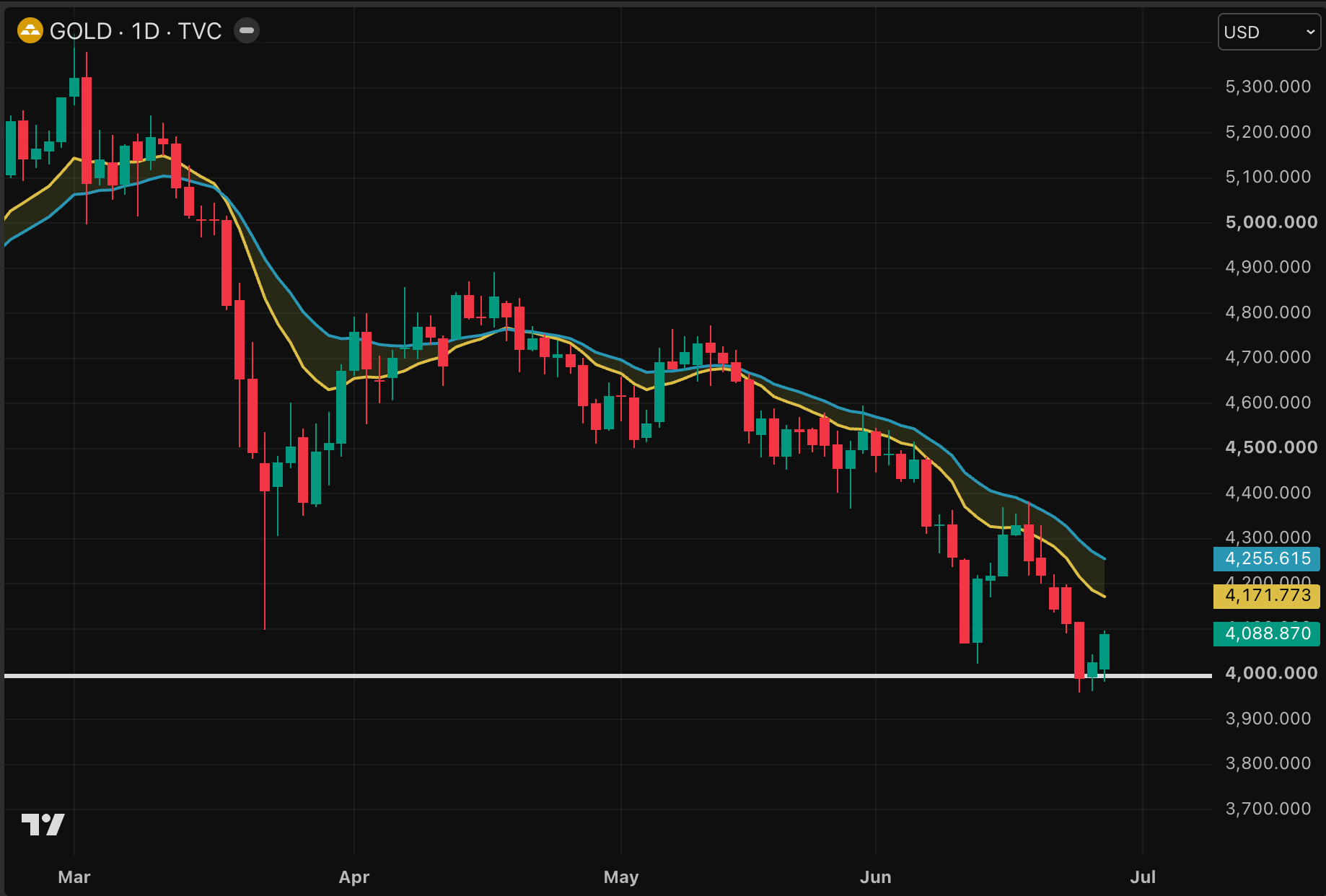
Holding the support around $4,000, combined with a breakout above these averages and a further cooling of the US dollar and bond yields, would be a powerful signal for gold especially if that also coincides with a modest rotation out of popular AI stocks toward other financial assets.
Furthermore, we are slowly moving toward the US midterm elections, scheduled for November 2026. That could become a moment when investor attention shifts once again toward US national debt and the future of the dollar, which would ultimately also work in gold's favor.
Falling interest rates, a weaker dollar and technical signals are giving gold room to breathe again. Is this the beginning of a new upward trend?

Thom Derks writes for GoldRepublic on gold, macro-economics and geopolitics. He studied Law in Leiden and Economics in Amsterdam. His personal fascination with scarcity and store of value through both bitcoin and gold brought him into the world of financial journalism. Through his own newsletter De Geldpers on Substack, he reaches over 5,800 subscribers with analyses on markets, geopolitics and the monetary system.