

Gold rises on falling bond yields and oil prices
The gold price climbed to just over $4,500 per ounce this week. That rise appears to be the result of declining US bond yields and falling oil prices. Although negotiations between the United States and Iran seem to be progressing slowly, markets continue to expect a swift resolution to the conflict.
After President Donald Trump made clear that negotiations are still ongoing, fears of further interest rate increases eased somewhat.
The gold price responds strongly to the oil market
Although gold is traditionally an asset that protects against inflation, the precious metal is currently benefiting from falling interest rates. Gold is what we call a non-yielding asset in the financial world, meaning it pays no interest like bonds or dividends like stocks.
At present, the gold price is responding strongly to movements in the oil market, as these influence inflation expectations, bond yields, and the US dollar. The cautious optimism surrounding peace prospects and a potential reopening of the Strait of Hormuz is currently supporting a rising gold price.
The downward trend needs to be broken
It is still too early to speak of a positive trend for gold again - at least in terms of short-term price direction. If we zoom out and look at the bigger picture, gold is undeniably in a rising market.
In the shorter term, however, a downward trend is in place. To break it, gold will first need to clear the 21-day moving average at $4,577, represented by the blue line in the chart below.
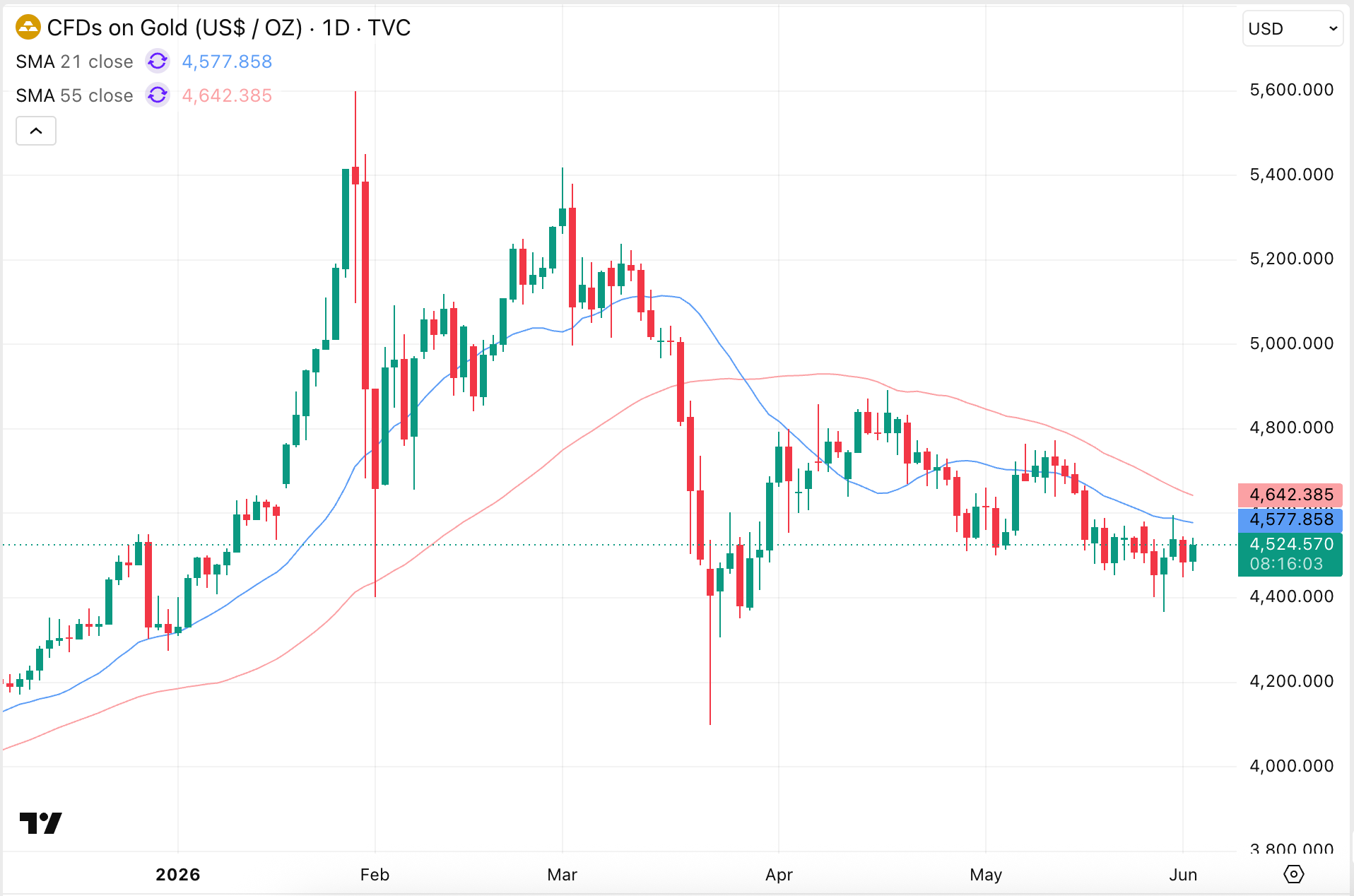
That alone would not be sufficient to draw conclusions. Certainty never exists in the financial world, but to give the benefit of the doubt, gold would also need to reclaim the 55-day moving average at $4,642.
In April and May, that average proved too strong a resistance level for the gold price. Once those hurdles are cleared, the market can start dreaming of new record highs again. For now, however, the momentum for that is largely absent, as it currently appears to be almost entirely concentrated in the AI sector.
The big picture remains positive for gold
The presence of a short-term downward trend does not necessarily mean an asset is in a bear market. While that scenario can never be ruled out, there is currently insufficient evidence to support it in the case of gold.
The chart below shows that the gold price continues to be supported by the longer-term moving averages - specifically the 200-day moving average cloud in blue and its exponential variant in red.
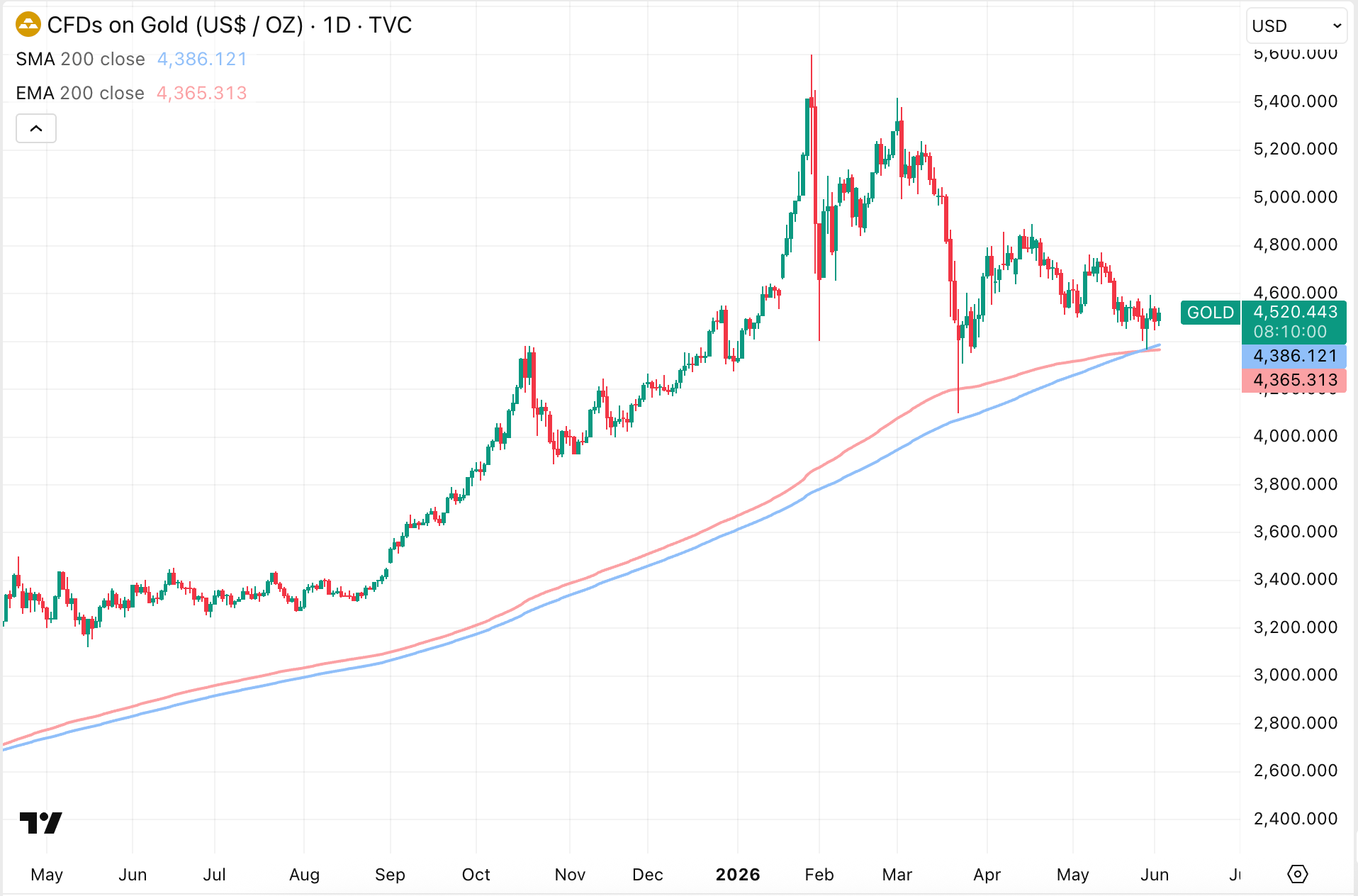
As long as the price continues to find support at these levels, as we saw in March and May, there is insufficient evidence to declare the end of the bull market. At the same time, it cannot be denied that an important phase is approaching for gold.
The price is moving within an increasingly narrow range and appears to be heading toward a decision point. Much will depend on developments surrounding Iran and the Strait of Hormuz, which have a significant impact on inflation, bond yields, and the US dollar.
That said, gold is holding up remarkably well given the circumstances. In addition to the negative impact of the Iran war, the market also has to contend with the enormous attention currently directed toward artificial intelligence.
The frenzy surrounding AI stocks has become so extreme that external developments are not stopping the American market from rising to record highs almost continuously. As we saw with gold in January, however, there always comes a point at which investors start taking profits.
That capital then needs to find a new home, and investing in gold could be an attractive option for investors at that point. As mentioned, the precious metal is holding its ground very well for now - in contrast to, for example, bitcoin - and the fundamentals continue to speak in gold's favour.
We live, after all, in a world where elevated geopolitical tensions are the norm, and where government debt, albeit somewhat in the background, remains a serious theme. Against that backdrop, the outlook for gold remains positive.
The gold price is climbing as inflation fears ease and bond yields fall. Can gold definitively break its current downward trend?

Thom Derks writes for GoldRepublic on gold, macro-economics and geopolitics. He studied Law in Leiden and Economics in Amsterdam. His personal fascination with scarcity and store of value through both bitcoin and gold brought him into the world of financial journalism. Through his own newsletter De Geldpers on Substack, he reaches over 5,800 subscribers with analyses on markets, geopolitics and the monetary system.