

The gold price is currently going through a very difficult phase. This has everything to do with tighter financial conditions in the form of a rising US dollar and climbing bond yields. At the time of writing, the US dollar index (DXY) is trading at 103.9 points, its highest level in 19 months.
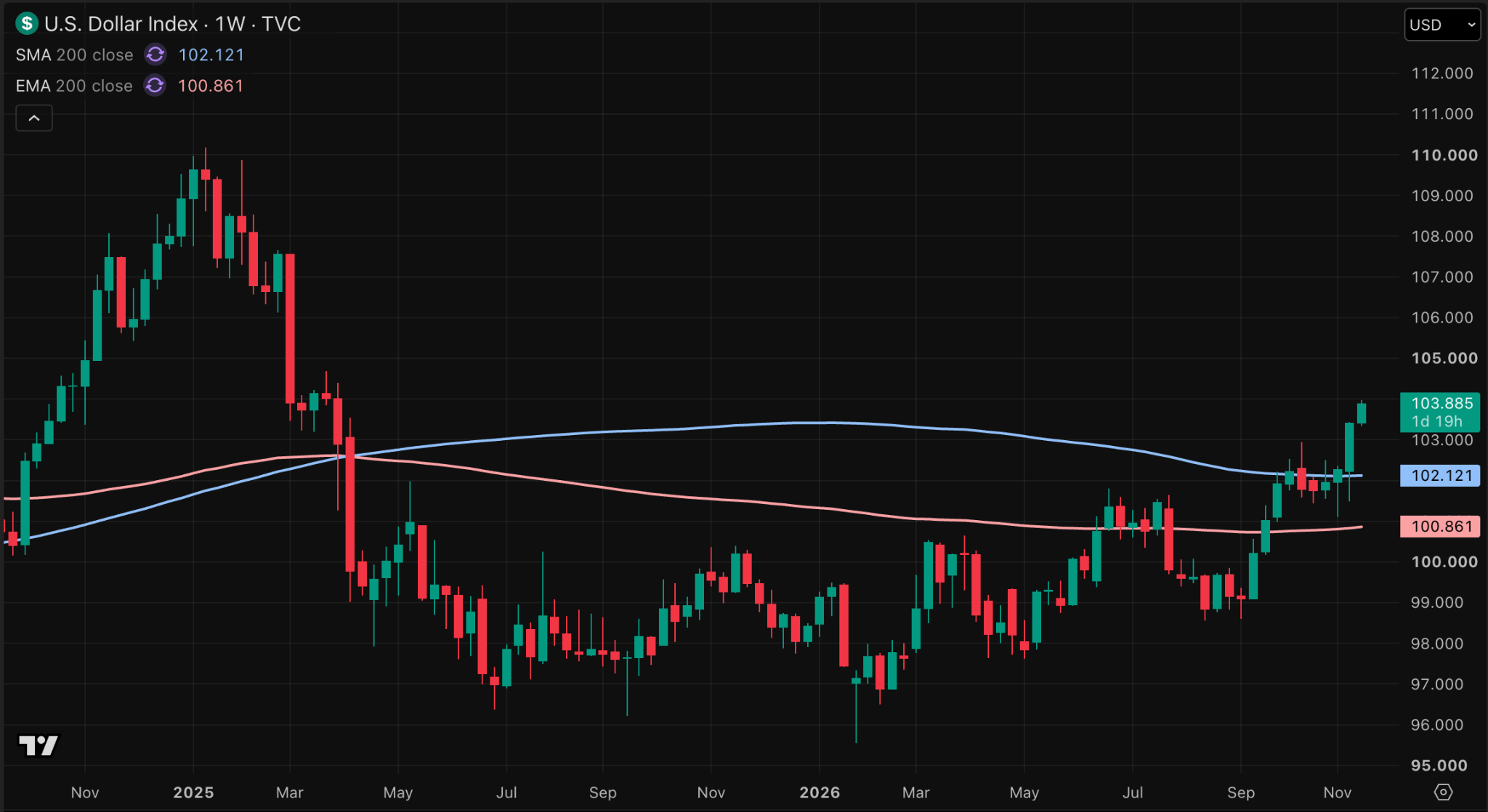
Gold peaked above 5,600 dollars per ounce, while the US dollar hit its lowest level of 2026 at that moment, at 95.5 points. After that, the dollar began to climb and the gold price came under pressure.
Initially, the US dollar recovered after gold fell back from its peak. The last part of the rise was driven mainly by hype. That hot air left the market. This pushed the gold price down quickly and gave the US dollar its first tailwind.
Then the war in Iran began, the oil price climbed at a furious pace, bond yields rose and the dollar gained even more ground.
After that, the market realised that the AI investment cycle is also a major cause of rising bond yields. The demand for capital is enormous, which means lenders can ask for higher interest rates.
Persistent inflation also plays an important role. It depends, among other things, on the sharply higher oil price since February 2026 and on the build-out of AI infrastructure. As a result of persistent inflation, the US central bank has recently become considerably more hawkish.
Until last week, the market was still pricing in roughly two interest rate hikes through to September 2027. Now it is almost four.
Then Albert Musalem, a member of the US central bank's rate-setting committee, spoke out this week in favour of a scenario with four rate hikes. And this at a time when bond yields have already risen sharply and the US dollar had momentum.
That combination of circumstances dealt the gold price another blow. The important support zone around 4,000 dollars per ounce has now clearly been lost. Gold now appears to be heading towards the 0.50 Fibonacci level of the bull market that began at the end of 2022 and ended in January 2026.
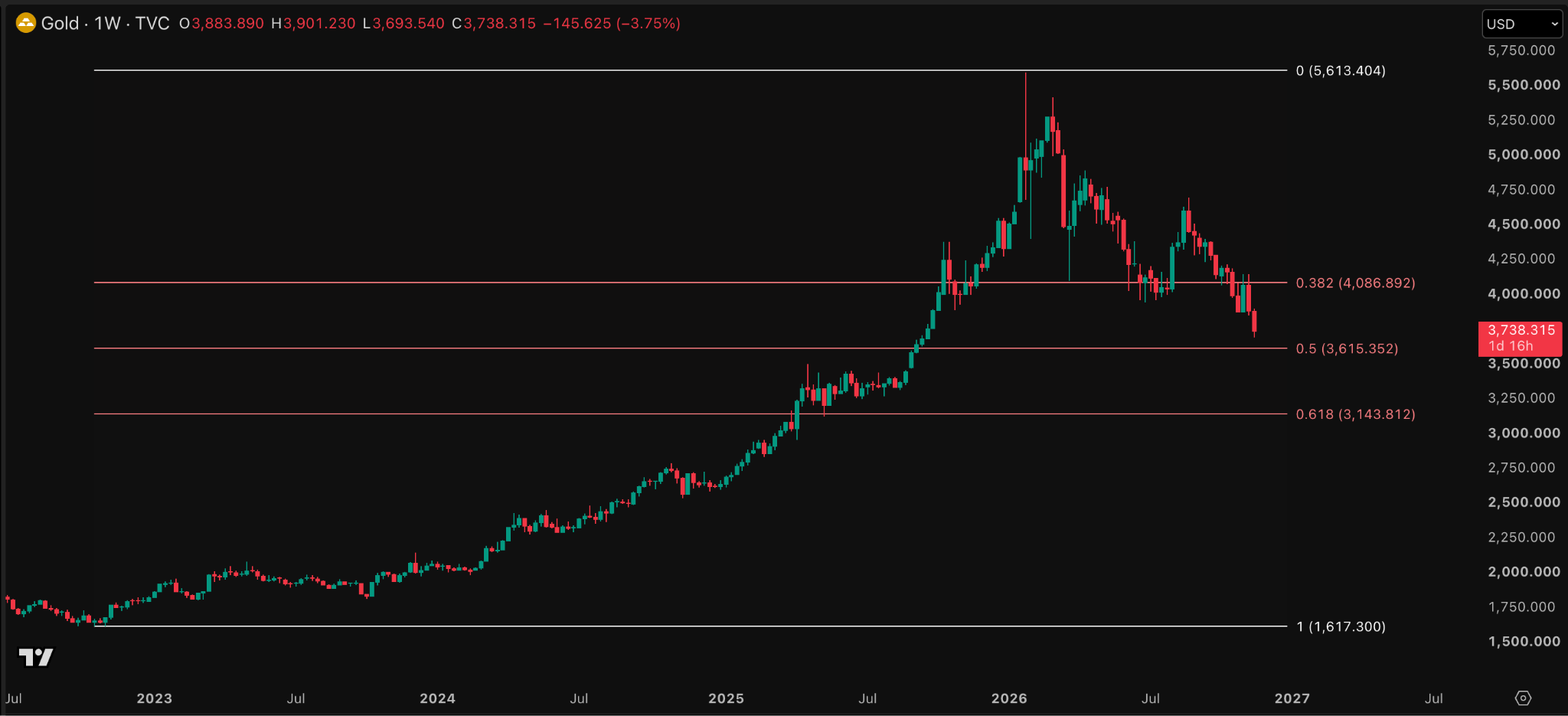
Reaching that level would mean that gold has given back 50 per cent of the total rise during the bull market. The 0.50 Fibonacci level is generally a point at which the market receives renewed support from buyers. For gold, that point is at roughly 3,615 dollars per ounce.
In the shorter term, there is a chance that gold can catch its breath. After the sharp price falls of recent days, the RSI dipped below 30 points yesterday. This means selling pressure is starting to take on fairly extreme proportions.
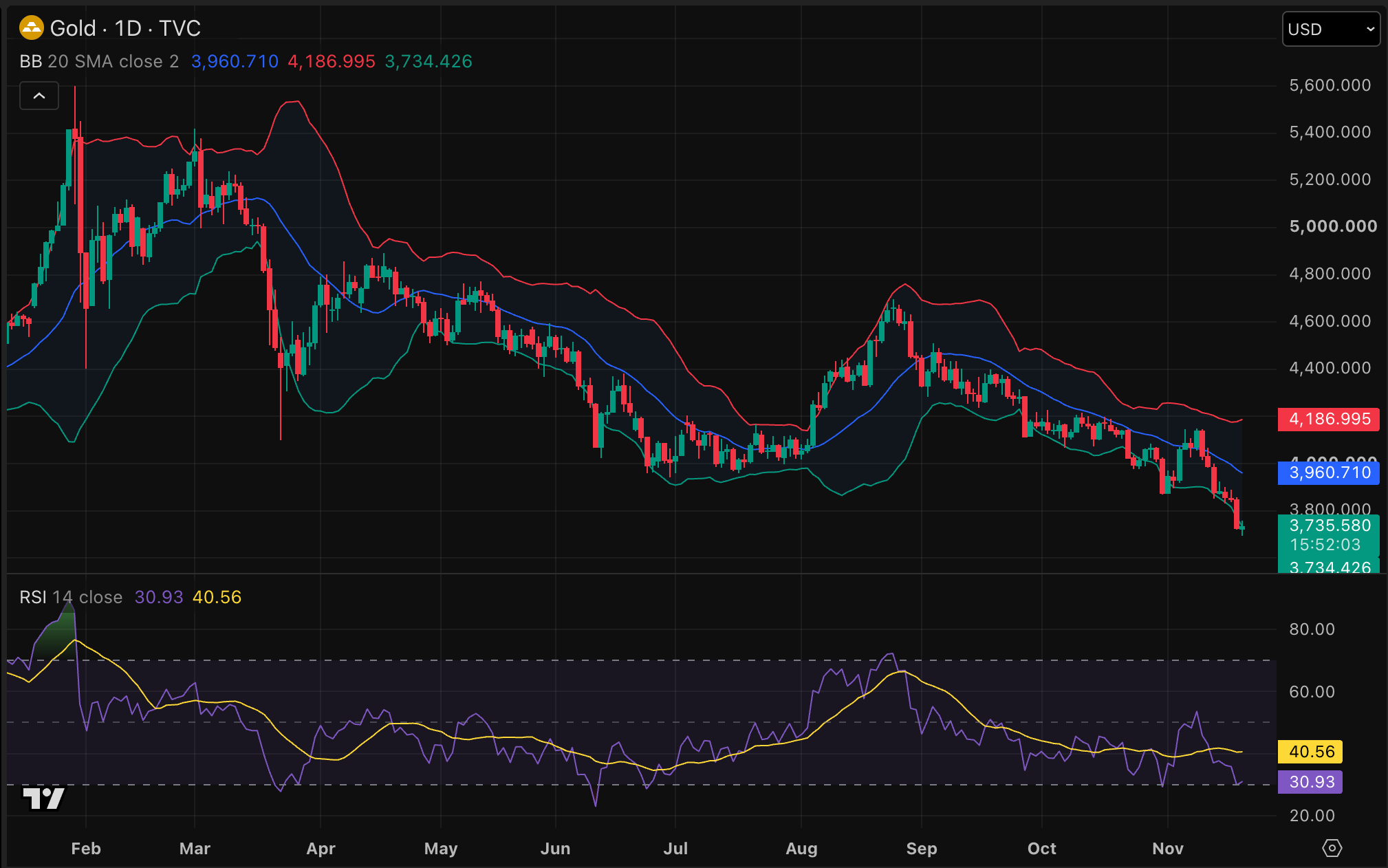
After a series of seven trading days in which the gold price did practically nothing but fall, a recovery could take place in the short term. The RSI, incidentally, is an indicator of the price momentum of a financial asset. For gold, it has become quite oversold.
At the same time, the gold price is trading at the lower end of its Bollinger Bands, see the chart above. It will be interesting to see whether a support level can be built here for the price. Ultimately, everything depends largely on the US dollar, and on the extent to which the world's reserve currency can continue its advance.
The odd thing is that, in the long term, these conditions only strengthen the investment case for gold. Rising bond yields mean that it becomes even harder for the US government to service its national debt of well over 40 trillion dollars.
Interest costs will increase, causing the budget deficit to rise, and the US government will probably have to take on even more debt.
In addition, we are currently looking at a US central bank that is taking a tougher stance, while the market is already doubting the sustainability of the AI investment cycle. If they actually carry out four rate hikes through to September 2027, that could endanger the foundations of the US economy.
Should the AI cycle come to a halt, it is probably a matter of time before the US central bank and other major central banks have to step in. So we find ourselves in the odd situation of one that creates downward pressure on the gold price in the short term, but makes the investment story stronger in the long term.
In the short term, gold is losing out to the strong US dollar, but oddly enough, this actually creates a much more favourable investment outlook for precious metals in the long term.

Thom Derks writes for GoldRepublic on gold, macro-economics and geopolitics. He studied Law in Leiden and Economics in Amsterdam. His personal fascination with scarcity and store of value through both bitcoin and gold brought him into the world of financial journalism. Through his own newsletter De Geldpers on Substack, he reaches over 5,800 subscribers with analyses on markets, geopolitics and the monetary system.