

Stress on Wall Street rises: a dramatic week for gold and silver
There’s no getting around it. Gold and silver are going through a difficult period. Especially when we look at the prices. Last week, the gold price lost more than 4 per cent, while silver fell by more than 6 per cent.
The big question, of course, is why precious metals are under so much pressure while uncertainty in the world is actually increasing. After all, gold and silver are essentially made to provide stability in an uncertain world.
The answer lies on Wall Street, where financial tensions continue to mount.
Investors are now starting to seriously doubt the sustainability of the AI investment cycle, which has become a key driver of the US economy and stock market. Financing costs are rising, credit spreads are widening and volatility is increasing.
Those credit spreads in particular are important. They tell us that investors are demanding ever more compensation for the risk that companies will be unable to repay their debts. So-called credit risk is rising. Investors see increasing risk in the debt-financed build-out of AI infrastructure.
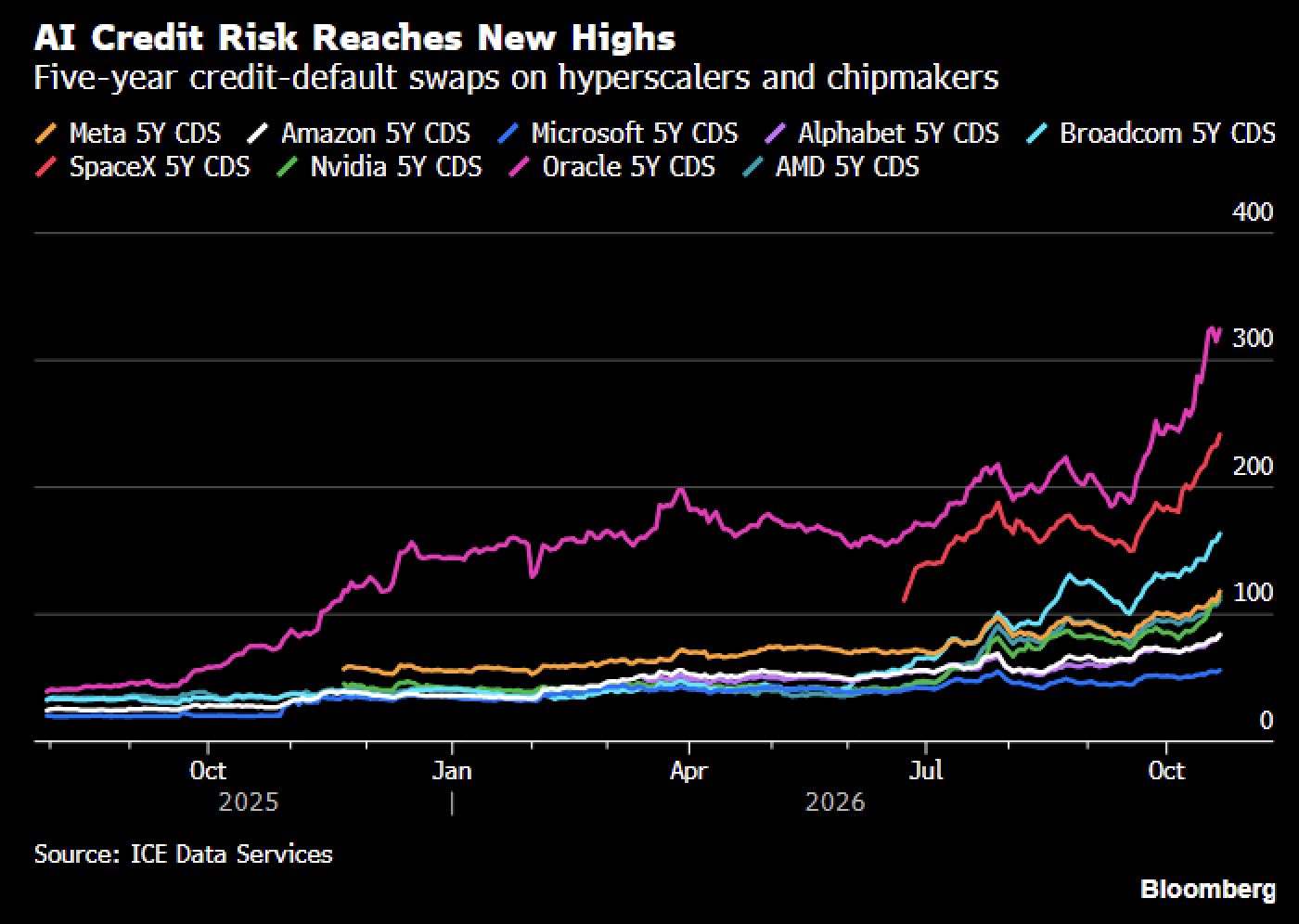
This potentially creates a fundamental problem. The huge investments in AI infrastructure depend on the continued availability of capital. As soon as lenders become more cautious, that investment cycle comes under pressure.
That appears to be precisely what the financial markets are currently worried about.
So why are gold and silver falling because of this stress?
At first glance, that seems contradictory. After all, gold is known as a safe haven. So why is the gold price falling at the very moment uncertainty is rising?
The answer is that during acute financial stress, investors do not look solely at the fundamental value of their assets. At times like these, liquidity becomes at least as important.
Investment funds have to reduce risk. Traders speculating with borrowed money may be forced to close positions, and other market participants try to strengthen their cash positions before real stress breaks out.
In an environment like this, essentially everything gets sold. It is no coincidence that we saw everything fall last week. We also saw this during the 2008 financial crisis and the 2020 coronavirus crash. In both cases, gold initially took heavy blows too, before going on to recover strongly.
This does not mean, by the way, that the same scenario will automatically repeat itself now. It does show, however, that a falling gold price during financial stress does not necessarily say anything about the appeal of gold in the longer term.
The difference between Wall Street and ordinary investors
It is precisely at moments like these that it is important to consider what kind of investor you actually are.
Many professional market participants are constantly judged on their results. A fund that falls significantly behind the market in a short space of time risks investors withdrawing their money.
For traders working with borrowed money, price falls can have even greater consequences. They may be forced to sell their positions, even when they are still fundamentally convinced of their investments.
For someone who owns physical gold, without borrowed money and with a long investment horizon, the situation is different.
A price drop of 20 per cent is unpleasant. A drop of 40 per cent is a lot more unpleasant. But as long as you are not forced to sell, you still own the same amount of gold.
Ultimately, we all know how this storm will end. If the AI economy really does collapse here, it is of course only a matter of time before governments and central banks reach for the proverbial money printer.
Fundamentally, these developments strengthen the case for gold and silver. However, that does not mean they cannot cause price falls in the short term, as we are seeing now.
The trick is to stay calm at moments like these. If you are in a position where you can get through this phase, there is nothing to worry about. It is mainly a matter of holding your breath, perhaps even buying more at lower prices, and waiting for the tide to turn.
A recession is no fun, but gold will not disappear. In the end, that weak economy will be met with money creation. And that is exactly why investors choose gold and silver.
Gold and silver are falling sharply as financial stress on Wall Street rises. Find out why investors are selling precious metals and what role AI plays.

Thom Derks writes for GoldRepublic on gold, macro-economics and geopolitics. He studied Law in Leiden and Economics in Amsterdam. His personal fascination with scarcity and store of value through both bitcoin and gold brought him into the world of financial journalism. Through his own newsletter De Geldpers on Substack, he reaches over 5,800 subscribers with analyses on markets, geopolitics and the monetary system.