How gold benefits from financial market volatility
2025 was another year of turmoil in the financial markets. We were dealing with trade wars, concerns about inflation, geopolitical conflicts and uncertainty about economic growth. This cocktail of uncertainty caused relatively large fluctuations in stock prices and gold.
Especially since the peak of Trump's tariff war in April 2025, we've seen a significant increase in volatility in the financial markets. Volatility refers to the extent to which the price of a financial asset fluctuates. The bigger the fluctuations, the more volatility, and investors generally don't like that.
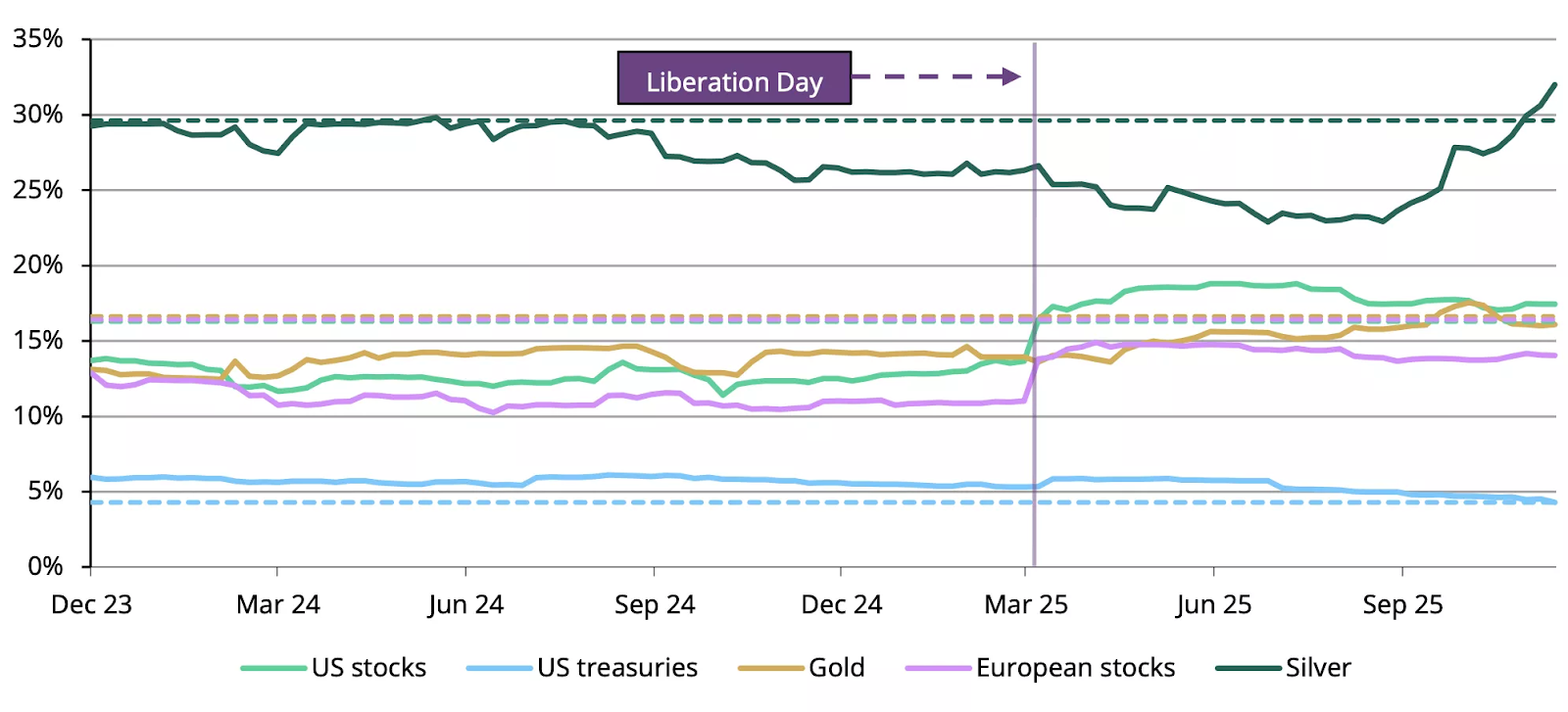
Gold stands out in a positive way
Of course, gold's volatility has increased due to the massive price rises. What is striking, however, in a positive way, is that volatility has remained broadly around the long-term average.
Normally, during periods of extremely strong price increases, you also see an explosion in volatility. This time, we're not seeing that. The price of gold rose by more than 60 percent in 2025, but volatility has been kept under control.
That tells us that gold has risen in a calm and gradual way, and that there is a certain conviction behind the upturn. Investors understand why gold is rising in this climate, and rapid rises weren't followed by rapid declines, which is often seen when investors are unsure about a financial asset.
At the same time, it is important to know that central banks are responsible for a significant share of the demand for gold. Central banks buy gold not to make a profit in the short term, but as a strategic reserve. This stable demand provides a foundation for the gold price, even in troubled markets. And the fact that central banks are buyers also gives investors extra confidence.
Investors say goodbye to bonds
Under normal circumstances, there is a negative correlation between stocks and bonds. This means: when stocks rise, you often see that bonds pay less, and vice versa. For that reason, it was normal for decades to hold a certain amount of bonds in addition to stocks, as a kind of stabilizer in times of economic turmoil.
This year, however, we saw a positive correlation between stocks and bonds. As a result, investors are realizing that bonds may no longer be suitable for the defensive role they once had in a portfolio.
For this reason, people should look for a potential alternative to bonds. An alternative asset that prefers to react differently to macroeconomic and geopolitical developments than stocks and bonds.
It's not for nothing that we call gold an uncorrelated asset. A financial asset that does not change with the prices of other assets, and usually draws its own plan. Just like we see it happening at times of geopolitical turmoil: gold and silver are rising, while stocks are struggling.
In the graph below, we see that the correlation between stocks and bonds is increasing, making this classic combination less effective as a diversification tool. At the same time, the correlation between stocks and gold is actually declining. From this perspective, it is not surprising that more and more investors are opting for a higher gold allocation in their portfolios. Within the so-called model portfolios of major banks, we also see that gold is playing an increasingly prominent role and, in some cases, partly replaces the traditional bond position.
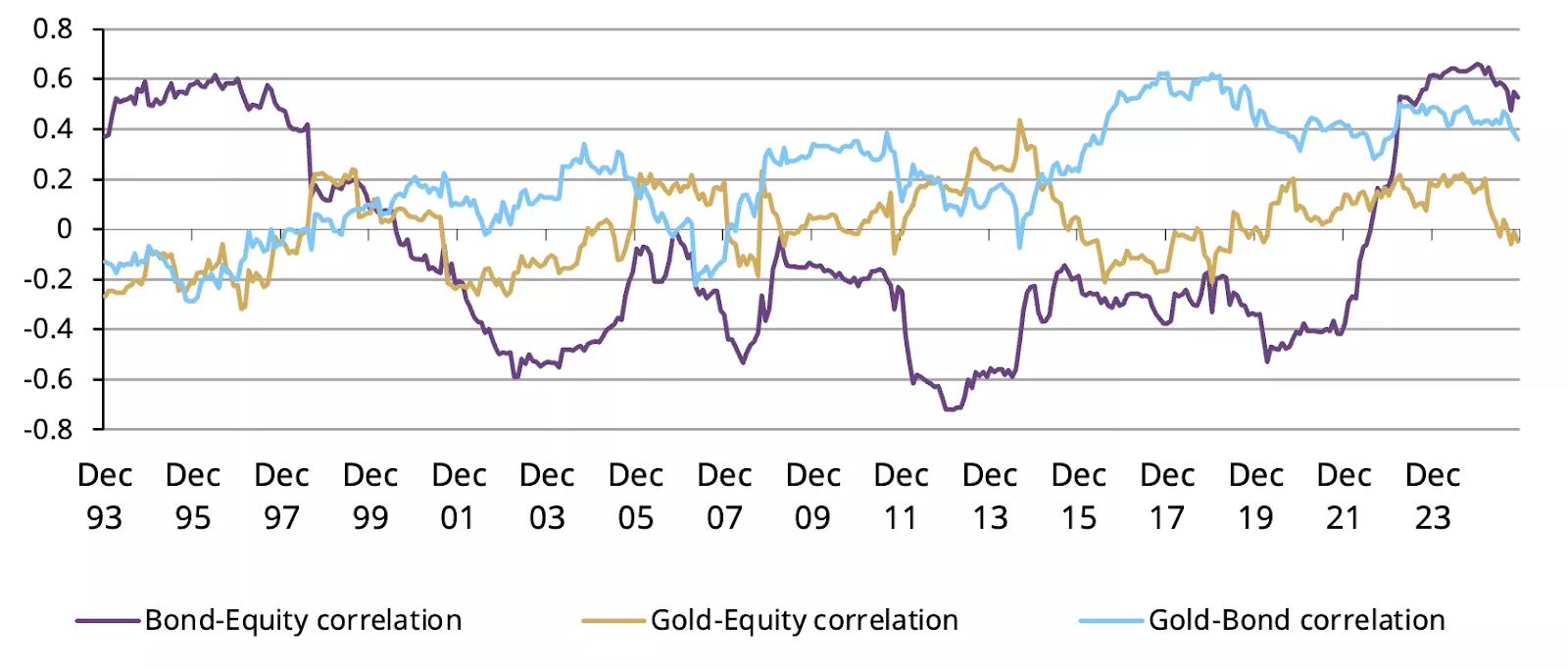
Gold benefits from volatility and changing correlations
The past year has been turbulent for financial markets. Due to economic uncertainty, geopolitical tensions and concerns about inflation, the prices of many investments fluctuated more than usual. Gold was not fully spared either: the gold price moved up and down more than in quiet years.
However, the larger fluctuations in the gold price good to install. Compared to previous periods, gold's behavior remains remarkably stable. The extent to which the price moves is still around the historical average and is also comparable to that of other investments that are intended to grow value in the long term.
At times when the gold price rose rapidly and there was a lot of trading, the unrest temporarily increased. Such peaks in mobility, however, were short-lived. As soon as the markets calmed down, gold's behavior also normalized. This indicates that gold is not carried away in panic, but is mainly used as a safe place in times of uncertainty.
This is important for investors, because the classic way of diversifying risks works less well than before. Normally, stocks and bonds combine to provide balance in a portfolio: if one falls, the other partly absorbs it. In an environment of high inflation and geopolitical tension, however, these investments often move in the same direction, reducing that protection.
It is precisely in such a situation that gold plays a special role. Because gold behaves differently than stocks and bonds, it can help to limit the overall fluctuations of an investment portfolio. Even a relatively small share of gold can provide more stability without significantly increasing the risk.
This means that, despite temporary price fluctuations, gold remains an important tool for investors who want to protect their assets in an uncertain world. Not as a quick profit maker, but as a strategic buffer against economic and political turmoil.
Gold will once again prove its role as a traditional safe haven in 2025, with strong price increases without extreme volatility. Learn why gold is extra attractive right now, as uncertainty increases and other protective investments are under pressure.

Thom Derks writes for GoldRepublic on gold, macro-economics and geopolitics. He studied Law in Leiden and Economics in Amsterdam. His personal fascination with scarcity and store of value through both bitcoin and gold brought him into the world of financial journalism. Through his own newsletter De Geldpers on Substack, he reaches over 5,800 subscribers with analyses on markets, geopolitics and the monetary system.