

The debasement trade is not yet ready for a comeback
Over the past few months, much has been written about the so-called debasement trade. This refers to investors fleeing to gold and other precious metals out of fear of monetary erosion. That fear stems primarily from rapidly rising government debt and the idea that governments will ultimately try to inflate those debts away.
This explains why gold and silver rose so sharply last year, even as yields on long-term government bonds were climbing. Normally that is a difficult combination. Higher bond yields make gold less attractive, since gold pays no interest. But within the debasement trade, it worked differently. Rising yields were actually a signal that investors were worried about the sustainability of public finances, which increased demand for protection.
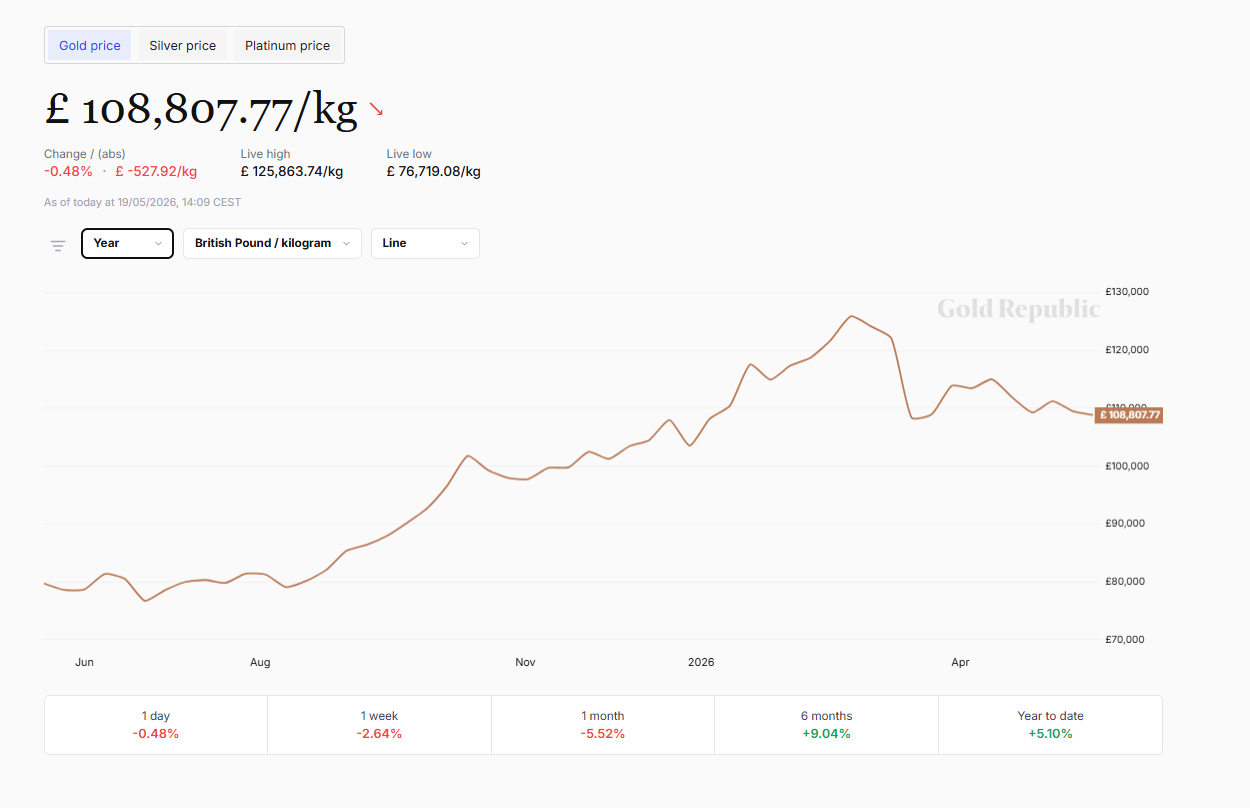
In that phase, gold was not bought because rates were falling, but because investors wanted to insure themselves against the risk that policymakers would erode the value of money.
Popularity became the problem
Yet that same popularity now appears to be working temporarily against gold. The debasement trade attracted a growing number of retail investors. That matters, because retail investors tend to be more sensitive to price movements and quicker to panic than the original investor base.
As a result, gold began behaving less like a safe haven and increasingly like a risk asset. Instead of rising in moments of uncertainty, gold started moving in line with broader market sentiment.
This became clearly visible during the war with Iran. In theory, gold should have benefited in such an environment. Geopolitical uncertainty, rising oil prices, inflation concerns, and climbing long-term yields normally form a favourable cocktail for gold.
But that did not happen. Since late February, the S&P 500 rose by approximately 8 percent, while the gold price fell by 14 percent over the same period. That is striking for an asset that is supposed to offer protection in turbulent times.
The market needs to be cleaned up first
The explanation likely does not lie with the fundamental case for investing in gold. That case has not disappeared. US government debt remains high, budget deficits stay large, and the political will to genuinely address those problems appears limited.
The problem lies more in positioning. Too much capital has piled into the same trade. Retail investors in particular were drawn in by the rapid rise of gold and precious metals, making the market vulnerable to a correction.
Before gold can trade as a safe haven again, that excess capital needs to be shaken out of the market. This process is known as a positioning cleanup. Weak hands need to sell, so that the market is once again supported by investors with a longer time horizon.
As long as that cleanup is not complete, gold remains vulnerable - reacting not like a classic safe haven, but like a crowded trade with too many investors in it at the same time.
Friday was an interesting test
That is precisely why Friday's price reaction was so interesting. It was almost a natural experiment for the gold market.
On one hand, long-term yields rose sharply. In the context of the debasement trade, that would normally be positive for gold. After all, higher yields reflect concerns about budget deficits, debt, and the sustainability of the system.
On the other hand, oil prices also rose as markets grew concerned about the situation around Iran and the possible closure of the Strait of Hormuz. Higher oil prices can push inflation higher, but they also weigh on growth and risk appetite. In the current market, the latter carries significant weight, putting pressure on gold as investors reduce risk exposure.
Gold was therefore caught between two forces. Rising bond yields should have supported the price, while rising oil prices and geopolitical stress created selling pressure.
The outcome was clear. Gold fell sharply. This suggests that the positioning cleanup is not yet complete.
The fundamental case remains intact
This does not mean gold has permanently lost its status as a safe haven. It means primarily that the market has temporarily fallen out of balance.
The underlying arguments for the debasement trade are still in place. Governments are spending more than they take in. Government debt continues to rise. Politicians have little incentive to make tough choices. And central banks may once again come under pressure to pursue policies that make debt more manageable, even if that comes at the cost of the purchasing power of money.
In such a world, gold remains a logical form of insurance. Not because gold needs to rise every quarter, but because it carries no obligation from a government, central bank, or financial institution.
Timing matters, however. A strong fundamental case does not automatically mean a market is ready for its next leg higher — especially when too many investors have already taken the same position.
Why gold is under pressure despite geopolitical unrest and rising interest rates. The fundamental case remains strong, but the market looks overcrowded.

Thom Derks writes for GoldRepublic on gold, macro-economics and geopolitics. He studied Law in Leiden and Economics in Amsterdam. His personal fascination with scarcity and store of value through both bitcoin and gold brought him into the world of financial journalism. Through his own newsletter De Geldpers on Substack, he reaches over 5,800 subscribers with analyses on markets, geopolitics and the monetary system.


.jpg.jpg)