

The FD (Het Financieele Dagblad) set out to find the reason behind Poland's appetite for gold and ended up at a doctoral thesis from 1979. And this just a few weeks after De Nederlandsche Bank itself called gold the “ultimate anchor of trust”. A journey through the deep-rooted ignorance about gold.
Anonymous
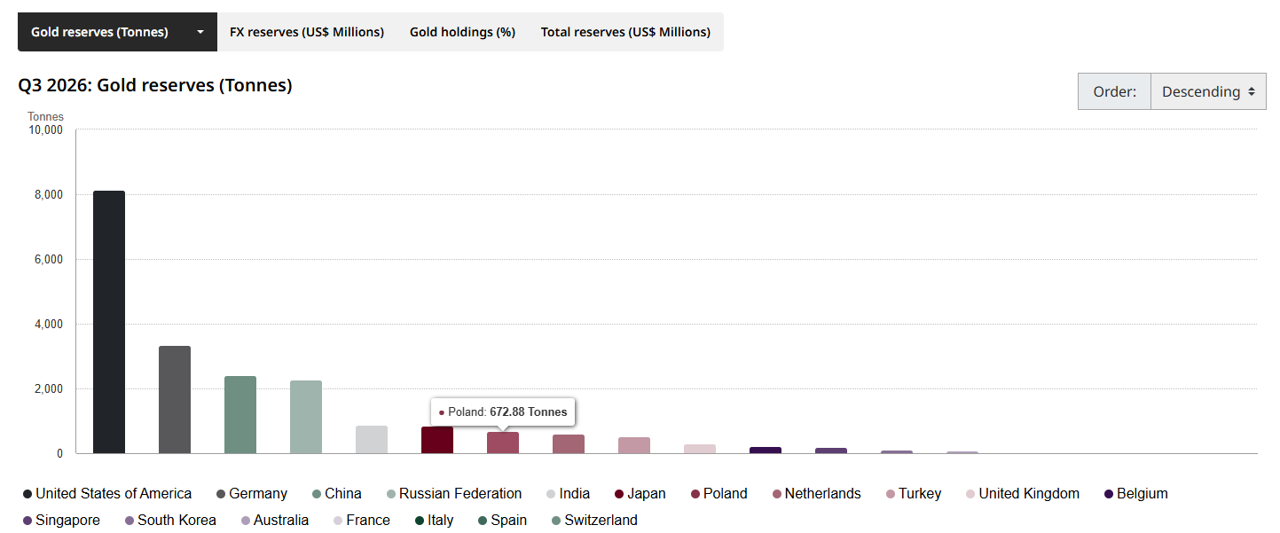
“Poland has more gold than the ECB.” That is how a recent article on the FD website opens. 700 tonnes to be precise, mostly bought up by the governor of the Polish central bank, Adam Glapinski.
That is undoubtedly a lot, but it is not the message that stays with me. For that, we need to go straight to the end of the FD article. It quotes an economist who wishes to remain anonymous and who claims that Glapinski has been stuck in the past and is not aware of the “contemporary monetary economy.”
1979
Why would a newspaper give the floor to an anonymous economist? But that aside. The sneer relates to the fact that in 1979 Glapinski earned his doctorate with a thesis on ‘Methodological foundations of Marxist economic history’. The assumption here is presumably that someone with such a title in 2026 naturally has no idea how the monetary world works. I think quite the opposite. Glapinski's insights are miles ahead of those of traditional economists.
The FD article is a blueprint of how many traditional economists, raised on the “contemporary monetary economy”, look at gold. They judge gold from within the existing system, whereas one of the most important reasons for owning gold has always been to be less dependent on that system.
What also stands out is how much of the reasoning ultimately comes down to the price movements of recent months, with no sense of the enormous developments taking place in our financial system.
Price risk is not systemic risk
For example, it is claimed without hesitation that gold has lost its role as a safe haven because the price has fallen by 30% since the start of this year. Quite apart from the fact that the gold price is still around 75% higher than at the start of 2024 (also an arbitrarily chosen starting point), the striking flaw in the reasoning is that price risk is equated with monetary or systemic risk.
I have yet to come across a central bank that sold its gold reserves because the price had fallen too much. That is because the properties that make gold attractive do not depend on that price.
Physical gold is nobody's liability, carries no counterparty risk and, at least as importantly, is intrinsically scarce and so cannot simply be printed by a central bank. But perhaps the most underrated property of gold is that it enjoys enormous trust. That is also the reason why central banks keep gold in their vaults.
It is odd to judge the usefulness of gold as a structural reserve by looking at a price chart. Especially when you consider that the (American) government bonds glorified in the article have also seen considerable volatility. Think back to 2022. Did anyone conclude then that government bonds were definitively unsuitable as reserve assets?
One man with a doctoral thesis?
If Poland's appetite for gold is fully explained by one central bank governor with an outdated thesis, why have central banks worldwide on average doubled their annual gold purchases over the past four years? From 500 to 1,000 tonnes.
Asked why they did so and why they hold more gold, 90% of the central banks surveyed cite performance in times of crisis and 84% cite long-term store of value. Notably, the argument “because we simply have it” (historical legacy) is still cited by fewer than half of central banks. So nostalgia for the gold standard is playing an ever smaller role.
Ultimate anchor of trust
That gold still forms the foundation of the financial system is, moreover, evident not only from surveys. The proof lies much closer to home than Warsaw.
On 2 September, DNB announced that it had moved 86 tonnes of Dutch gold from the United States and Canada to London. Not, of course, to speculate on a higher price, but because of ‘increasing geopolitical unrest’, to strengthen ‘crisis preparedness’ and to hedge against ‘extreme systemic risks’.
DNB refers to gold in passing as the ‘ultimate anchor of trust’. So if the system really goes wrong, gold is what the Dutch central bank falls back on. That goes far beyond the rather limited view of the economists at the FD.
A bunker without interest
Of course, the article would not be complete without the classic argument: gold pays no interest. A professor at the University of Warsaw, Goczek, compares gold to a bunker: safe in an emergency, but cold and cheerless in everyday life.
A forcefully worded metaphor, but in my view it does not hold up on substance. For a start, most people are happier with something that gives them confidence. Beyond that, the interest received has to be valued properly. Cash flows are not sacred by definition once you factor in inflation. A bond paying 3% interest with inflation at 5% costs you 2% of purchasing power per year. The cash flow arrives neatly, but the purchasing power evaporates.
And while we are looking at gold as an investment: since the link to the dollar was abandoned in 1971, gold returned an average of around 9% per year in dollars up to the end of 2025. Not bad for something dismissed as a cheerless bunker. On top of that, gold adds a great deal of diversification to a portfolio. When things go badly wrong on the stock markets, gold often (not always) does well. Investors often fixate on returns, but the importance of diversification in limiting the risk of your portfolio should not be underestimated.
The bigger picture
As is often the case, traditional financial media focus mainly on the risks of gold. The analysis of the risks of the supposedly attractive alternatives, almost always bonds, is conspicuously absent.
So let me quickly set them out for you once more. Debt ratios of more than 100% of GDP inevitably raise questions about the sustainability of debt. The risk of "safe" government bonds has demonstrably increased. The diversification benefits of bonds are smaller than many investors think. That is because bond returns move with equities more often than against them. If you factor in inflation, as you should, you would have lost purchasing power since the start of this millennium on a basket of global government bonds. And finally: with every attempt to improve debt sustainability, investors pay the price in the form of low interest rates and higher inflation.
A sense of reality
Back to Glapinski. If you ask me, the governor of the Polish central bank has both a sharper historical perspective and a better grasp of today's monetary reality than the FD would have us believe. And as long as someone new sees the light every day, I will keep writing pieces that challenge entrenched thinking.
The FD explains Poland's appetite for gold with a 1979 thesis. Why that analysis falls short, and why gold is still the ultimate anchor of trust.

Jeroen Blokland has over 20 years of experience as a professional investor and was formerly Head of Multi-Asset at Robeco, where he was responsible for a client portfolio of over five billion euros. After leaving Robeco he founded True Insights, an independent investment research platform, and has since built a following as a columnist, YouTuber and sought-after speaker. With over 100,000 followers on X, he is one of the most prominent voices in Dutch finance. For GoldRepublic he writes on macro-economics, markets and the role of gold in a diversified portfolio.