86 tonnes of gold and one uncomfortable question
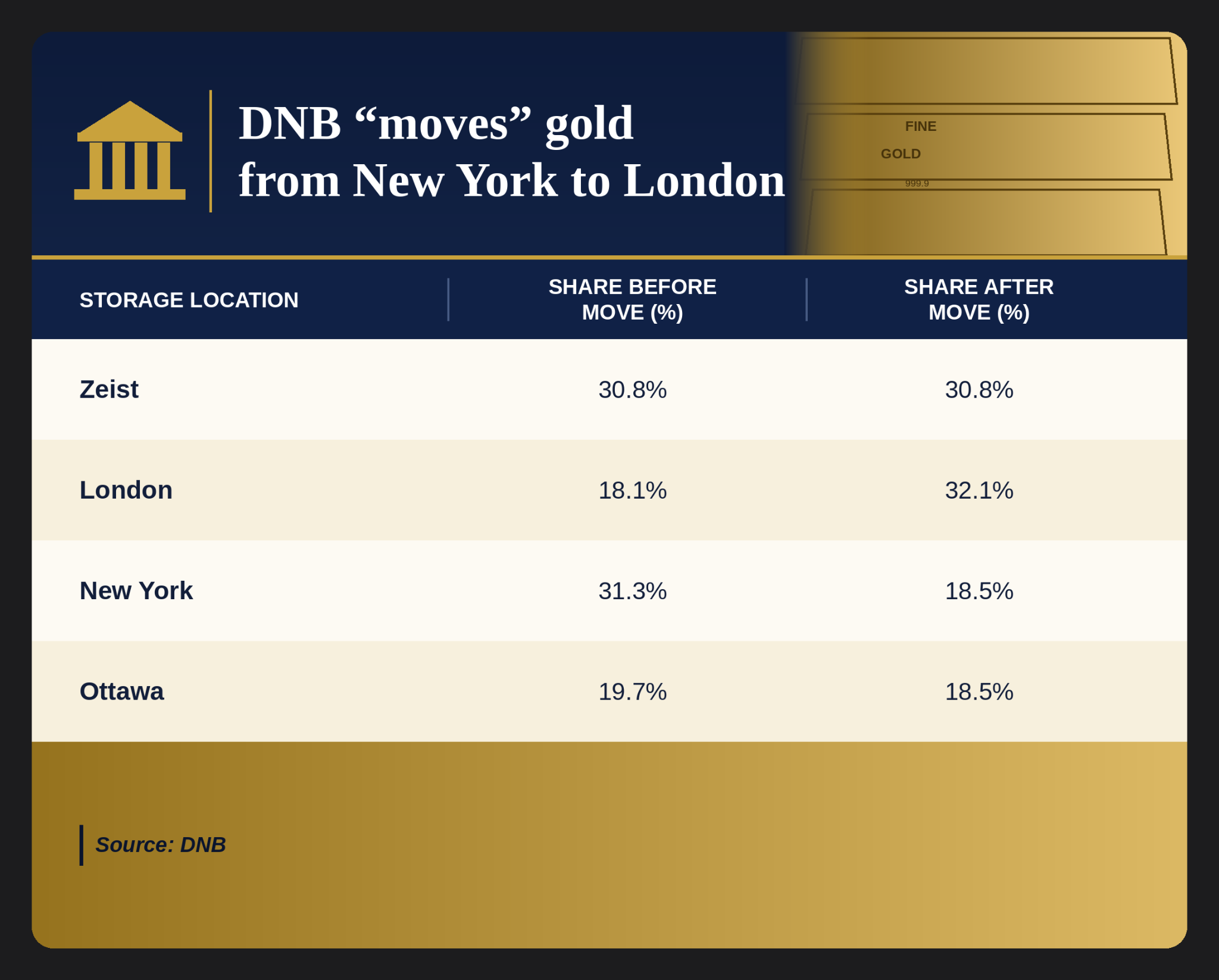
Judging by the number of posts on its website and on social media, DNB is rather pleased with itself over its decision to shift a substantial part of the Dutch gold reserves (partly through selling and buying, incidentally) from New York to London. But what should we really make of this?
It's obviously a "catchy" news item: a central bank casually moving 86,000 kilos of gold, worth roughly €11 billion at market value, from one place to another.
In this case, it's a move from New York to London. Naturally, the usual media outlets were quick to link DNB's move to the policies of US President Trump. Because that, too, makes for a good headline.
DNB, however, has a different explanation, one that, if you ask me, few people give proper credit to. Most media outlets take DNB's statement at face value and immediately move on to the next catchy headline.
Tradability: why London over New York?
The real reason, according to DNB, is that the tradability of the Dutch gold increases when it's held in a vault in London rather than in New York. London is, after all, the epicentre of the gold trade, or so DNB must have thought.
While that conclusion isn't outright wrong, it does come with an important nuance. London is the centre of the international institutional gold trade, but a significant part of that trade is administrative in nature. In industry jargon, this is referred to as "unallocated gold," where no specific gold bars are assigned to the buyer. Physical delivery, therefore, is far from a given in every transaction.
When it comes to trading physical gold, the actual bars themselves, the focus needs to shift considerably further east. Shanghai has rapidly developed into one of the most important centres for physical gold trading. That said, the fact that DNB has moved a large chunk to London (partly via selling in New York and buying in London) doesn't mean our central bank is now sitting on a pile of unallocated gold.
That doesn't mean this decision raises no questions. With London, DNB is opting for speed and tradability. There, DNB can trade the gold at lightning speed, for example to free up dollars, while physical delivery in London can be arranged directly with the buyer.
But it is London. London has been outside the EU since Brexit. That means, at the very least, that London falls outside the EU's own jurisdiction. What exactly are the rights of EU countries in the United Kingdom? How dependent does DNB become on whatever political developments unfold there? The United Kingdom hasn't exactly presented itself as an oasis of political calm in recent years.
And how well are the euro and British pound systems actually connected to each other in times of crisis? During a systemic crisis, payment systems can fail, capital controls and sanctions can be imposed, and countries can suddenly develop entirely different interests, meaning the assumed gold liquidity could still disappear. For DNB, liquidity apparently takes precedence over sovereignty here.
Gold as the ultimate anchor of trust
The magic word here, of course, is crisis. In fact, it's gold's characteristics during a crisis that led DNB to redistribute the gold differently across its various locations.
In DNB's own words: "By holding a larger share of the gold reserves in London, gold's function as an anchor of trust has been strengthened. Gold is seen as the ultimate anchor of trust, because it is uniquely suited to hedging against extreme systemic risks."
The ultimate anchor of trust, it's right there in black and white. And rightly so. Because that's exactly what gold is. It's the foundation an entire financial system can fall back on when officials, governments, central banks, and so on, have once again made a mess of things.
That they do indeed make a mess of things is nothing new. In fact, it's simply their nature. Our relentless desire for more, for endless growth, keeps driving the endless attempt to stretch the financial system further, just to keep growing (harder).
This is the point where a big "error" always pops up in my head. How can you keep insisting that gold shouldn't be part of people's wealth because "it doesn't generate cash flows"?
But that's not at all what makes gold so crucial. It's that property of being a scarce asset, one you can't endlessly print or issue, that keeps a financial system in balance, or prevents it from collapsing like a house of cards. It offers the purest form of (monetary) trust. Something we can always fall back on, central banks and governments included, whenever we've once again let things derail.
In a crisis, that's worth many times more than companies (or governments) that cling desperately to paying their little dividend (or coupon) only to go bankrupt anyway. Gold plays at a whole different level: when it comes to the question of "what is needed to protect the system and safely preserve value (wealth) when the crisis arrives."
What will you do?
The decisive question is: does DNB's decision to bring the gold to London, even though it perhaps should have been Zeist, point to an increasing or decreasing likelihood of such a crisis?
And if the answer is that the likelihood is increasing, shouldn't the ultimate protection against that crisis automatically carry more weight?
To ask the question is to answer it.
DNB moved 86 tonnes of gold from New York to London. What does that choice say about tradability, risk and gold's role as the ultimate anchor of trust?

Jeroen Blokland has over 20 years of experience as a professional investor and was formerly Head of Multi-Asset at Robeco, where he was responsible for a client portfolio of over five billion euros. After leaving Robeco he founded True Insights, an independent investment research platform, and has since built a following as a columnist, YouTuber and sought-after speaker. With over 100,000 followers on X, he is one of the most prominent voices in Dutch finance. For GoldRepublic he writes on macro-economics, markets and the role of gold in a diversified portfolio.