

Gold strong amid macroeconomic storm
The gold price is currently being pulled sharply in both directions by serious macroeconomic forces. A good week ago, gold reached a local peak of nearly $4,700 per ounce, before falling to $4,280 and now climbing back to $4,432.
The downside volatility began with the hawkish Jackson Hole speech by Kevin Warsh, chair of the US central bank, last Friday. By repeatedly flagging his dissatisfaction with the path of inflation, he cautiously hinted at a rate hike in September.
This was followed by rising yields right across the bond market, a rebound in the US dollar, and downward pressure on gold and silver. In particular, the rise in long-term rates is becoming a theme that investors and policymakers are growing increasingly concerned about.
Rising long-term rates dominate the narrative
This week the US 10-year yield reached its highest level since November 2023, while the 30-year yield hit its highest level in 20 years. This development isn't limited to the United States. The Japanese 10-year yield, for example, climbed above 3 percent for the first time since 1996.
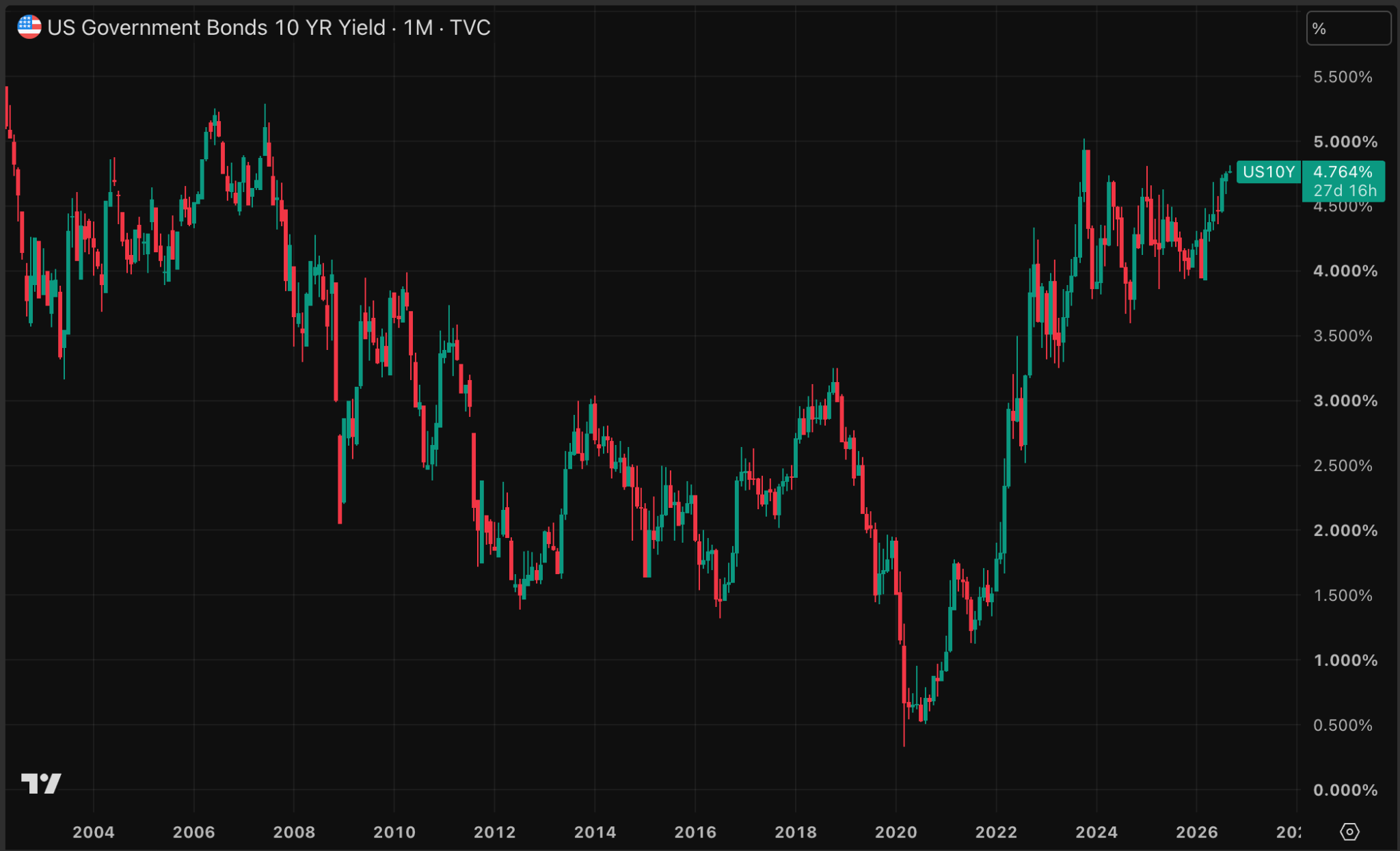
In the short term in particular, this acts as a downward force on gold and silver. Higher rates compete directly with precious metals, on which — unlike the US dollar — you can't earn interest.
At the same time, higher rates actually strengthen the long-term case for investing in precious metals. That's because they mean the US government has to pay more interest on its ever-growing $40 trillion national debt.
Meanwhile, leading central bankers are also speaking out on this development in the media. On Wednesday, New York Fed President John Williams, who also votes on the US central bank's interest rate policy, said he believes the rise in yields is mainly the result of a strong economy — and explicitly not of a dysfunctional market.
In effect, Williams is claiming that high rates are primarily the result of enormous demand for capital from the AI investment cycle, rather than concerns about the extent to which the United States is losing control of its national debt. The truth is probably somewhere in between.
The huge demand for capital driven by investment in AI and data centres is naturally pushing rates higher. But it also makes sense that investors want to be compensated, in the form of a higher rate, for the risk posed by the growing US national debt.
Gold finds support at a key level
While the rise in rates is creating short-term uncertainty across financial markets, the gold price is holding up fairly well. For now, gold appears to be finding support from the 200-day exponential moving average at around $4,309 per ounce.
Gold price finds support from the 200-day exponential moving average. Source: TradingView
The key now is for gold to form a local bottom around this level that is higher than the bottom formed since late June. If that happens, the next step would be forming a higher high relative to the local peak of nearly $4,700 per ounce reached in late August.
In the short term, investors are often rattled quite badly by developments like these. The 30-year yield rising to its highest level since 2007 sounds alarming.
While that can certainly be problematic for gold and other markets in the short term, it's important not to lose sight of the long term.
The US government has to plug its annual budget deficit — currently close to $2 trillion, or roughly 6 percent of GDP — with new debt. If demand from the private market isn't sufficient, there will likely come a point again where the US central bank has to step in.
In theory, there's another route too. For example, by loosening capital requirements for banks so they need to hold fewer reserves — and can therefore create more loans. That's also a way of pumping more capital into the financial system, and it's increasingly being discussed in Washington.
One way or another, choosing inflation — a disguised form of money creation — appears to be the only option for keeping this system running. Gold and silver have traditionally protected against this development, and there's a good chance they'll continue to do so.
Iran conflict back in the spotlight
While John Williams of the US central bank said in the interview cited earlier that inflation expectations are "well anchored," the market is still concerned about this. The difference is that Williams is talking here about medium- and long-term inflation expectations.
Inflation over the coming year could rise significantly because of the Iran conflict and rising energy prices. Looking three years ahead, inflation is typically much less sensitive to temporary shocks. The question, of course, is how temporary the oil shock will prove to be. When the war with Iran began in late February, almost no one expected it would still be a theme in September.
Now that the conflict between the United States and Iran is flaring up again, the Brent oil price is once again comfortably above $90 a barrel. That's making it increasingly difficult for central banks to ignore potential rate hikes.
That sentiment came through in Kevin Warsh's Jackson Hole speech, but the market is now also expecting rate hikes from the Bank of Japan and the European Central Bank. This week, eurozone inflation rose above 3 percent.
In the short term at least, that's adding further upward pressure on bond yields.
As long as this storm continues to rage through financial markets, the upside potential for gold and silver is likely limited. That's why it's especially important for gold to find support at key levels, as discussed earlier in this newsletter. If it manages to do so, that would already be a powerful signal.
It would show that investors are interested in entering gold and silver for the long term around current prices, despite the short-term macroeconomic backdrop looking unfavourable. The fact that the price isn't falling further could be seen as a signal of market confidence in a better future for precious metals.
Even as bond yields worldwide climb toward 2008 crisis levels, the gold price is holding up reasonably well. Here's what it means for the market.

Thom Derks writes for GoldRepublic on gold, macro-economics and geopolitics. He studied Law in Leiden and Economics in Amsterdam. His personal fascination with scarcity and store of value through both bitcoin and gold brought him into the world of financial journalism. Through his own newsletter De Geldpers on Substack, he reaches over 5,800 subscribers with analyses on markets, geopolitics and the monetary system.