Table of contents

Stay informed about everything you need to know about investing


You would expect that the gold price and the silver price are more or less equal all over the world. After all, in theory, it concerns the same raw materials. However, practice shows a different picture. The graph below shows that investors in the Shanghai silver market are currently paying 11.01 percent more for their precious metal than in the United States. Gold is also structurally higher in China than in many Western markets.
We'll explore exactly how that is possible, and what this says about the global precious metals market, on this page.
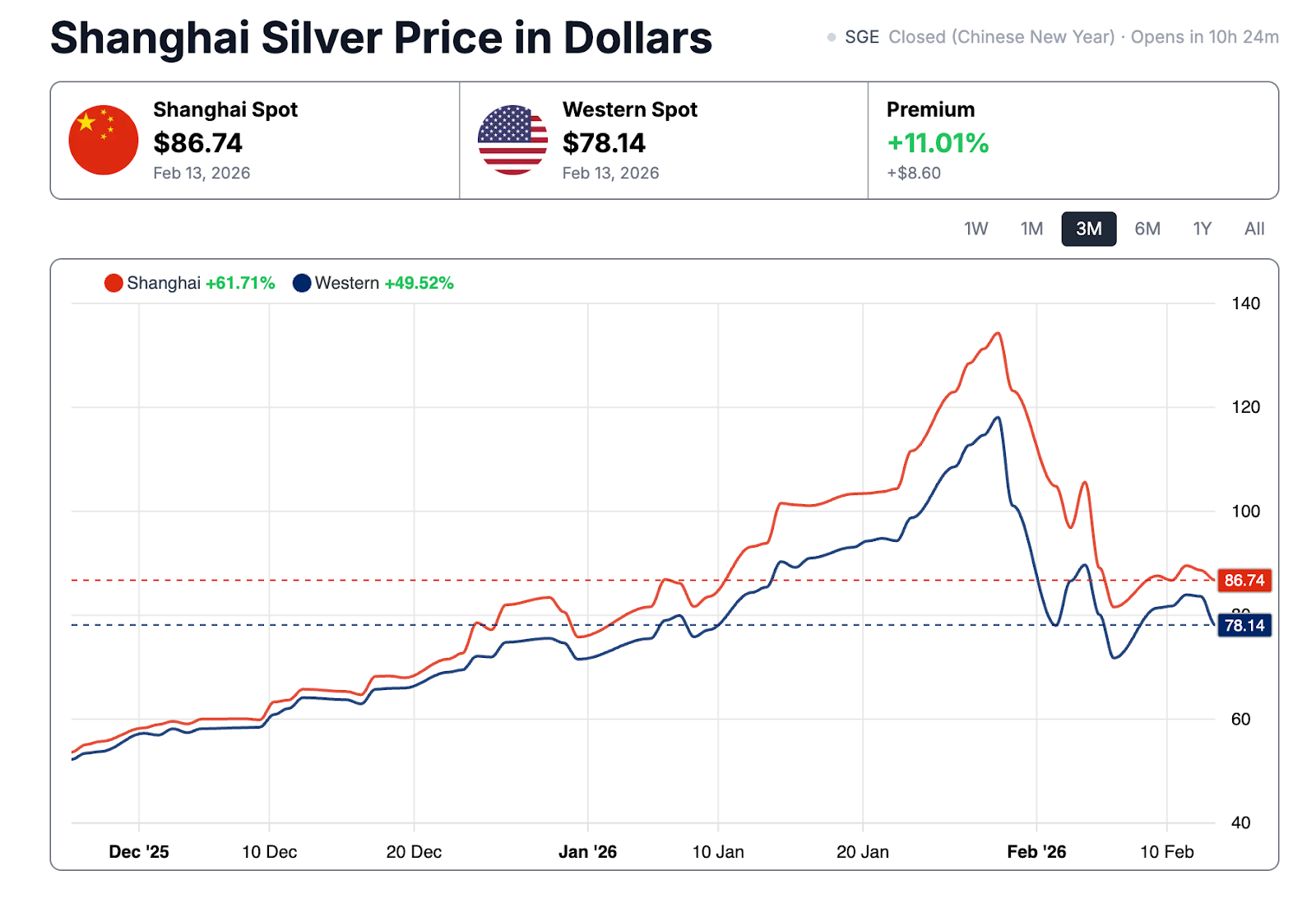
In the United States and Europe, gold and silver prices are largely stated at trading venues such as the COMEX in New York and the London market. There, futures contracts and other financial instruments dominate trading. Most of these contracts are not physically settled, but are settled financially.
As a result, prices in the West mainly reflect liquidity conditions, speculative positions, the state of the dollar and expectations about interest rate developments, and to a much lesser extent the immediate availability of physical metal.
In China, things work differently. At the Shanghai Gold Exchange and Shanghai Futures Exchange, physical delivery plays a much larger role. Shanghai prices are therefore more closely linked to the actual demand for metal that can actually be removed from the stock market system.
When the demand for physical gold or silver increases, that pressure translates more quickly into higher local prices in China. This difference in market structure is an important explanation for the fact that precious metals are regularly more expensive in China than in the rest of the world.
In Chinese culture, gold has been used for centuries venerated as a symbol of prosperity and success. The precious metal represents wealth and abundance and is believed to bring happiness to those who own it.
Gold is also associated with the term “jin yun”, which can be loosely translated as “golden happiness” or “future prosperity”. During the Chinese New Year, people therefore exchange gifts in the form of gold jewelry, coins and ornaments to wish each other a prosperous year.
In China, the value of gold is not only in its material content. The color also plays an important role. Gold not only symbolizes wealth, but also happiness and positive energy. Wearing gold clothing or decorating houses with gold decorations during the Chinese New Year would attract prosperity and blessings.
Together with red, which stands for happiness and joy, gold is therefore the dominant color during this festive period. So gold is deeply embedded in Chinese culture. From that perspective, the popularity of the precious metal is no surprise.
Chinese households have limited access to international financial markets. It is difficult for capital in China to leave the country freely. As a result, many Chinese people rely on domestic investments, such as real estate or bank account savings.
That is exactly the crux of the story. When house prices are under heavy pressure and savings rates hover around 1 percent, gold suddenly becomes an attractive alternative. In such an environment, the precious metal acts as a way out within an otherwise closed financial system.
Currently, around 1 percent of Chinese households' wealth consists of gold, according to research by ANZ Research. However, that bank expects this share to rise to around 5 percent in the long run, especially now that the real estate market remains weak and savings rates are extremely low.
“People see investing in gold increasingly as a form of insurance,” says Zhaopeng Xing of ANZ Research.
Given the cultural importance of gold in China, it is not surprising that investors are turning their eyes to the precious metal right now. The world is in a phase of increasing geopolitical tensions, in which China itself plays a central role. Increasingly, Western investors are also warning that traditional safe havens are under pressure, as Wall Street legend Ray Dalio is now even calling for selling government bonds and buying gold.
In addition, it is regularly heard that the Chinese government is committed to weakening the dominant position of the US dollar, a process that is often referred to as de-dollarization. In a world where power relations are shifting and the future is becoming less predictable, the appeal of assets that are not directly dependent on political policy or economic systems is increasing.
After all, for gold, it doesn't matter whether China or the United States is tomorrow's world leader. The precious metal is outside the playing field of national currencies and geopolitical power blocs. That is precisely why gold acts as an attractive safe haven during this period, something that is also reflected in the recent price movement.
Why do Chinese investors pay up to 11% more for gold and silver than in the West? Learn how physical demand, culture, and capital restrictions are driving prices and what that says about the future of the global precious metals market.
The latest updates, analysis and insights from precious metals and financial markets


Socials