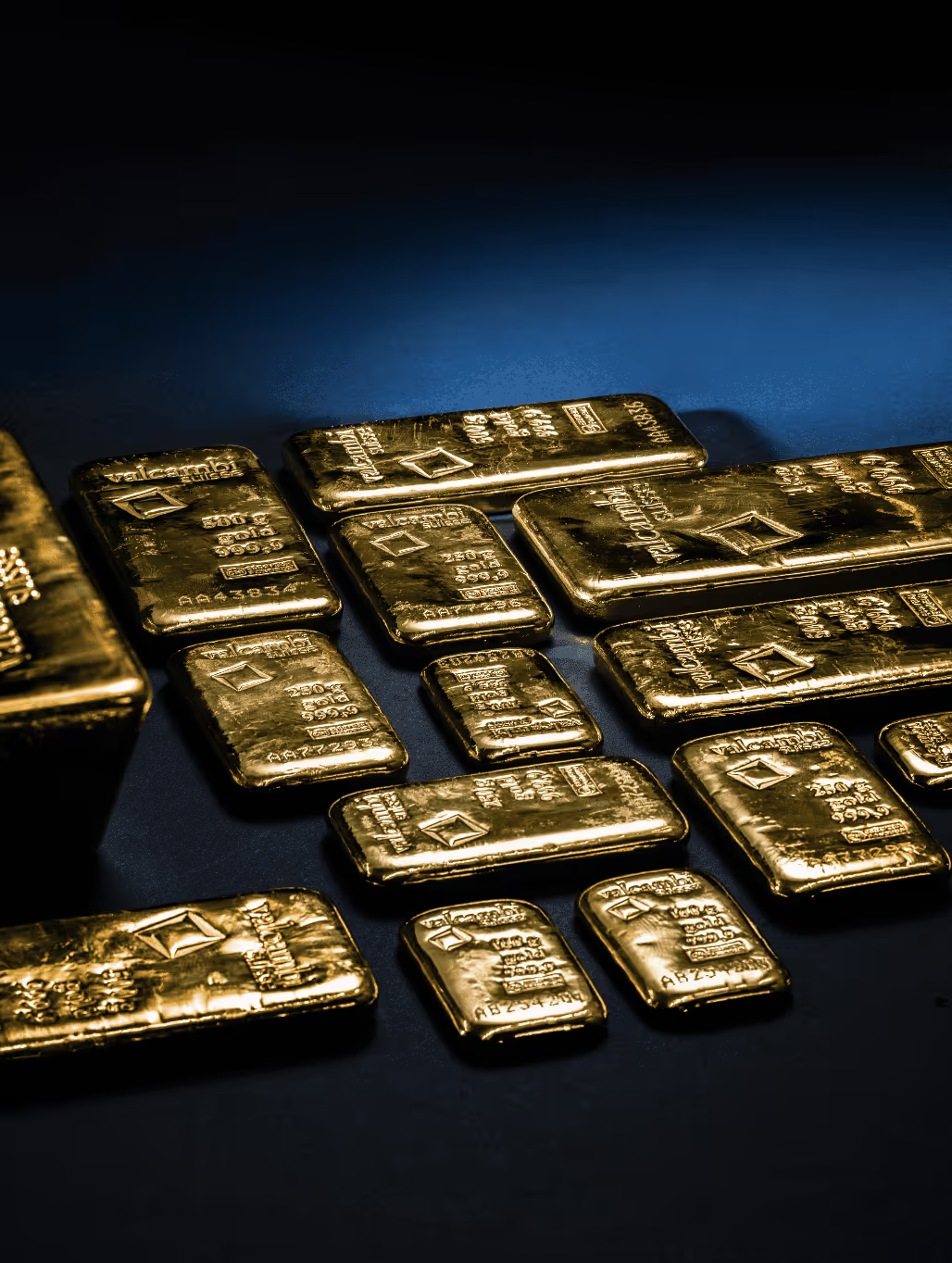


Gold in a bear market: Iran war brings fierce volatility
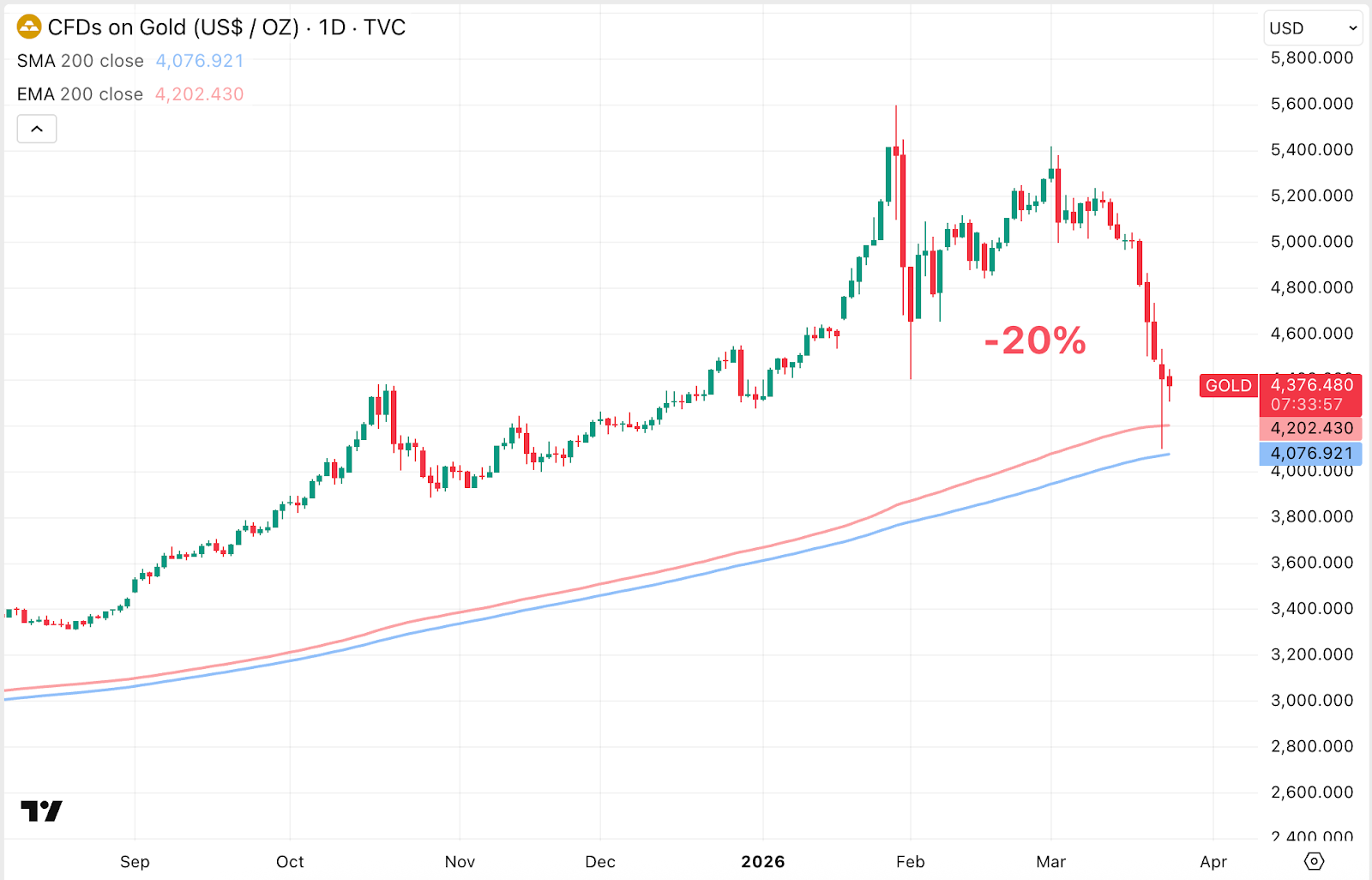
The gold price fell by more than 20 percent from the record exchange rate at the end of January. According to the official definitions, the precious metal is in a bear market because of that decline. Although gold performed rock-solid last year due to all the geopolitical turmoil, the Iran War a different result for now. How is that possible exactly?
Developments in and around Iran are shaking gold
You would expect that gold is benefiting from an increased level of geopolitical turmoil. This time, things are slightly different in the short term. This is all due to the sharp rise in oil prices as a result of the closure of the Strait of Hormuz.
- The Iran conflict brought the oil price above 100 dollars a barrel.
- Rising oil prices are pushing inflation expectations higher.
- Higher inflation expectations reduce the chance of US central bank rate cuts.
- As a result, interest rates are rising, making gold relatively less attractive because the precious metal pays no interest.
In addition, the United States' policy regarding the war causes a lot of ambiguity.
- On Friday, Donald Trump said he did not need the oil from the Strait of Hormuz. For that reason, the war would be moving towards an end.
- On Saturday, Trump suddenly issued an ultimatum to Iran. If the Strait of Hormuz did not reopen within 48 hours, the U.S. would attack Iran's critical energy infrastructure.
- On Sunday, we saw stocks fall sharply when futures reopened. Before the stock market opened on Monday, Trump announced that there are good talks with Iran. The 48-hour ultimatum was subsequently extended by five days.
- Not long after, Iran denied these talks.
At the moment, the reality is that the Strait of Hormuz is closed. Ships that want to cross the strait must pay 2 million dollars to Iran for it. As long as that is the case, the oil price will remain high, which is currently resulting in a difficult situation for the gold price.
In addition, of course, gold came from a very strong period. Investors are left with relatively large virtual profits, so it is still attractive to take some risk off the table and make a profit. This also contributes to the sales wave that gold is experiencing.
Panic is exaggerated, the long term remains positive
Although the gold price has recently been at a much higher level, it is an exaggeration to panic. For now, gold appears to be supporting the 200-day average (blue) and the 200-day exponential average (red). Gold last lost these support points in 2023.
At the time, that marked a local soil for the precious metal.
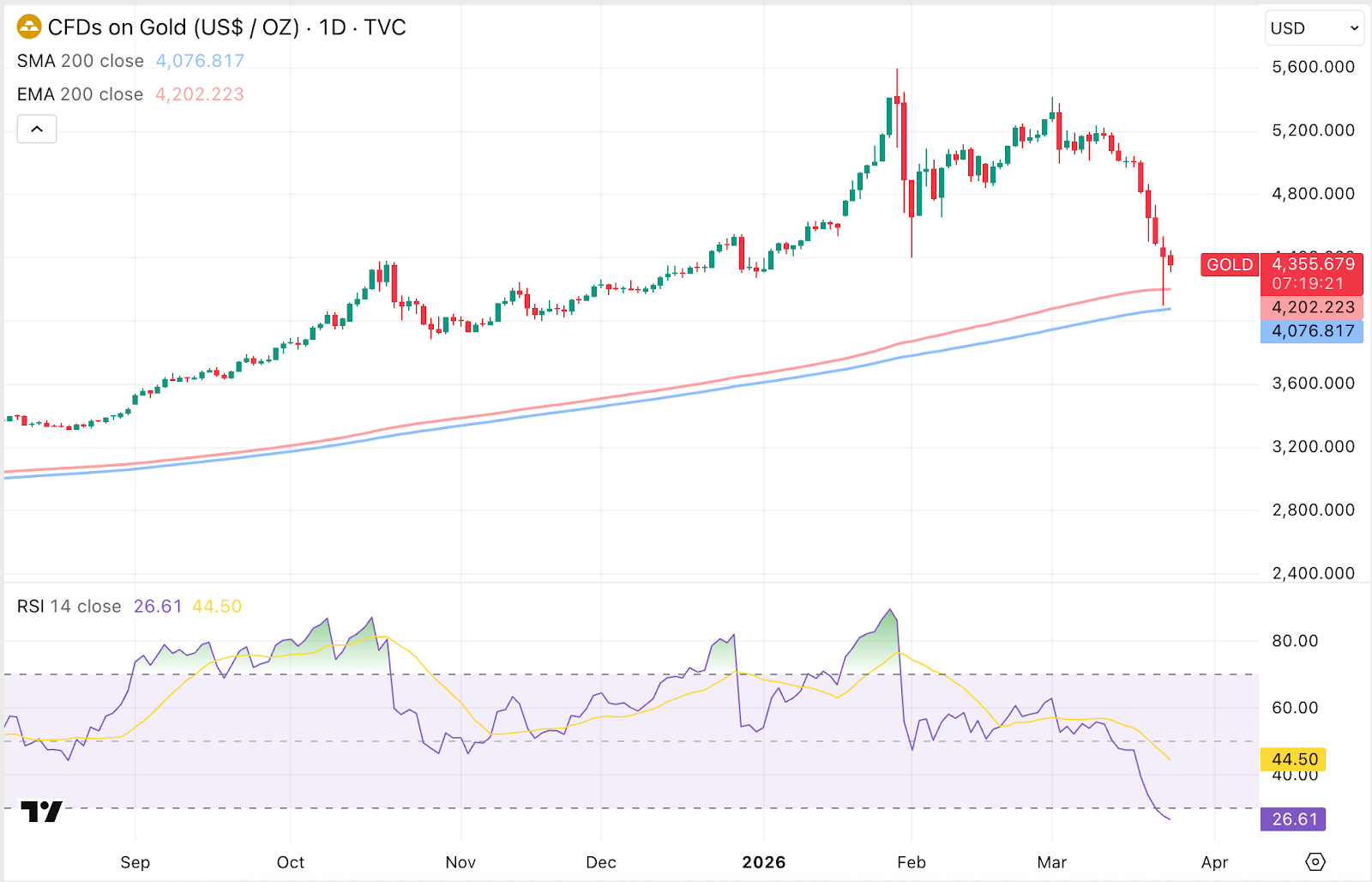
In addition, gold's Relative Strength Index (RSI), an important indicator of momentum, has reached its lowest level since 2023. This, too, is a signal that the bottom before the price may be starting to come into view.
Of course, there are no guarantees, and technical analysis is not an exact science, but we are also cautiously seeing some constructive signs for gold.
Furthermore, the situation in the Middle East may be a problem for gold in the short term. In the longer term, in theory, it is actually a positive force. War is expensive and makes the world less efficient.
For example, if the increased oil price causes a global recession, it is only a matter of time before central banks intervene. Now inflation is rising and that limits the scope for interest rate cuts.
But if a recession were to occur due to the rise in oil prices, there is a good chance that central banks will come up with interest rate cuts and other forms of support very quickly. In that scenario, gold is suddenly a lot more attractive again.
The same will happen when the situation in the Middle East cools. In that scenario, the inflation threat will decrease rapidly, central banks will regain room for interest rate cuts, and gold's relative attractiveness against the US dollar will increase.
For now, the Iran conflict seems to be causing negative volatility for gold, especially in the short term. In the longer term, gold remains an attractive investment in this context, for which there is solid evidence. For example, you can also see the sharp fall in prices as an opportunity to return. investing in gold.
Gold is falling due to rising oil prices and higher interest rates, but the long-term perspective remains strong. Is this dip just an opportunity to get in?

Thom Derks writes for GoldRepublic on gold, macro-economics and geopolitics. He studied Law in Leiden and Economics in Amsterdam. His personal fascination with scarcity and store of value through both bitcoin and gold brought him into the world of financial journalism. Through his own newsletter De Geldpers on Substack, he reaches over 5,800 subscribers with analyses on markets, geopolitics and the monetary system.