Silver rises nearly 25% from its low and benefits from focus on growth metals
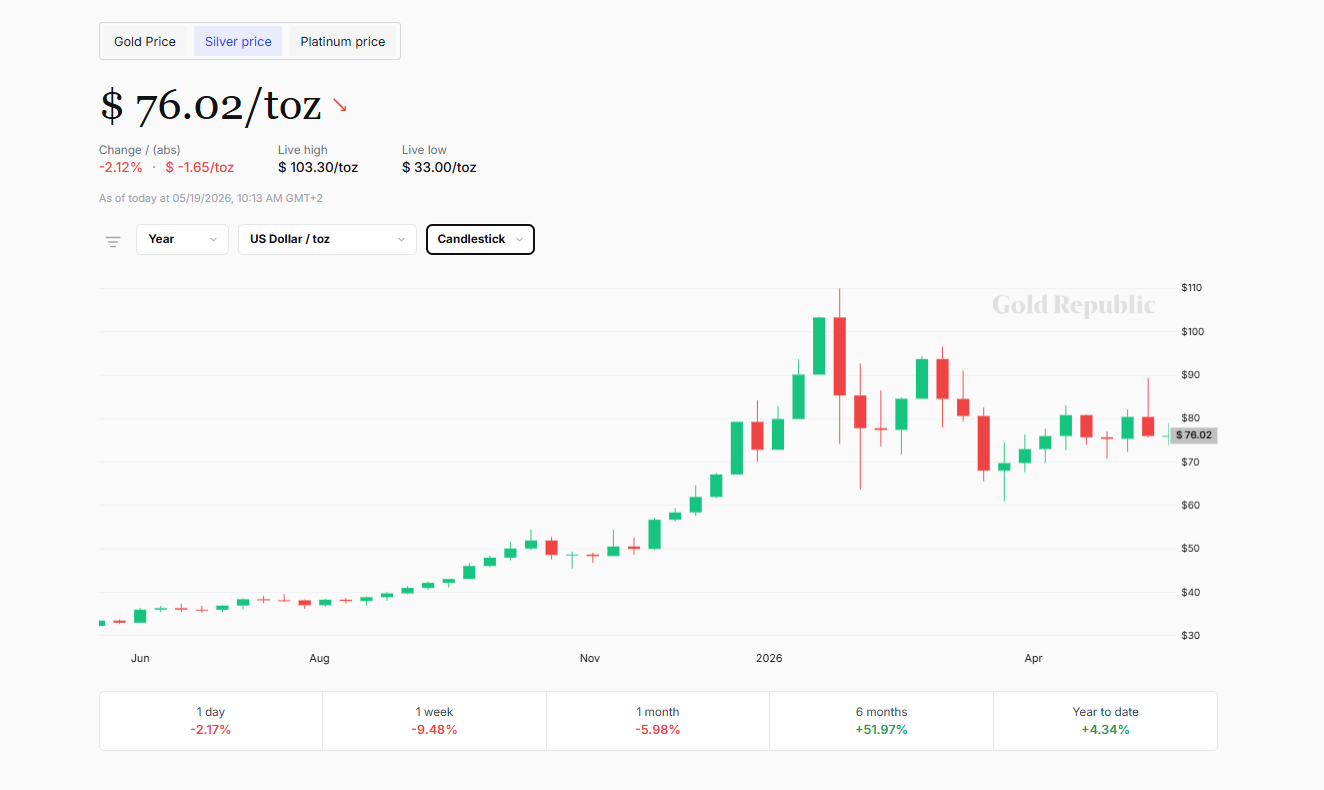
The silver price is staging an impressive recovery. From its low of around 61 dollars per ounce, silver has climbed nearly 25 percent. Over the past few days the rebound has been somewhat sluggish, but the market is clearly attempting to move higher again.
According to John Caruso van RJO Futures, it is "clear" that the market is currently focused on "growth metals" rather than "fear metals."
Why is silver outperforming gold right now?
Although silver, like gold, functions as a hedge against monetary inflation, the metal has a second face. Silver is not only a monetary metal, but also an industrial metal. And that is precisely what makes it so interesting for investors in the current market environment.
Gold benefits primarily from uncertainty, falling real interest rates, concerns about budget deficits, and distrust of fiat money. You could label gold, as John Caruso did, a fear metal. That is the classic monetary role of gold.
Silver often moves with those same forces, but gets an additional engine on top: economic growth.
At the moment, the market is clearly paying increasing attention to the industrial side of silver. The metal is used in computer chips, solar panels, electric vehicles, electronics, network infrastructure, and data centers.
This places silver right at the intersection of two major themes of our time: the AI revolution and the energy transition.
Strong confidence in the AI economy
The construction of AI data centers requires enormous amounts of electrical infrastructure, high-grade chips, cooling systems, connectors, and other electronic components. Silver plays a role in many of these applications, as it is the best electrical conductor of all metals.
Where copper is often used for large-scale infrastructure, silver becomes particularly attractive in applications where efficiency, reliability, and conductivity are critical.
This makes silver more sensitive to an environment in which the market regains confidence in growth. When investors are primarily fearful of recession or financial stress, gold is often preferred as the pure safe haven.
But once the picture shifts toward a combination of monetary uncertainty and economic resilience, silver comes into its own.
That is precisely what we are seeing now. The market is still concerned about inflation, geopolitics, and the sustainability of the monetary system - supporting precious metals broadly. At the same time, equity markets, the AI cycle, and demand for industrial commodities remain remarkably strong. This gives silver a double tailwind: protection against monetary debasement and exposure to growth.
Silver is not a safer version of gold, but a complement
Nevertheless, it is important not to view silver as a safer version of gold. The metal is simply too cyclical for that. Where gold is primarily bought as protection against monetary uncertainty, financial stress, and falling real interest rates, silver moves much more strongly with the economic cycle.
But that industrial side works both ways. In periods of recession fears, slowing growth, or stress in financial markets, silver can actually fall harder than gold. Investors tend to flee toward the purest monetary metal: gold.
In such phases, silver has less of a safe haven character and behaves more like a risk asset.
That is why silver is most interesting as a complement to gold. Gold forms the defensive foundation: the insurance against monetary disorder, political uncertainty, and financial stress. Adding silver introduces a more offensive component. It still offers protection against monetary debasement, but also provides exposure to growth, innovation, and industrial demand.
In a portfolio, gold can therefore be seen as the more stable anchor position within precious metals, while silver offers more leverage on the same monetary story. When conditions are favorable, silver can rise much harder than gold. But when sentiment turns, that leverage can work in the other direction as well.
That is precisely why silver should not be considered a replacement for gold. It is rather the dynamic complement - less defensive, but with more upside potential in an environment where monetary uncertainty coincides with economic growth.
That is why silver is currently outperforming gold. Not because gold is losing its role, but because silver is telling more stories at once. It is a monetary metal, an industrial metal, and an AI metal all in one. That combination is precisely what makes it more attractive for investors seeking both protection and growth right now.
The silver price is recovering strongly thanks to growing focus on AI, data centres and industrial metals. Why is silver currently outperforming gold?

Thom Derks writes for GoldRepublic on gold, macro-economics and geopolitics. He studied Law in Leiden and Economics in Amsterdam. His personal fascination with scarcity and store of value through both bitcoin and gold brought him into the world of financial journalism. Through his own newsletter De Geldpers on Substack, he reaches over 5,800 subscribers with analyses on markets, geopolitics and the monetary system.