

Gold and silver remain remarkably strong through the rate storm
Gold and silver are under pressure from rapidly rising US bond yields. This week the real yield on 10-year US government bonds climbed to 2.90 percent. That's the yield left over once inflation is accounted for, and it's now at its highest level since 2002.
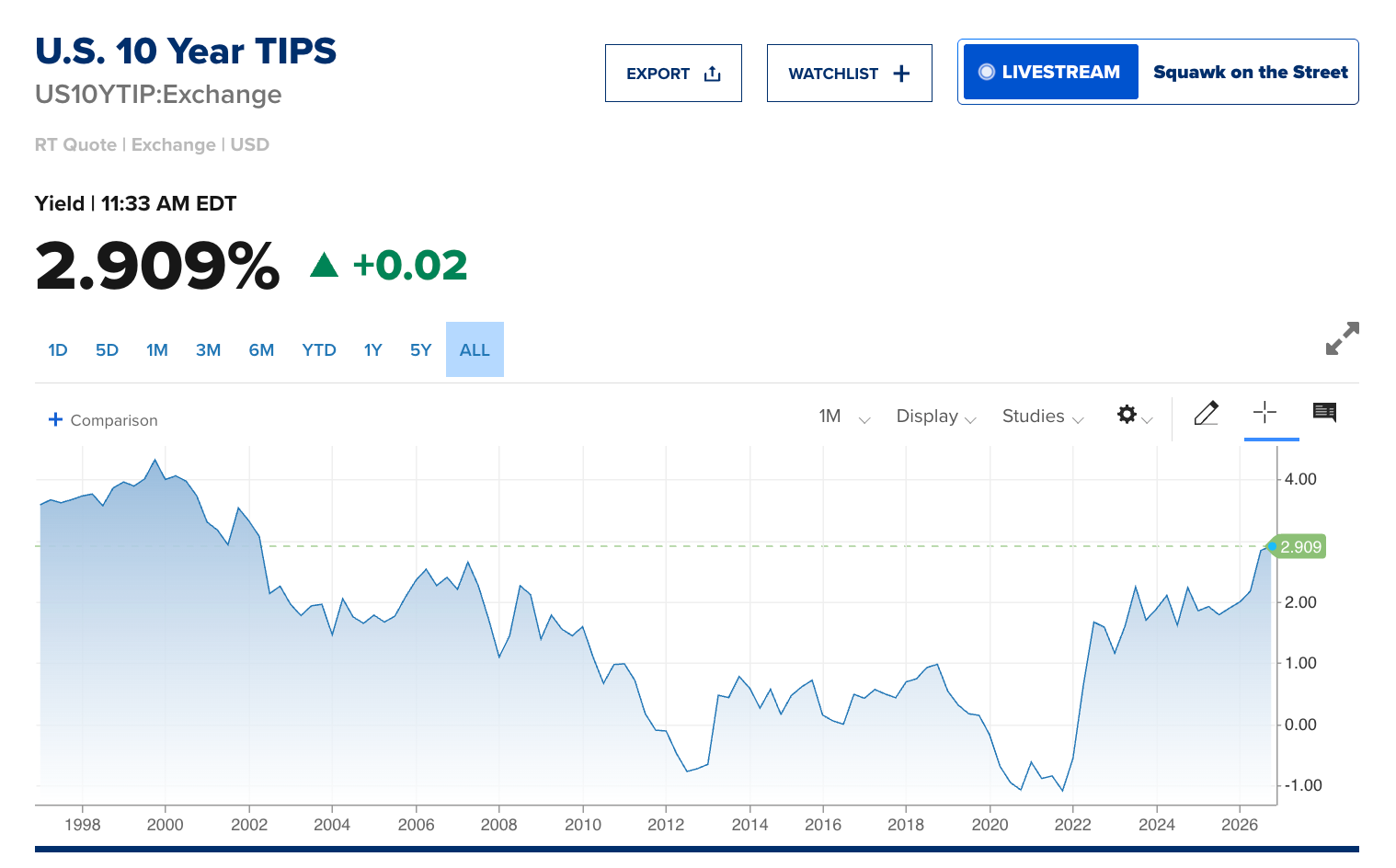
For investors, this means US inflation-protected government bonds currently offer a real return of almost 3 percent. That makes gold and silver relatively less attractive, since precious metals don't pay interest or dividends themselves. That's why gold and silver are facing headwinds in the short term as a result.
In the financial world, US government bonds are generally regarded as "risk-free." The reason is simple: the US government borrows in its own currency and can issue dollars to meet its nominal payment obligations.
That doesn't mean investors face no risk at all. With a standard US government bond, you know exactly how many dollars you'll receive at maturity, but not how much those dollars will still be able to buy by then.
Investors are ignoring the rise in real yields
Normally, a rise in real yields goes hand in hand with a flight out of precious metals. We saw that, for example, in 2022, when the US central bank began a cycle of rate hikes to fight the wave of inflation. The chart below shows investors selling off gold ETFs en masse at the time.
The blue line represents gold holdings in ETFs, and the red line represents the inverted real 10-year yield. A decline in that inverted line therefore means the real yield is rising.
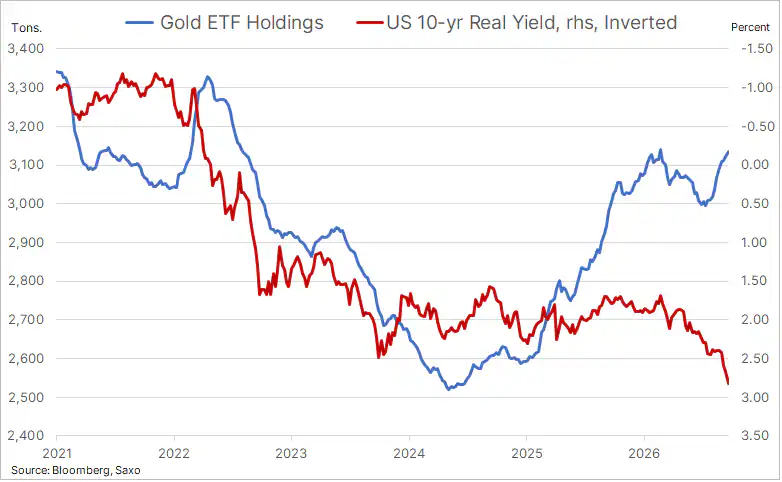
What's interesting is that we're seeing the opposite right now. Real yields are rising to their highest level in decades, while investors are actually accumulating more gold through ETFs.
The crucial question is whether this demand for gold holds up under these conditions. This is likely a group of investors who care less about rates and base their decisions more on the financial consequences of rising bond yields.
Rising real yields hurt gold because they increase the competition from government bonds as an alternative. But at the same time, higher rates deepen concerns about government finances and make it harder for businesses, consumers, and the economy as a whole to service their debt.
That, in turn, strengthens demand for gold as a hedge against economic risks and the risks surrounding government finances.
Oddly enough, rising bond yields therefore act as a short-term stress test for gold, while they actually strengthen the case for holding it as a long-term investment.
For now, ETF investors don't seem to be bothered by any of this, which is keeping the gold price fairly stable given the circumstances. In the short term, that makes it especially interesting to keep an eye on ETF flows, to see whether investors keep ignoring the rise in real yields.
Interestingly, we're seeing exactly the same pattern at GoldRepublic in our own customer data. Compared with the preceding months, our customers have only bought more gold in August and September, despite rising real yields.
The Fed is keeping its foot off the pedal
This week opened with remarks from New York Fed President John Williams, who said he sees no rush for the US central bank to raise rates. His opinion matters, since he has a direct vote on the central bank's rate policy.
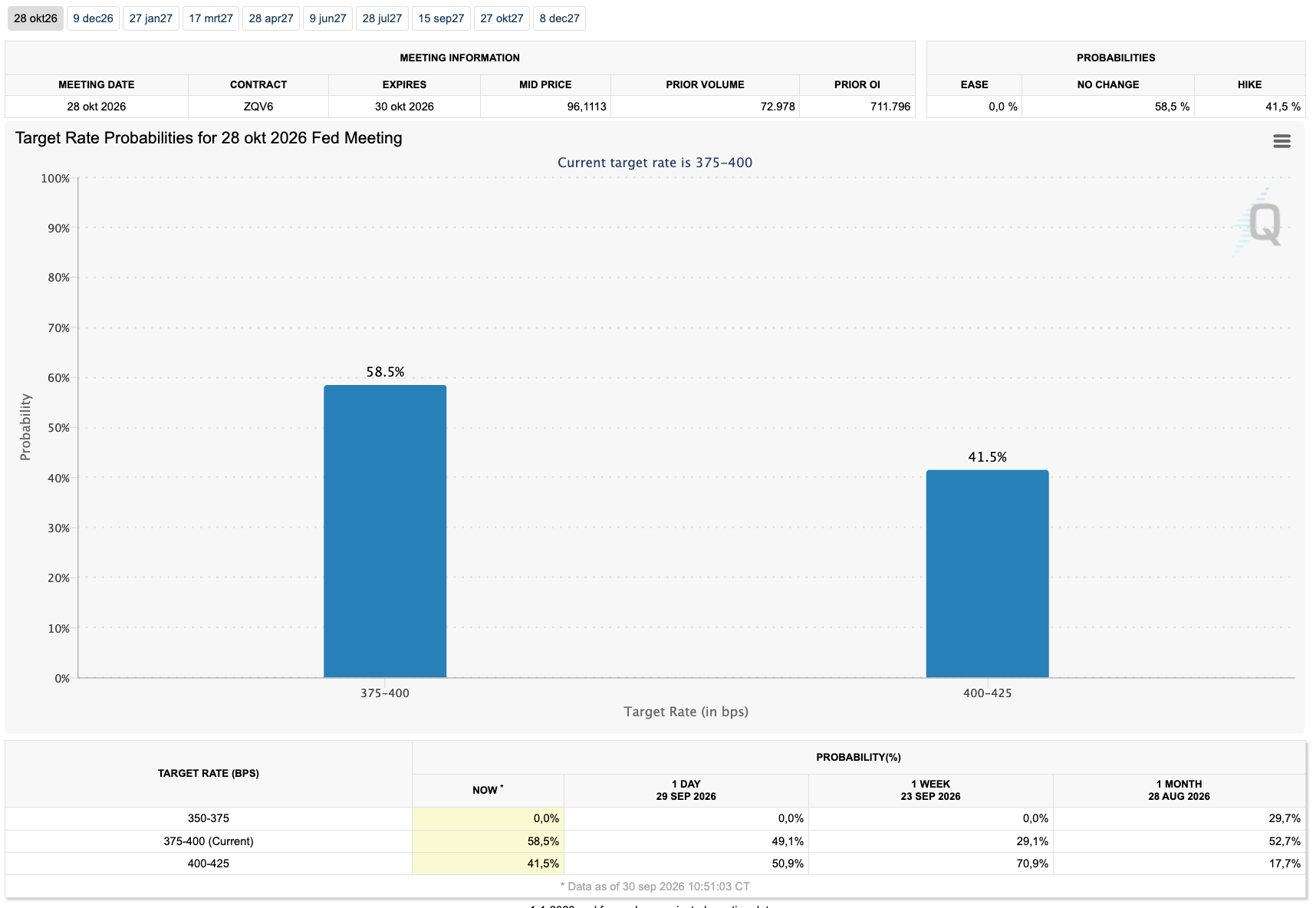
As a result, the probability of a rate hike at the October 28 meeting dropped from around 70 percent to its current 41.5 percent.
Those remarks got an extra boost on Wednesday afternoon when PCE inflation came in well below expectations. That's the US central bank's preferred inflation gauge, although it's worth noting that a new method has been introduced for calculating it.
Under that new calculation method, the average over the past three months, annualized, came out at 2.0 percent inflation for August. That's exactly the level the US central bank is aiming for.
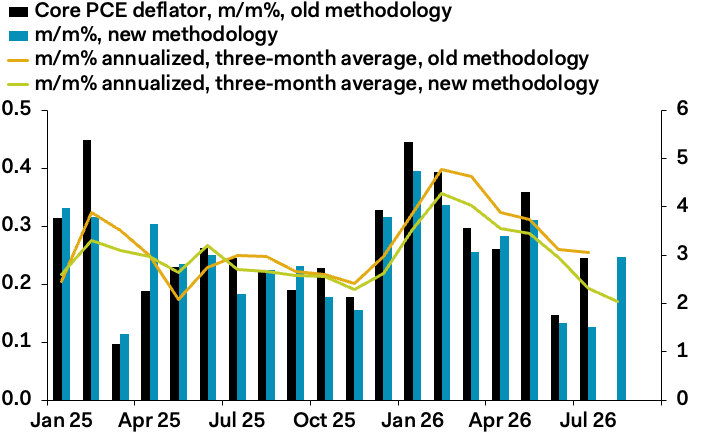
If the US central bank is basing its decisions on this indicator, the market's reasoning is that a rate hike in October becomes less likely. The main criticism from many analysts is that it's rather convenient to change a calculation method in a way that lowers inflation, and then conclude that no rate hikes are needed.
For now, the market doesn't seem to fully agree with that view either. After the inflation figures were published, further lowering the odds of an October rate hike, long-term bond yields actually rose. The 10-year yield climbed further, and the same goes for the 30-year yield.
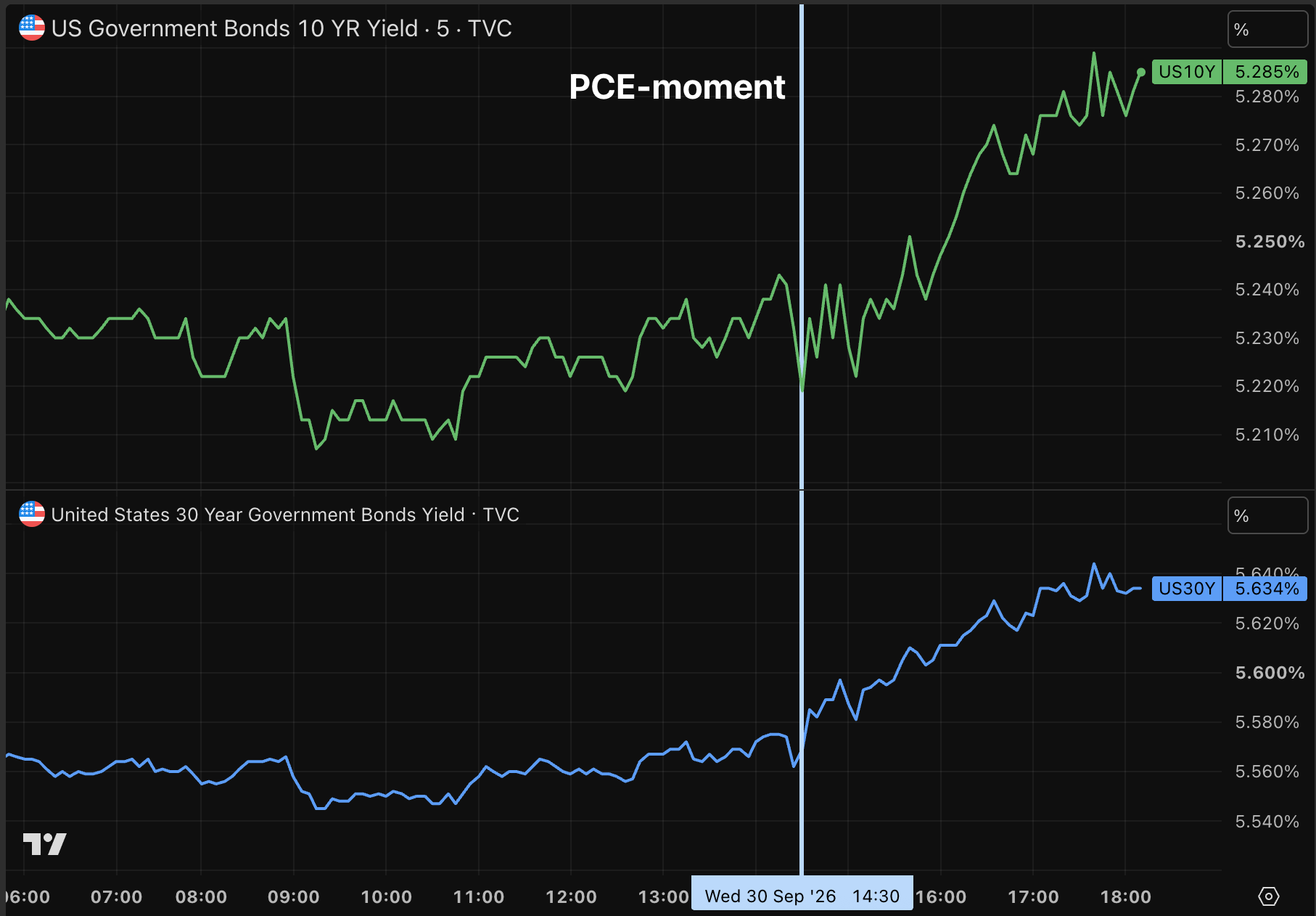
Investors are effectively saying: "Great that this inflation reading means you won't raise rates further, but in that case we want compensation in the form of higher yields if you want to borrow our capital over a longer period."
The market, in other words, suspects that the inflation problem will get further out of hand if the US central bank doesn't step in with rate hikes. So the market is, in effect, carrying out a rate hike of its own.
The result is that the gold price faces that stress test again in the short term, while the longer-term picture only gets stronger. At these rates, it becomes increasingly difficult for the US government to keep its mountain of debt under control. And this isn't just an American problem. It's a global phenomenon.
The gold price keeps standing its ground against relentlessly rising bond yields. Here's why investors keep choosing precious metals, even as rates hit their highest levels since 2002.

Thom Derks writes for GoldRepublic on gold, macro-economics and geopolitics. He studied Law in Leiden and Economics in Amsterdam. His personal fascination with scarcity and store of value through both bitcoin and gold brought him into the world of financial journalism. Through his own newsletter De Geldpers on Substack, he reaches over 5,800 subscribers with analyses on markets, geopolitics and the monetary system.