

Trump triggers fresh storm for gold and silver
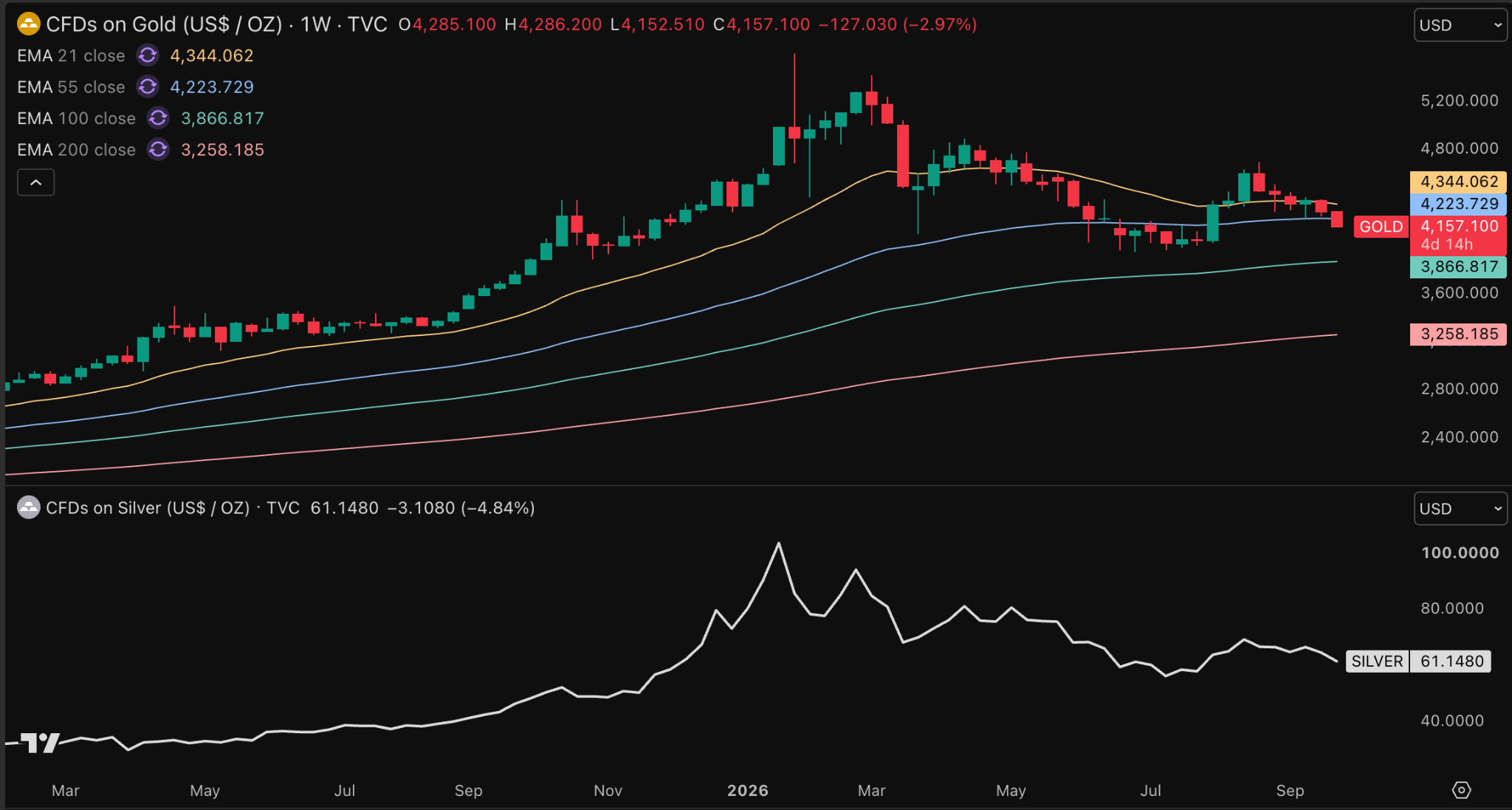
Gold and silver have started the new trading week with sharp declines. The gold price is trading almost 3 percent lower, around $4,150 per ounce, while the silver price has shed around 5 percent and is trading at $61 per ounce.
These declines, too, are largely down to the war with Iran. Donald Trump rejected Iran's proposal to reopen the Strait of Hormuz.
Not because Trump wants to keep the strait closed, but because he didn't agree to the additional conditions Iran attached to a reopening. In exchange for a swift resumption of shipping traffic, Iran demanded, among other things, that the United States withdraw from the country, lift the naval blockade, end the economic pressure, and release frozen Iranian assets.
The result is that we're starting the trading week with a 3 percent rise in the Brent oil price and, once again, higher US bond yields.
On top of that, Chinese investors may be taking profits on gold and silver ahead of Golden Week, a week-long holiday period during which hundreds of millions of Chinese travel and factories are often closed.
Rising bond yields are the biggest problem
Because of the developments around the Iran war, the US 10-year yield has now risen to 5.22 percent, and the 30-year yield has even climbed to 5.53 percent. That puts it at its highest level since 2004.
The rise in bond yields is now mainly driven by the market expecting a stricter US central bank, because of the renewed increase in oil prices. For October, the futures market now sees a nearly 70 percent chance of a rate hike.
In total, the market is now pricing in around 90 basis points of rate hikes. That may sound technical, but it effectively means the market expects roughly four standard 0.25 percentage-point rate hikes by the end of 2027.
The odds favour a positive surprise
Although that sounds negative and creates plenty of short-term headwind for gold and silver, it's important to keep a few things in mind here.
The market doesn't wait for rate hikes to actually happen. Right now, the market is pricing in the strict scenario of nearly four rate hikes by the end of 2027. Those expectations are already reflected in market prices.
The gold price is therefore already trading as if those rate hikes are actually coming. Investors are now factoring in an extremely strict rate scenario.
Those expectations can't get all that much stricter than they already are. That's the key thing to keep in mind here. There are still two rate meetings left on the calendar for 2026. For both, the market now expects a rate hike from the US central bank.
In other words, the odds of a positive surprise are greater than the odds of a negative one.
It's more likely that, for example through a peace deal between the US and Iran, only one rate hike materialises, instead of the two the market currently expects. That would immediately give gold and silver some breathing room.
Meanwhile, the odds of things getting even gloomier are small. It's almost impossible for the market to price in even more rate hikes for 2026, unless the US central bank were to consider 0.50 percentage-point increases.
Rate hikes won't fix the real problem
That, however, is highly unlikely, not least because the problem mainly lies with oil prices. There's an oil shortage due to the Iran war. Rate hikes don't solve that problem. If anything, they put even more pressure on the weaker parts of the US economy.
It's therefore worth asking what rate hikes would even solve in this situation, while at the same time they risk jeopardising the AI investment cycle. That's something the US central bank doesn't want to risk in the AI arms race with China, which has to be won at all costs.
The arguments against a strict cycle of rate hikes still appear to outweigh the arguments for multiple increases.
That's precisely where the basis lies for a scenario in which gold and silver could recover over the coming weeks. That would happen if the market moves away from the current, almost extremely strict, rate scenario for the US central bank.
For now, though, what matters is that gold and silver manage to find support in the macroeconomic storm that has been sweeping through markets since Monday morning.
Gold and silver open sharply lower after Trump rejects Iran's proposal. Rising oil prices and yields add fresh headwinds.

Thom Derks writes for GoldRepublic on gold, macro-economics and geopolitics. He studied Law in Leiden and Economics in Amsterdam. His personal fascination with scarcity and store of value through both bitcoin and gold brought him into the world of financial journalism. Through his own newsletter De Geldpers on Substack, he reaches over 5,800 subscribers with analyses on markets, geopolitics and the monetary system.