

French debt crisis: the case for gold
"There are decades where nothing happens, and there are weeks where decades happen." So spoke the Russian revolutionary Vladimir Lenin.
In a sense, that statement can also be applied to the global bond markets. Although the total bond market is two to three times larger than the entire stock market, government bonds are usually the dullest investment category for many investors.
Usually, that is, because there are moments when they suddenly become very important. Moments when they change world history. That may sound exaggerated, but history shows that bond markets can even bring down governments:
- Italy (2011): yields on Italian government bonds shot up and the spread with Germany rose from roughly 2 to 5 percentage points within a few months. The financial pressure ultimately became so great that Prime Minister Silvio Berlusconi tendered his resignation in November 2011.
- Italy (2019): once again, the bond market caused political tensions. The spread with Germany was around 2 percentage points when Prime Minister Giuseppe Conte announced his resignation in August, after his governing coalition had collapsed.
- United Kingdom (2022): British Prime Minister Liz Truss presented plans for sizable tax cuts without clear funding. Investors lost confidence, UK government bonds were sold off en masse, and yields exploded. The Bank of England had to step in to prevent a financial crisis. After just 44 days, Truss announced her departure.
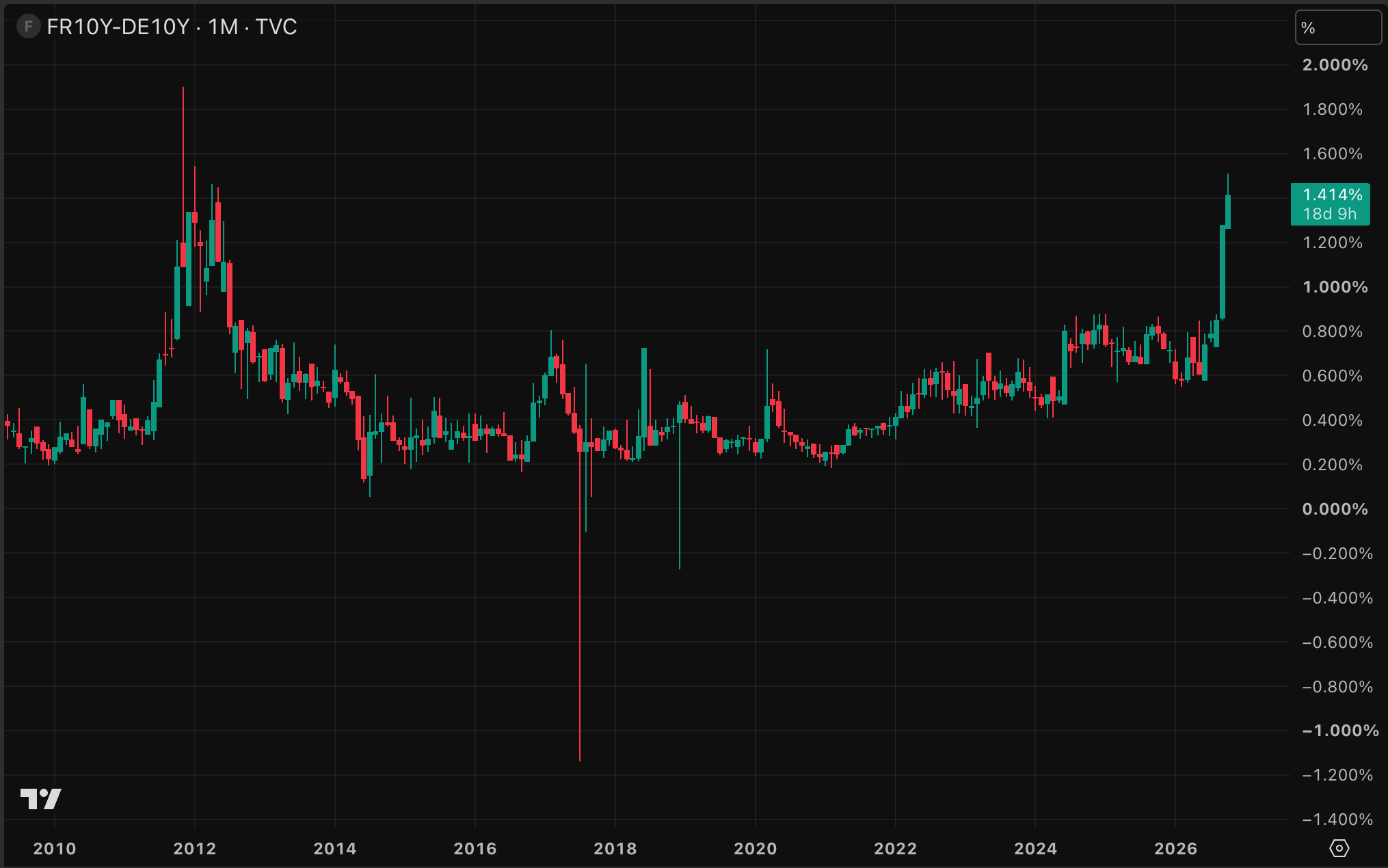
Right now, France is losing control of its bond market. The spread with Germany currently stands at 1.414 percentage points. The highest level since the eurozone crisis of 2012.
If French bond yields stay at their current level for the next ten years, the situation threatens to deteriorate further. Even if the French economy grows by 3 percent a year and the budget deficit stabilizes at 5 percent of GDP, annual interest costs could climb to as much as €200 billion. Almost three times as much as now.
How is that possible? France not only has to take on new debt to finance its budget deficit, but also to replace existing debt as it matures. That happens at today's much higher rates. As a result, the average interest rate on the total government debt gradually climbs.
In this scenario, interest costs rise to roughly 5 percent of GDP, more than twice as much as now. That means an ever larger share of the French economy is needed just to pay the interest on government debt. Money the government can no longer spend on, for example, education, healthcare, and infrastructure.
And that's where the danger for Europe lies. At some point, the pressure on French public finances could become so great that investors and politicians look to the European Central Bank (ECB) for a solution.
The ECB has instruments to intervene in the bond market, although they come with conditions attached. But that's precisely where it gets interesting for gold investors. Because if central banks are forced to support the bond markets, that could put confidence in government bonds, and ultimately in the monetary system too, under pressure.
The point at which central bankers have to step in to stabilize the situation is getting steadily closer. That's precisely an important part of the case for an investment in gold and silver. You can see the natural scarcity of precious metals as insurance, or protection against currency debasement.
In addition, there's no counterparty risk with physical gold and silver. You simply own it. You're not dependent on the financial health of a government or company. It exists. And it protects.
Please note: we're not writing in this piece that there is an acute debt crisis in France. That doesn't change the fact that the situation is starting to look increasingly worrying.
France's government debt and bond yields are rising. What are the risks for Europe, and why could this strengthen the case for gold?

Thom Derks writes for GoldRepublic on gold, macro-economics and geopolitics. He studied Law in Leiden and Economics in Amsterdam. His personal fascination with scarcity and store of value through both bitcoin and gold brought him into the world of financial journalism. Through his own newsletter De Geldpers on Substack, he reaches over 5,800 subscribers with analyses on markets, geopolitics and the monetary system.