

A bad tax doesn't make gold a bad investment
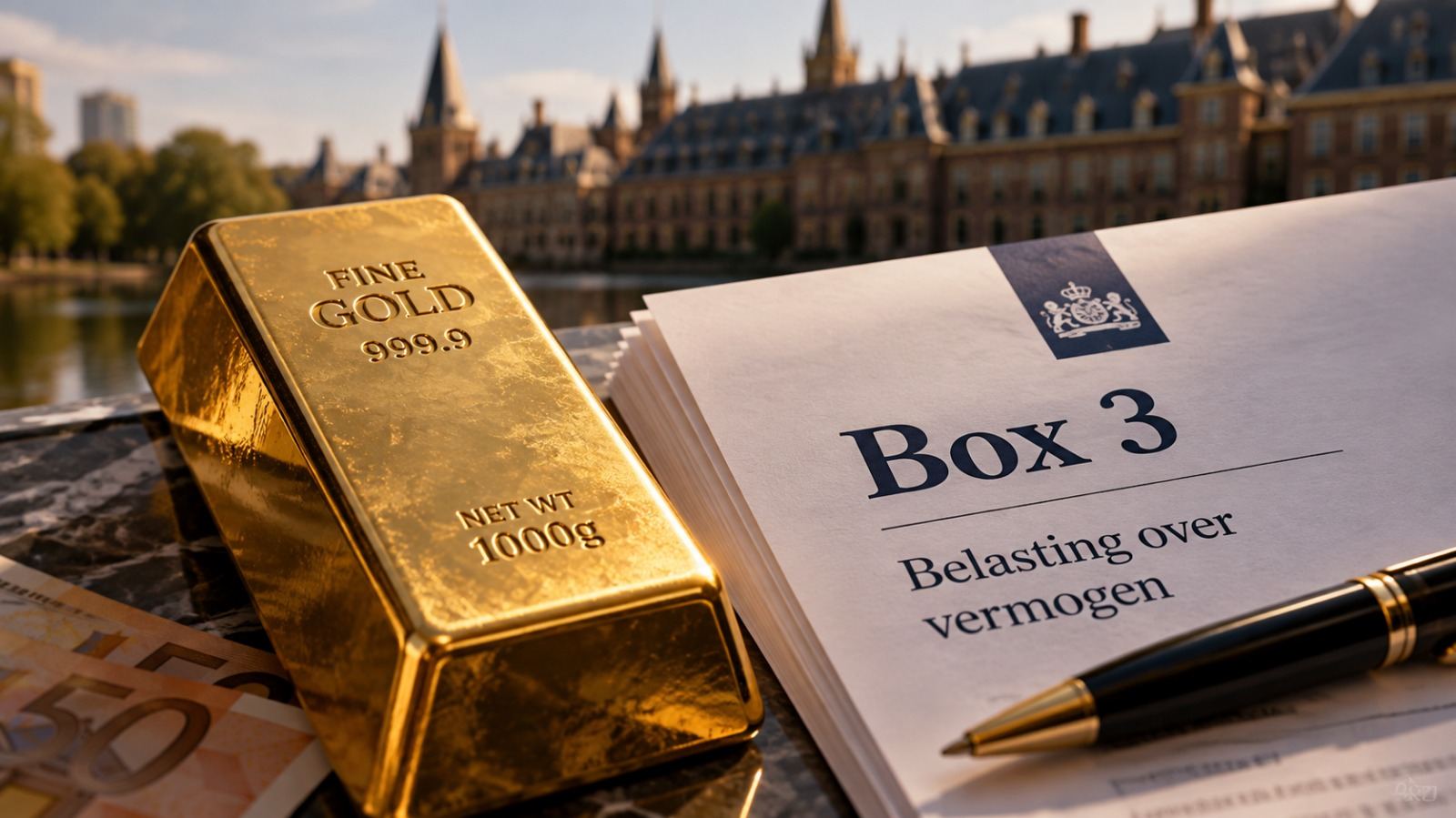
This piece concerns "Box 3," the Dutch tax category for savings and investments. The underlying argument, that a bad tax doesn't automatically make a good investment bad, applies well beyond the Netherlands too.
I understand the anger over Box 3 very well. In fact, I share it. A tax rate of 36% on your nominal investment return strikes me as excessive, especially since part of that return isn't real wealth growth at all, but simply compensation for inflation.
I also think the wealth-growth tax is a bad idea. Paying tax on profit you haven't even realized yet can mean having to sell part of your investments just to pay the tax authorities. That money can then no longer generate returns. You're undermining the effect of compound interest, which, in my view, a government should actually want to encourage.
So far, I largely agree with everyone who's currently angry.
But then I see something happening that I'm far less comfortable with. The legitimate criticism of the tax suddenly gets turned into the conclusion that investing in gold or bitcoin no longer makes sense. Or that you'd be better off just saving. And that's where things go wrong, as far as I'm concerned.
So what should you actually do with your money?
Because what are you supposed to do instead?
Say you have $100,000. You could put it in a savings account. You'll probably pay little or no tax, but if the interest rate lags behind inflation, you can be fairly sure you'll lose purchasing power. The number on your bank statement might go up, but it'll buy you less.
Or you could invest. In gold, for example.
For me, one question ultimately decides it: do I expect gold, after tax and inflation, to protect my purchasing power better than saving or other investments?
If the answer to that is yes, why would I stop investing in it just because the tax is bad?
What our calculations show
That sounds almost too simple. So we ran the numbers. Not just with one neat example where everything goes up nicely every year, but with a million different return paths. In each path, stocks, bonds, gold, and bitcoin move differently. Sometimes they rise, sometimes they drop sharply. Inflation varies too. We then settle the tax and look not just at how many dollars are left, but above all at how much you can still buy with them.
For a portfolio of $100,000 (and for smaller amounts too), that produces an interesting result.
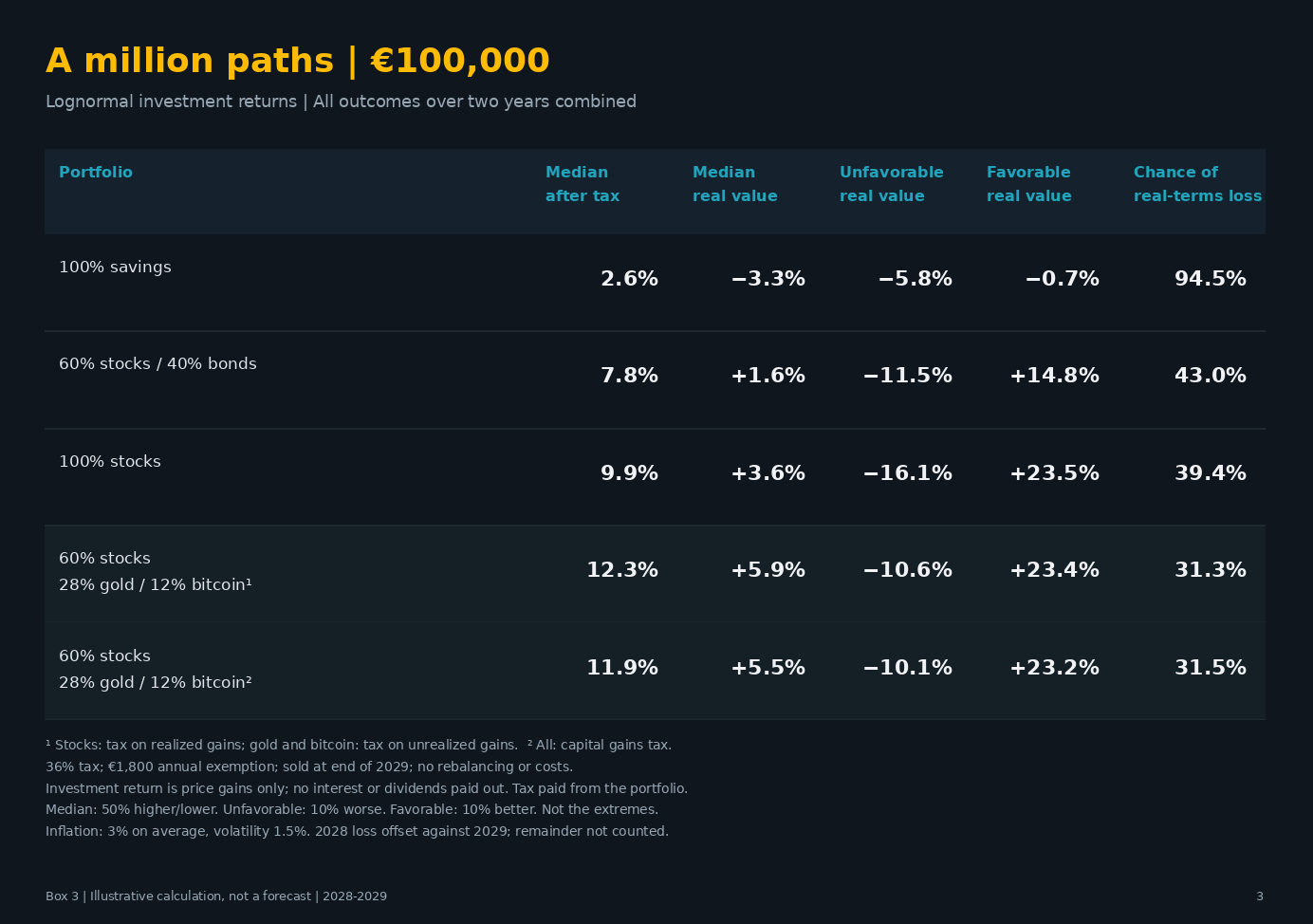
Saving looks safe, because the number in your account barely moves. But in our calculations, the saver ends up with less purchasing power in almost 95% of the million paths. No dramatic market crash, no bitcoin halving, no collapsing gold price. Just slowly getting poorer because inflation outpaces your net savings return.
That kind of certainty obviously doesn't exist with investing. A portfolio including gold can disappoint too, and we shouldn't gloss over that. But under our assumptions, a portfolio that includes gold and bitcoin alongside stocks offers a much greater chance of preserving purchasing power, even after paying the tax.
And that, for me, is exactly the point.
The discussion right now is almost entirely about how much tax you pay. But tax is only one part of the final outcome. What you invest in, how much return you get from it, and how much inflation there is along the way matter at least as much.
Take gold. If you expect gold to barely generate any return over the coming years, you shouldn't buy it. Not under a capital gains tax, and not under a wealth-growth tax either.
But I actually expect gold to remain a good investment. Debt keeps rising worldwide, governments need ever more money, and central banks are being drawn ever deeper into the debt problem. For me, those are exactly the conditions under which a scarce asset that no one can print at will stays attractive.
It would be strange, then, to say: I expect gold to protect my purchasing power, but because of Box 3 I'd rather put my money in a savings account that I expect to lose purchasing power.
Don't let the tax dictate your investment decisions
In saying this, I'm not excusing the tax. Quite the opposite. 36% is, in my view, still far too high. And taxing unrealized gains every year disrupts the compounding effect. That downside also grows the longer you hold the investment.
But don't let the government determine your investment decisions on top of that.
That's perhaps my most important message amid all the commotion around Box 3. Object to a bad tax. Point out the inconsistencies. Argue for a lower rate and a system that encourages investing and wealth building.
But in the meantime, keep thinking like an investor.
Because ultimately, it's not about how much tax you pay. It's about what you're left with after tax and inflation, and what you can still buy with it.
If gold was a good investment before the new Box 3 plans, it can still be one afterwards.
Maybe even especially now.
The Dutch Box 3 tax is unfair, but that doesn't mean gold has stopped being a good investment. A million-scenario calculation shows why.

Jeroen Blokland has over 20 years of experience as a professional investor and was formerly Head of Multi-Asset at Robeco, where he was responsible for a client portfolio of over five billion euros. After leaving Robeco he founded True Insights, an independent investment research platform, and has since built a following as a columnist, YouTuber and sought-after speaker. With over 100,000 followers on X, he is one of the most prominent voices in Dutch finance. For GoldRepublic he writes on macro-economics, markets and the role of gold in a diversified portfolio.