Can Gold Benefit from Central Banks Caught in a Trap?
In an ideal scenario, central banks raise interest rates when inflation rises and lower them when the economy needs support. In theory, that sounds simple. In practice, reality is often quite different.
The problem is that inflation and economic growth don't always behave neatly by the book. Sometimes inflation rises while the economy is actually starting to cool. Central banks then find themselves in a difficult position. If they raise rates to fight inflation, they increase the risk of economic damage. If they lower rates to support the economy, they may reignite inflation.
The Central Banks' Balancing Act
Precisely that makes the current situation so complicated. Rising energy prices and climbing interest rates are increasing pressure on consumers and businesses. At the same time, a significant part of the global economy is still performing reasonably well, partly thanks to massive investments in artificial intelligence.
This makes it difficult for central banks to make a clear choice. Inflation calls for tougher language, but the underlying vulnerability of the economy calls for caution.
Consumers Are Losing Purchasing Power
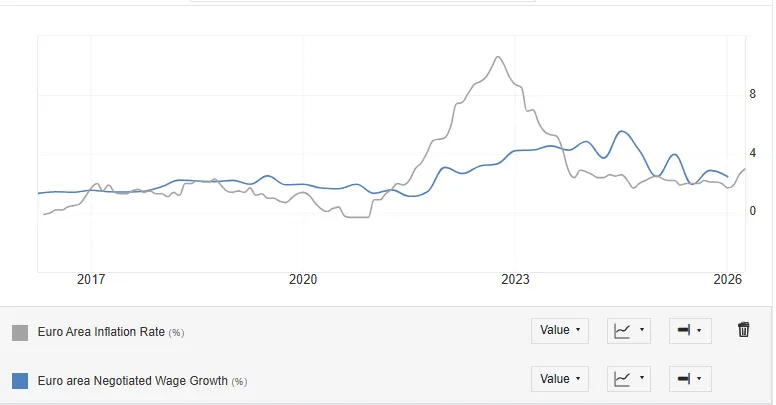
The chart below shows how inflation in the eurozone is now rising faster than wages. This means that consumers are losing purchasing power under current conditions. Their expenses are growing faster than their incomes, leaving less room for non-essential purchases.
This makes the situation even more difficult for central banks. On one hand, rising inflation theoretically calls for higher interest rates. On the other hand, the risk is growing that higher rates will put consumers — and with them the broader economy — under even more pressure.
This creates a dangerous balancing act. If central banks cannot intervene forcefully enough, there is theoretically a risk that inflation could spiral further out of control. Not because central bankers want that, but because the economic damage of higher rates eventually becomes too great.
In other words: central banks may sound tough, but the question is how much room they actually have in practice to turn those words into action. If consumers are already losing purchasing power, businesses are facing higher financing costs, and the economy is showing signs of fatigue, every additional rate hike becomes riskier.
Why Gold Benefits from This Uncertainty
For the gold price, this is theoretically a favorable environment. The precious metal has been seen for centuries as protection against monetary debasement and loss of purchasing power. Especially when investors sense that central banks are falling behind the curve, gold's appeal increases.
Normally, higher interest rates can put pressure on gold, since gold itself yields no interest. But in this case, the key question is whether central banks can still credibly rein in inflation. If inflation remains high while central banks are limited in their ability to act, real interest rates may remain under pressure — that is, the interest rate after subtracting inflation.
It is precisely this real interest rate that matters for gold. When savings accounts and bonds offer insufficient protection against rising prices, investors more readily seek refuge in alternatives that are not dependent on central bank policy.
In such a scenario, gold benefits not only from inflation itself, but also from doubt about the effectiveness of central banks. It becomes more attractive as insurance against loss of purchasing power, monetary uncertainty, and the risk that policymakers respond too late or too cautiously.
The inability - or difficulty - of central banks to intervene means they cannot act optimally. That is precisely where gold has historically provided a solution. You can never say anything with certainty in the financial world, but all the uncertainty prevailing right now does not appear to argue against investing in gold.
Central banks are caught between inflation and economic slowdown. Why that very uncertainty could work in gold's favor

Thom Derks writes for GoldRepublic on gold, macro-economics and geopolitics. He studied Law in Leiden and Economics in Amsterdam. His personal fascination with scarcity and store of value through both bitcoin and gold brought him into the world of financial journalism. Through his own newsletter De Geldpers on Substack, he reaches over 5,800 subscribers with analyses on markets, geopolitics and the monetary system.