

Why is there so much Chinese money?
It never ceases to amaze me how few investors, economists, and financial journalists are able to piece simple puzzle pieces together. So I'll do it once again. This time with the enormous mountain of Chinese money.
Growth requirement
China's statistics bureau recently reported economic growth of 4.3% year-on-year for the second quarter. That sounds enormous. In Europe, we're already happy if we scrape past one percent.
Yet that 4.3% is actually a rather poor figure. It represents the slowest growth pace since the last quarter of 2022, and it also falls well short of the official growth target of 5%.
A lively debate then unfolds about what's causing this disappointing Chinese growth figure and what it might mean for the global economy, inflation, and so on.
But the real conclusions never come.
An unrealistic target
As I show in detail in my book The Great Rebalancing, China is aging faster than any other major economy. So fast, in fact, that China's working-age population will shrink by hundreds of millions of people (yes, you read that right) over the coming decades. Closer to everyday reality: childcare capacity in China has fallen by 40% in recent years due to a lack of demand.
In every country, the size of the working-age population is the key factor determining how fast an economy can grow structurally. With such rapid aging, that growth in China is certainly not fast. Nevertheless, the central government in Beijing stubbornly sticks to a growth target of 5%. China would need to be extremely productive to achieve that without resorting to tricks. Unfortunately, that's not the case.
The trick
The solution to China's growth problem? Exactly the same as for France's or Japan's growth problem: debt. With extra debt, governments around the world buy economic growth. As far as I know, no politician has ever been elected on the message: let's all shrink together, and things will work out fine.
The more unrealistic the growth target, the more debt is needed to hit it anyway. This directly explains why China's mountain of debt is growing much faster than in other parts of the world. Less than twenty years ago, China's total debt was significantly lower than that of Europe and the United States. But since 2023, the opposite has been true: China's total debt pile is now larger. And it's therefore also growing faster.
China is quite literally borrowing its way to 5% economic growth.
Money is debt
This piece of the puzzle almost always goes unmentioned in the financial media. But it doesn't stop there. As the chart below shows, China's total money supply is now more than twice the size of that of the United States — even though the Chinese economy is over a third smaller, and the Chinese yuan is certainly not a global reserve currency.
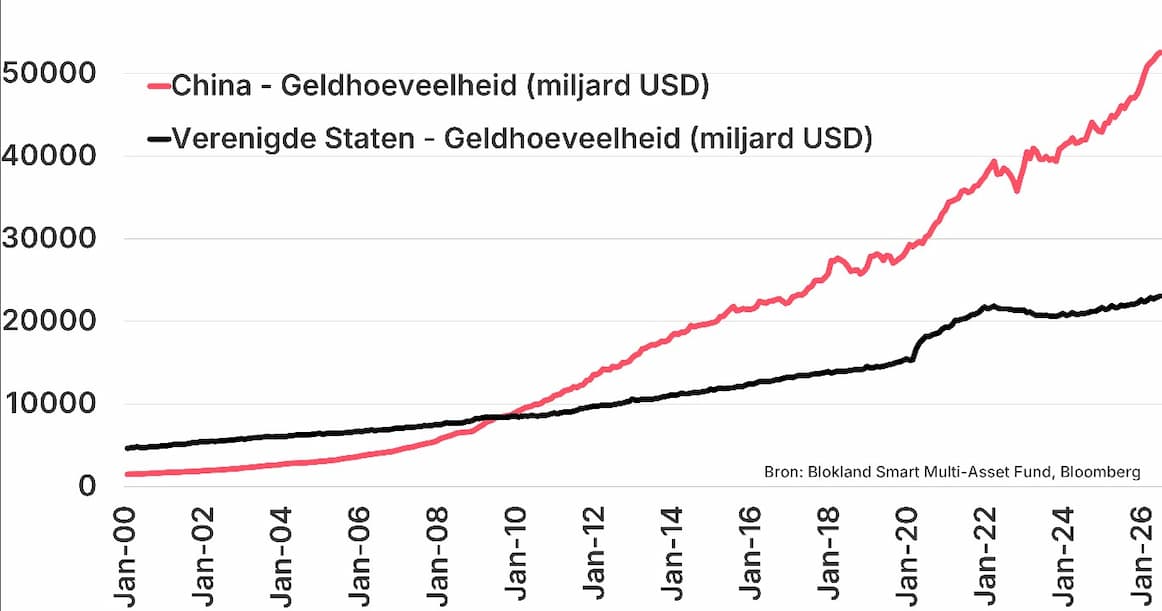
How is that possible? This too is simple. In the current financial system, money is debt. To be able to buy up all that debt, ever more liquidity (read: money) needs to be sitting in the system. Increasingly, that happens directly. Central banks print new money and buy government debt. Or they park it with banks, which are forced by regulation to hold government paper as a buffer.
Gold shines
The last piece of the puzzle is gold. Why does China buy such enormous amounts of gold? Because it also creates enormous amounts of money. What most people do know is that our money runs on trust — trust that you can pay with it, that other people will accept it, and that it won't lose its value.
When there's this much money in circulation, that trust comes under pressure. After all, who's lining up to pay for everything in Chinese yuan, or to receive their salary in that currency? So, to keep the mechanism of buying growth with debt — which is then financed by printing extra money — from breaking down, China also needs to buy trust.
How do you force trust in your currency? By backing it with real value. And as a rule, that value is gold.
The Great Rebalancing
Although, in my view, there isn't a single flaw in the reasoning above, many investors and economists still give me a rather blank look when I try to explain that this is how the system works. It's really not that difficult a puzzle.
When I then mention that I've built an entire investment fund around this dynamic, I'm still regularly dismissed as a crank or an extreme investor. What they fail to see is that financial systems have been starting to wobble for thousands of years the moment trust disappears.
No matter. I'll happily keep building — I simply love putting together puzzles.
China's economic growth is fueled by debt and money creation. Discover why this directly explains China's massive gold buying spree.

Jeroen Blokland has over 20 years of experience as a professional investor and was formerly Head of Multi-Asset at Robeco, where he was responsible for a client portfolio of over five billion euros. After leaving Robeco he founded True Insights, an independent investment research platform, and has since built a following as a columnist, YouTuber and sought-after speaker. With over 100,000 followers on X, he is one of the most prominent voices in Dutch finance. For GoldRepublic he writes on macro-economics, markets and the role of gold in a diversified portfolio.