


Investors defy classic market wisdom and buy gold
You'll no doubt have noticed that bond yields have risen sharply worldwide. After the 2008 crisis, rates fell towards, or even below, zero. Since then, however, we've seen a reversal. The real US 10-year yield reached its highest level in more than 20 years on Friday, at 2.63 per cent.
The real yield is the interest rate adjusted for inflation. In theory, investors can now buy 10-year US government bonds and actually generate a positive return, since at current levels a 10-year US bond outpaces inflation.
Normally, that would be bad news for gold. The metal pays no interest, so higher real yields make government bonds relatively more attractive by comparison. What's interesting is that today we're seeing a very different market reaction, one worth taking a closer look at.
Back to the 2022 inflation surge
In 2022, the world was hit by a severe wave of inflation. In response, central banks embarked on an aggressive cycle of rate hikes, which drove a sharp rise in real yields.
Investors reacted by selling gold ETFs quite heavily, as shown in the chart below. In blue, we see ETF-held gold holdings shrinking from 2022 onwards, while the red line is the inverse of the real US 10-year yield.
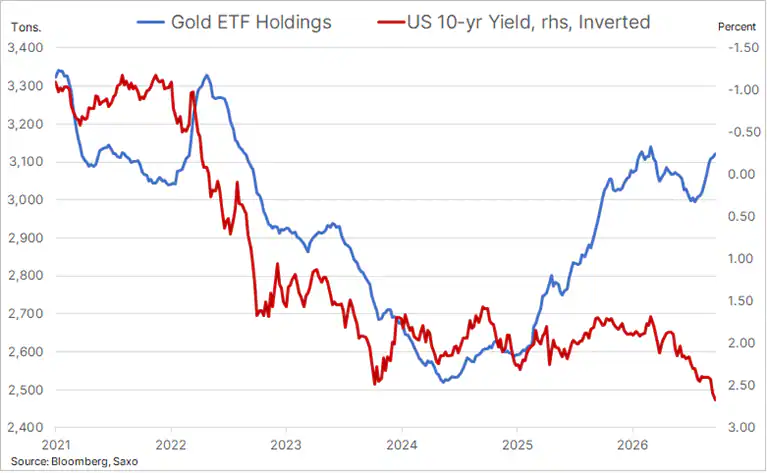
Back then, the gold price held up reasonably well, and even entered a very strong period, helped in part by heavy buying from central banks, which offset the investors selling their gold through ETFs.
That's when we first saw the gold price begin to decouple from real yields: gold stayed stable while real yields rose.
But ETF investors did sell their gold at the time because of rising real yields. Now we're seeing that relationship break down entirely, and even reverse. Real yields are currently climbing to their highest levels in decades, while investors are pouring more capital into gold ETFs than ever.
Unlike in 2022, ETF gold holdings aren't shrinking as real yields rise. They're actually growing. Investors now apparently see reasons to buy gold rather than sell it.
The classic argument that you should sell gold when real yields rise, because the metal pays no interest, now looks out of date.
Why are investors ignoring this classic rule?
We obviously can't read every investor's mind. But the gold price's reaction in 2022 probably plays a role. Back then, investors did sell their gold ETFs as real yields rose, and missed the start of the bull market that peaked at $5,600 an ounce in January 2026.
It's likely no coincidence that gold's failure to behave as expected in 2022 is shaping how investors act now.
On top of that, concerns about government debt have only grown in recent years. Investors see high yields on government bonds not just as attractive, but also as a warning sign of underlying risk.
As rates rise, annual interest costs increase, budget deficits widen further, and the global debt pile keeps growing. Confidence in government money is fading.
And if investors no longer trust government money and bonds as a counterweight to equities, gold becomes an appealing alternative.
The AI bull market will also come to an end at some point. When it does, a few things are likely to happen that could work in gold's favour:
- Demand for capital drops sharply, as it would slow the AI investment cycle. That would push rates down and make gold even more attractive relative to government money.
- A stalling AI cycle would also likely prompt a response from governments and central banks: in other words, the money taps would be opened to support the economy. The AI investment cycle plays an increasingly large role in economic growth; if it falters, the risk of recession is far from negligible, and governments and central banks would likely step in. In that scenario, confidence in government money is unlikely to improve.
Investors see gold as a hedge against governments' debt situation, but also as protection against the end of the AI bull market. In today's financial world, gold is taking on multiple roles, which may be why old rules of thumb, such as gold falling when real yields rise, no longer fully hold up.
Gold prices typically fall when real interest rates rise. Back in 2022, investors sold off gold ETFs en masse as a result. This time, however, they've spotted something that may have changed their minds.

Thom Derks writes for GoldRepublic on gold, macro-economics and geopolitics. He studied Law in Leiden and Economics in Amsterdam. His personal fascination with scarcity and store of value through both bitcoin and gold brought him into the world of financial journalism. Through his own newsletter De Geldpers on Substack, he reaches over 5,800 subscribers with analyses on markets, geopolitics and the monetary system.




.jpg.jpg)


