


I love it when a plan comes together
Anyone old enough, like me, to have watched The A-Team on television will know Hannibal Smith's legendary catchphrase. I found myself thinking of it regularly over the past few weeks. Not because I'm hoping for a crisis in the bond markets quite the opposite but because developments in the United States, the United Kingdom and Japan are, almost one by one, showing why it is now an absolute necessity to top up your wealth with scarce assets.
What we're seeing isn't a debt crisis. Not yet. But it's becoming increasingly clear how much effort governments and central banks now have to make to prevent one from happening. Central banks need to keep interest rates high, or even raise them further, to fight inflation driven above all by the situation in the Middle East. Meanwhile, those same high rates are putting ever more strain on the enormous pile of debt built up over recent decades. That is the bind the financial system now finds itself in.
Treasury Twist
Take the United States. US government debt now stands above $40 trillion, and Treasury Secretary Scott Bessent has made no secret of the fact that he'd like to see long-term rates lower. The Treasury has therefore recently tripled the scale of its buybacks of long-term government bonds. At the same time, government financing is leaning heavily on shorter-dated debt.
That measure has been nicknamed the Treasury Twist, a nod to Operation Twist from 2011. The mechanism is different this time. Back then, the Federal Reserve bought long-term government bonds while simultaneously selling short-term ones. Now it's the Treasury that, through its debt management, is trying to ease the pressure at the long end of the yield curve. Call it what you like the message is no less interesting: the US government doesn't want long-term rates to rise much further, and it certainly doesn't want investors offloading long-term Treasuries en masse.
Threadneedle Twist
On 17 September, the United Kingdom joined in. The Bank of England decided to keep £120 billion of its longest-dated government bonds, with maturities from 2049 onwards, on its balance sheet. Another £222 billion of shorter-dated bonds will simply be allowed to mature, meaning only around £146 billion will ultimately need to be actively sold. And that will happen very gradually, at £20 billion a year.
Forget the numbers for a moment. As far as I'm concerned, this move deserves the name "Threadneedle Twist", after Threadneedle Street, where the Bank of England is based. Different dancer, but unmistakably the same dance. Take as many long-dated bonds as possible off the table that the market would otherwise have to absorb, and in doing so, limit the upward pressure on interest rates.
The reaction left little to the imagination. UK 30-year gilt yields fell sharply exactly what the Bank of England likes to see, even if it would no doubt phrase that rather differently itself.
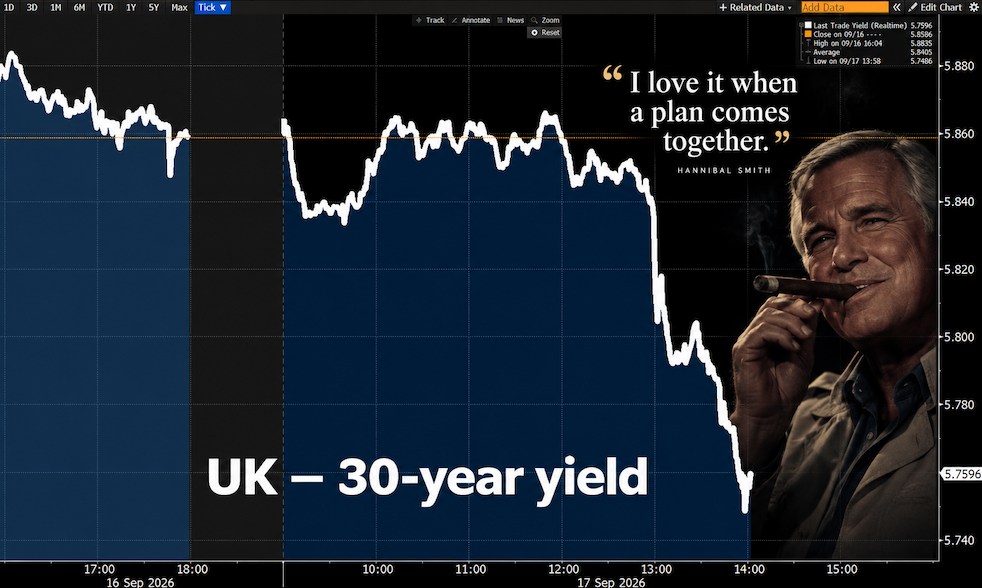
British 30-year yield falls sharply after Bank of England announcement. Source: TradingView
Konnichiwa
This week the Bank of Japan raised interest rates to 1.25%, but the central bank's policymakers were divided. Two of them unexpectedly voted against the move. And at the press conference following the decision, Governor Ueda was far from forthcoming.
Normally, a rate hike would be expected to support the yen. But the forward-looking message was anything but hawkish, which left the yen weaker instead.
Japan, too, is caught in the same dynamic. The central bank needs to tighten policy to keep inflation in check and protect the currency, while at the same time knowing that higher rates have ever bigger consequences for public finances given the country's enormous government debt.
That's the common thread running through all these developments. Central banks are still fighting inflation, but they can no longer ignore the consequences of higher rates for a debt-driven financial system.
This is not the old normal
And that's precisely where, in my view, the discussion around bonds goes wrong. Of course bonds look more attractive than they did four years ago, when rates were still hovering around zero. And yes, I do expect long-term rates to eventually fall again.
But why they fall matters far more than whether they fall.
If rates fall because inflation structurally returns to 2%, budget deficits shrink and government debt stabilises, then the outlook for bonds looks a lot better. But if rates fall because governments and central banks are being forced to intervene ever more aggressively to stop interest costs from spiralling out of control, that's an entirely different story.
And we're probably still only at the beginning. Buying back bonds now and delaying sales, as the Bank of England is doing, are still relatively simple interventions. If the pressure really builds, quantitative easing (QE), financial repression, and eventually even yield curve control are all firmly back on the table.
That is not a return to the old normal. It is evidence that we are getting ever closer to the limits of what our debt-driven economies can bear.
Which is exactly why Hannibal came to mind. There's a reason we now manage two funds that both, each in their own way, invest in scarcity. Not because every rate intervention is automatically good news for gold or bitcoin, but because the direction the financial system is moving in is becoming ever clearer.
As only Hannibal could put it: "I love it when a plan comes together."
Central banks are fighting inflation while high interest rates increase the debt burden. The US, UK and Japan show how this tension is growing.

Jeroen Blokland has over 20 years of experience as a professional investor and was formerly Head of Multi-Asset at Robeco, where he was responsible for a client portfolio of over five billion euros. After leaving Robeco he founded True Insights, an independent investment research platform, and has since built a following as a columnist, YouTuber and sought-after speaker. With over 100,000 followers on X, he is one of the most prominent voices in Dutch finance. For GoldRepublic he writes on macro-economics, markets and the role of gold in a diversified portfolio.
.jpg.jpg)