

Gold holds its own impressively, while Bitcoin falls sharply
After an exceptionally strong 2025, the new year also started promising for the gold price. In a short time, the precious metal continued to rise, until a sharp correction suddenly started at the end of January. Within a few days, gold lost more than 20 percent of its value, while the silver price even lost almost halved.
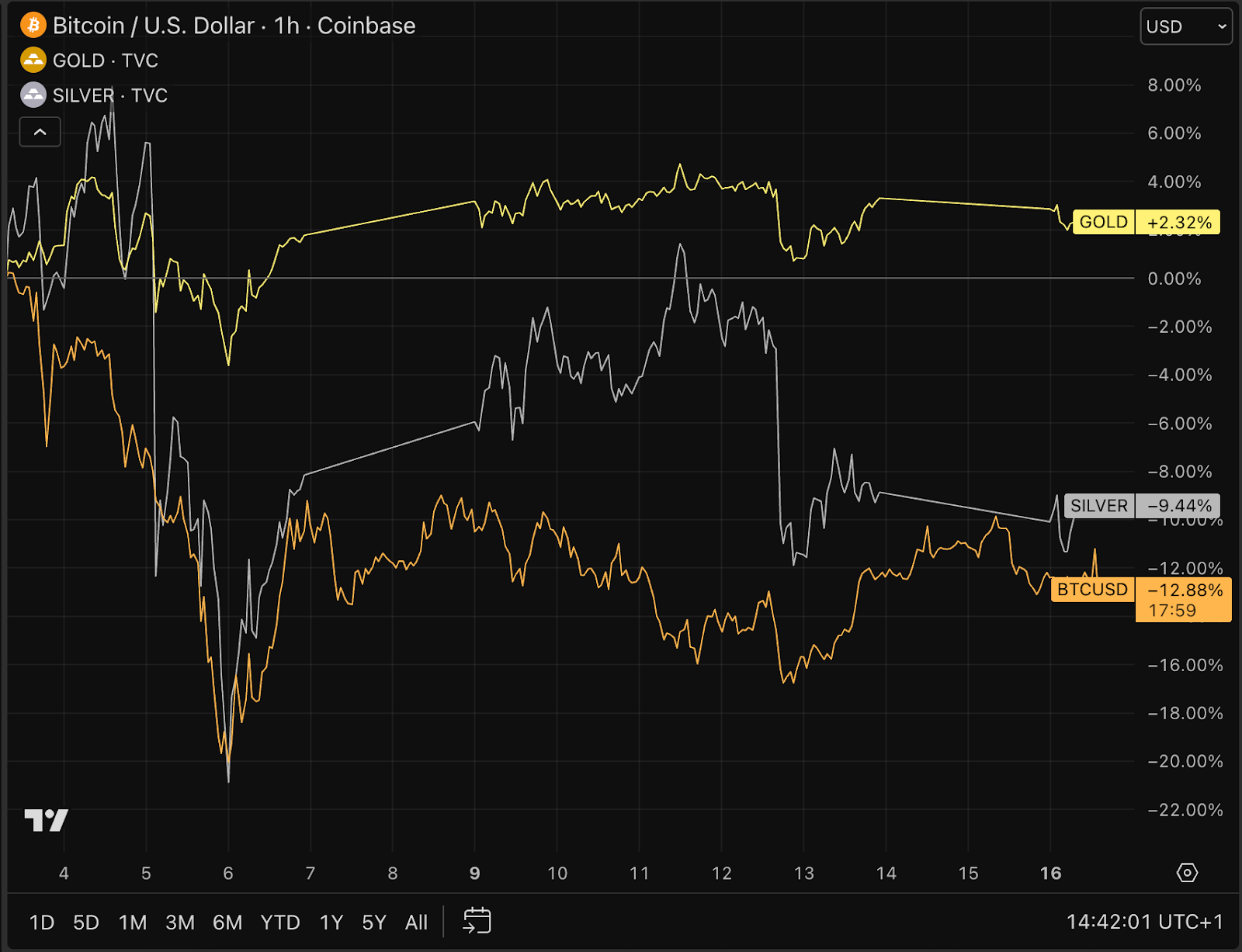
After the extreme returns of the past year, such a decline was in the air. Nevertheless, it is important for investors to look beyond short-term price movements. If you do that, you will see that gold is holding its own remarkably strongly against both silver and Bitcoin.
While Bitcoin reached a provisional bottom below $60,000 in early February and silver was also struggling, gold managed to stabilize and show its muscle.
Gold follows the growth of the money supply
Jurrien Timmer also noticed the relative strength of gold. He is Director of Global Macro at Fidelity Investments, a company that manages nearly $6 trillion in assets. According to Timmer, we should read something important about gold in this price action. Namely, that the precious metal is still an important asset that can protect against monetary inflation.
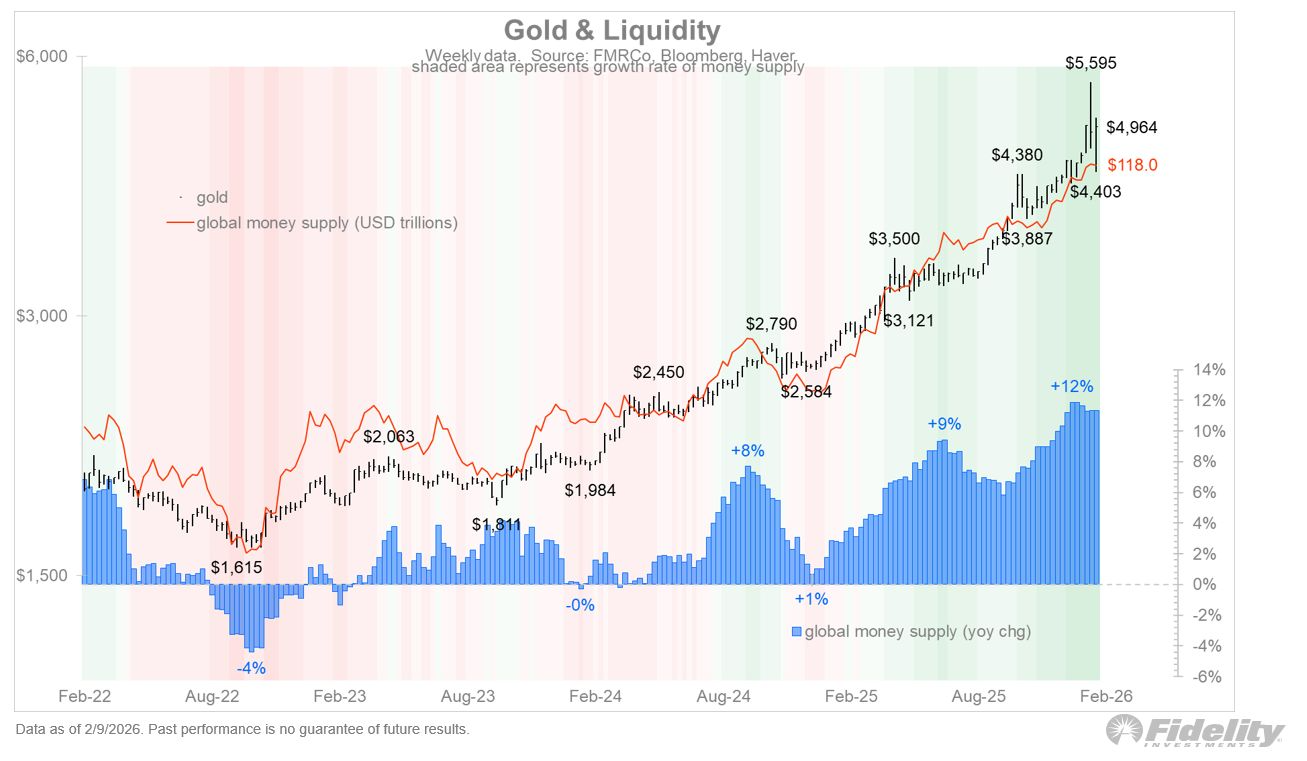
In this graph by Timmer, we see that the gold price supports the global money supply measured in US dollars (orange line).
“Although gold lost $1,200 per ounce in value in two weeks, it maintained the trend line as support and continues to fluctuate around the ever-growing global money supply. The upward trend seems intact and is now also refreshed after the margin calls,” says Timmer.
By “the margin calls”, he means washing out excessive speculation. If the price of a financial asset rises rapidly, more and more people with borrowed capital will speculate on further increases. However, as soon as the price falls, those positions run into problems and those people receive a margin call: “You have to add capital to your account now, otherwise we will be forced to close your position.”
That happened en masse during the roughly $1,200 crash that we saw at the end of January. Now, the gold price has already recovered somewhat and most speculators have disappeared from the market, allowing the price to continue “on a clean slate”. And according to Jurrien Timmer, in this case, continuing the upward trend means resuming.
Separating hype and foundation
The last part of the increase in the gold price could be seen as pure hype and speculation. Due to the increases in recent years, private individuals began to become increasingly enthusiastic, and for fear of completely missing out, many people jumped into the market at the last minute.
Then you sometimes get explosive increases that have little to do with the original reason for the price rises. When the inevitable crash comes and the hype is over for a while, you have to see what is still standing after the clouds of dust have descended.
In the case of gold, there still seems to be a solid foundation for further price rises. Jurrien Timmer already notes that gold at least still responds to the growth of the global money supply, and thus continues to fulfill its role as protector against inflation.
In addition, there is still an increased level of geopolitical unrest. This makes gold more attractive for two reasons:
- We don't know what tomorrow's world will look like. It is quite possible that China will emerge as a leader on the global geopolitical stage in the coming decades.
- This uncertainty means that it is more difficult for investors to decide which stock markets to invest in. That is exactly what makes an investment in gold more attractive, because the precious metal is politically and economically independent.
- The geopolitical uncertainty means that countries and continents are more self-sufficient. In Europe, for example, there are plans to invest much more in defense. This expenditure probably cannot be financed by austerity alone, which means that additional debt creation and thus inflation are looming.
The foundation for gold to also perform strongly in the coming decade therefore seems to be there. While real confirmation for the resumption of the upward trend is yet to come, the initial response from gold prices is at least promising. That's what it seems investing in gold Still a great idea even after the crash at the end of January. Especially if you do it for the long term.
After a sharp pullback, gold is proving its resilience, while Bitcoin and silver are losing ground. Read why experts see opportunities for a new upward phase right now.

Thom Derks writes for GoldRepublic on gold, macro-economics and geopolitics. He studied Law in Leiden and Economics in Amsterdam. His personal fascination with scarcity and store of value through both bitcoin and gold brought him into the world of financial journalism. Through his own newsletter De Geldpers on Substack, he reaches over 5,800 subscribers with analyses on markets, geopolitics and the monetary system.