Are we about to discover gold's real price?
A few weeks ago, I watched an interesting episode of The Jay Martin Show, titled The Day China Reveals Gold's Real Price. In it, Martin defends a provocative claim. According to him, China is on the verge of walking away from the Western paper gold market, and as a result, gold's "real" price will eventually become visible.
Whether he turns out to be right, I don't know. I don't have a crystal ball. But honestly, I don't think that's the most important question. Far more interesting is why China is taking this step right now. The beauty of it is that you don't need to listen to what China says to find the answer. Simply look at what China actually does.
What China does, not what China says
Several of China's largest banks have stopped trading paper gold for retail investors. Notably, this doesn't apply to physical gold. Chinese citizens can still buy as much gold as they want. It's only the paper contracts that are slowly disappearing from view. That might seem like a minor detail, but it goes to the heart of how the world has determined the gold price for decades.
The lesson of 1968
To understand why, we first need to go back to 1968. After the Second World War, the US dollar had become the world's reserve currency. Foreign governments could exchange their dollars for gold at any time, at a fixed price of $35 an ounce. As long as everyone trusted that the United States held enough gold, that system worked perfectly well.
But money doesn't come from nowhere. In the 1950s and 1960s, America structurally spent more than it earned. Wars, social programmes, and its role as a world power were increasingly financed with newly created dollars, while the amount of gold barely changed. Eventually, a few countries did some simple arithmetic. If there are more and more dollars set against the same amount of gold, each dollar automatically represents less gold.
France began exchanging dollars for physical gold. Other countries followed. What started as a steady outflow ended in a full-blown run on the American gold reserve. The London Gold Pool collapsed, the London gold market had to close temporarily, and a few years later the link between the dollar and gold disappeared for good.
The lesson of 1968 is actually very simple. You can defend the price of money or gold for years, but in the end, scarcity always beats promises.
What you're buying when you buy paper gold
That history also makes clear why developments in China are interesting. When most investors buy gold today, they aren't actually buying gold at all. They're buying a contract that entitles them to gold. That contract can change hands dozens of times without a single gold bar ever being moved. As long as virtually nobody asks for physical delivery, that system works fine.
But it also has an important consequence. The price isn't determined solely by the amount of gold available, but also by the number of paper claims issued against that gold. Nobody knows exactly how many of those claims exist for every physical ounce. In other words: the world's most important gold price is set in a market that doesn't even know precisely how much of the underlying product is actually available. That's remarkable, to say the least.
The difference between paper claims and physical ownership is therefore not a technical detail, but the heart of the matter.
China is building for physical delivery
China appears to have less and less confidence in that system. The country discourages paper gold contracts, while the Shanghai Gold Exchange is set up entirely for physical delivery. At the same time, storage capacity in Hong Kong is being significantly expanded. A paper market doesn't need enormous vaults. You only build those when you expect that large quantities of physical gold will genuinely be stored and traded.
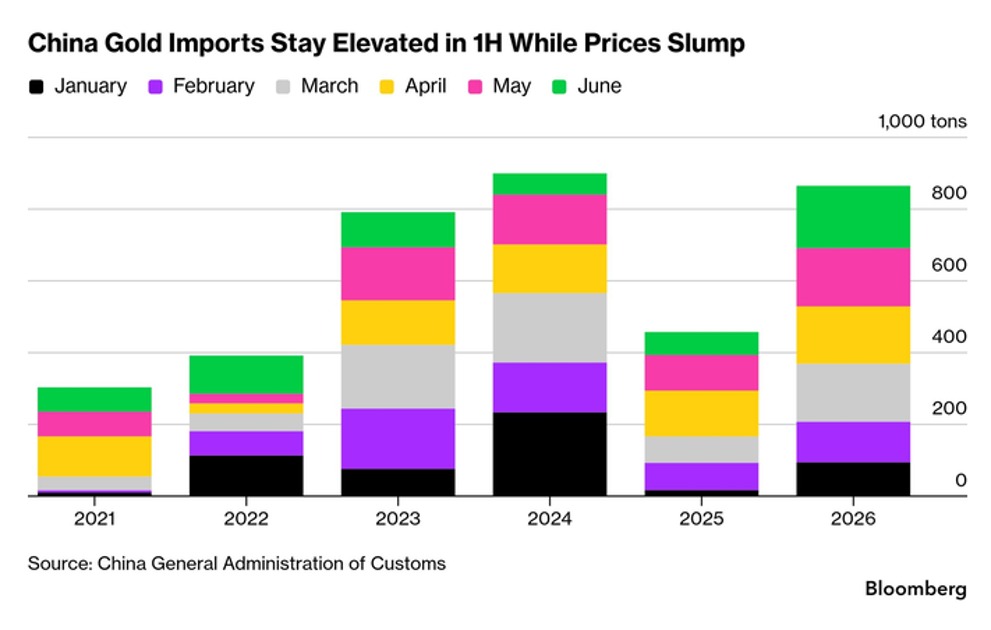
Anyone wondering what lies behind this strategy will find much of the answer in the country's monetary situation. We wrote about this at length previously in why China buys so much gold.
Central banks buy what they advise against
Perhaps even more interesting is the behaviour of central banks. For years, we've been told that gold pays no interest, generates no cash flows, and therefore has barely any role to play within a modern monetary system. Meanwhile, central banks have been buying record amounts of physical gold for years. A large share of those purchases isn't even officially reported. At the same time, more and more countries are reducing their dependence on US government bonds.
Here too, the rule applies: don't listen to what central banks say. Look at what they do.
Gold isn't a commodity, it's money
That's precisely why I don't see gold as a commodity, but as money — as real value. Ultimately, investing isn't only about returns. It's about purchasing power. In dollars, houses, cars, and groceries seem to keep getting more expensive. Measured in gold, many of those same goods have actually become cheaper over recent decades. Ultimately, that says far more about the purchasing power of paper money than about the value of gold.
What holds true regardless of the outcome
Does this mean Jay Martin will be proved right and that the paper and physical gold prices will diverge? Nobody knows. But even if that never happens, one observation still stands. The institutions that understand our monetary system best are exchanging paper promises for a scarce asset that nobody can print more of, at record speed.
Perhaps that's the most important development of all. Not because gold suddenly needs to be worth much more tomorrow, but because the people responsible for our monetary system are increasingly opting for a form of money whose supply cannot be expanded without limit.
China is stepping away from paper gold in favour of physical delivery. Discover why this could reveal gold's real price and what central banks are doing.

Jeroen Blokland has over 20 years of experience as a professional investor and was formerly Head of Multi-Asset at Robeco, where he was responsible for a client portfolio of over five billion euros. After leaving Robeco he founded True Insights, an independent investment research platform, and has since built a following as a columnist, YouTuber and sought-after speaker. With over 100,000 followers on X, he is one of the most prominent voices in Dutch finance. For GoldRepublic he writes on macro-economics, markets and the role of gold in a diversified portfolio.

.jpg.jpg)