

Why one rate hike doesn't change the gold story
This week, financial markets focused on the much-anticipated interest rate decision from the US central bank. In the end, the Federal Reserve's rate-setting committee unanimously decided on a rate hike. As a result, we're seeing a slightly stronger dollar in the short term, while gold and silver faced some headwinds.
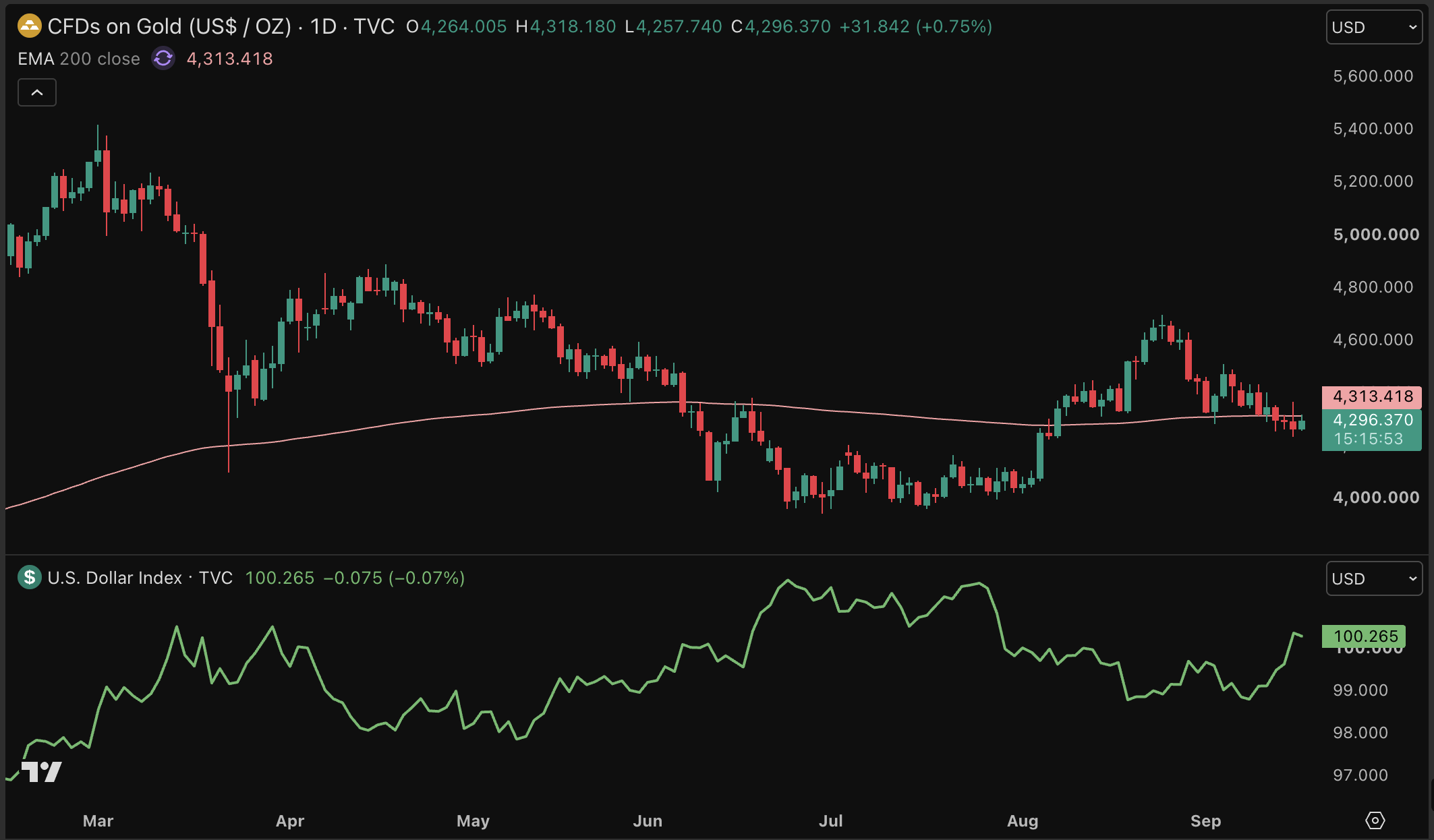
Gold price falls, while the dollar index (DXY) climbs above 100 points after the rate decision. Source: TradingView
Although the decision to raise rates is of course relevant for gold, silver and platinum, a much bigger and more fundamental shift is taking place beneath the surface. A shift that yesterday's rate hike does little to change. A shift that strengthens the case for investing in gold.
From an abundance of capital to a scarcity of capital
Since the great financial crisis of 2008, almost all the major forces in the financial world have been pulling in the same direction.
- Central banks bought government bonds to push down interest rates
- Companies financed themselves cheaply, and tech giants used their enormous income to buy back their own shares
Capital was abundantly available, while demand for capital was relatively low. That resulted in a climate in which extremely low, and sometimes even negative, interest rates were possible. That is now starting to reverse.
- Governments need to borrow ever more capital to close budget deficits
- Central banks are barely active any more as buyers of government bonds
- And companies' financing needs are rising because of the AI revolution
Among tech giants in particular, we're seeing a shift away from buying back their own shares and toward investment in data centers and everything related to AI. So we're now in a phase where more parties are chasing capital.
That is probably the main explanation for the worldwide rise in long-term interest rates at the moment.
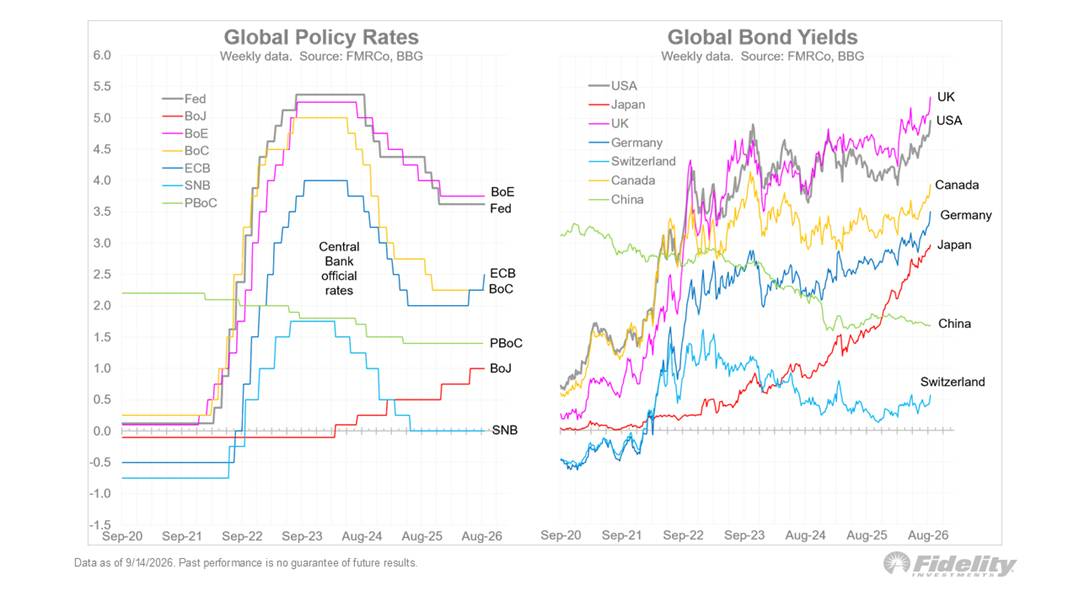
Long-term interest rates are rising worldwide, except in China. Source: Fidelity/LinkedIn
Governments are already stepping in to control interest rates
But that immediately creates an important problem, one that could turn out positive for gold and other assets that protect against inflation. Governments simply cannot keep paying ever-higher interest rates on their government debt indefinitely. At some point they will have to step in and try to artificially lower rates, in order to ease the debt burden.
In recent weeks, we've already seen that reflected in the actions of Scott Bessent, the US Treasury Secretary. He announced an accelerated buyback of long-term government bonds and intervened in the currency market to support the weakening Japanese yen.
Both of those are actions aimed at stopping the rise in long-term US bond yields. In various ways, the US government is therefore already trying to control interest rates.
Financial repression as a stealthy policy tool
Zooming out further, financial repression is likely becoming an increasingly attractive policy route. In theory, governments could also address their debt problems with higher taxes, sharp spending cuts, or very strong economic growth. In practice, those solutions are often politically and economically painful.
Financial repression can happen much more subtly. Central banks don't need to reach for the money printer en masse tomorrow to achieve it.
One likely option is that regulation is loosened to make it more attractive for banks and other large financial institutions to hold government bonds.
That could happen, for example, by adjusting capital or leverage requirements. Banks would then have more room on their balance sheets to hold or trade government bonds. The government wouldn't need to buy up government debt directly itself to create extra demand.
More structural demand for government bonds means, all else being equal, higher bond prices and lower interest rates.
Furthermore, over time central banks could deliberately keep the policy rate below inflation, start buying government bonds again, or otherwise prevent real interest rates from staying high for long.
That's precisely where things get interesting for gold. Suppose inflation is 4 percent, while the yield on government bonds is kept around 3 percent. A bond investor then does receive interest, but loses around 1 percent a year in purchasing power terms.
The nominal interest rate is positive. The real interest rate is negative. For governments, that can be attractive. After all, inflation helps to gradually erode the real value of existing debt. For savers and bondholders, it's a different story. They lose purchasing power.
That creates an environment in which investors increasingly look for assets that don't depend on a government's creditworthiness or monetary policy. Gold and silver are classic examples of that.
What this means for gold and silver
This week's rate hike may create short-term headwinds for gold and silver, for example via a stronger dollar and higher short-term rates. But beneath that day-to-day movement lies a far more important story. A world in which capital is becoming scarcer, government debt is growing, and governments have ever more reasons to ultimately suppress real interest rates.
That is precisely what could strengthen the case for gold over the longer term. That's probably also why the gold price is still holding up fairly well in the short term, despite considerable macroeconomic headwinds.
The rate hike may weigh on gold in the short term. Rising government debt and potential pressure on real interest rates could support gold over the longer term.

Thom Derks writes for GoldRepublic on gold, macro-economics and geopolitics. He studied Law in Leiden and Economics in Amsterdam. His personal fascination with scarcity and store of value through both bitcoin and gold brought him into the world of financial journalism. Through his own newsletter De Geldpers on Substack, he reaches over 5,800 subscribers with analyses on markets, geopolitics and the monetary system.


.jpg.jpg)