

Gold stalls, but remains fundamentally strong
Gold and silver didn't quite manage to extend the positive momentum of recent weeks this week. That's no reason to start doubting the outlook again straight away, however. Over the past 30 days, both precious metals are still up by more than 12 percent.
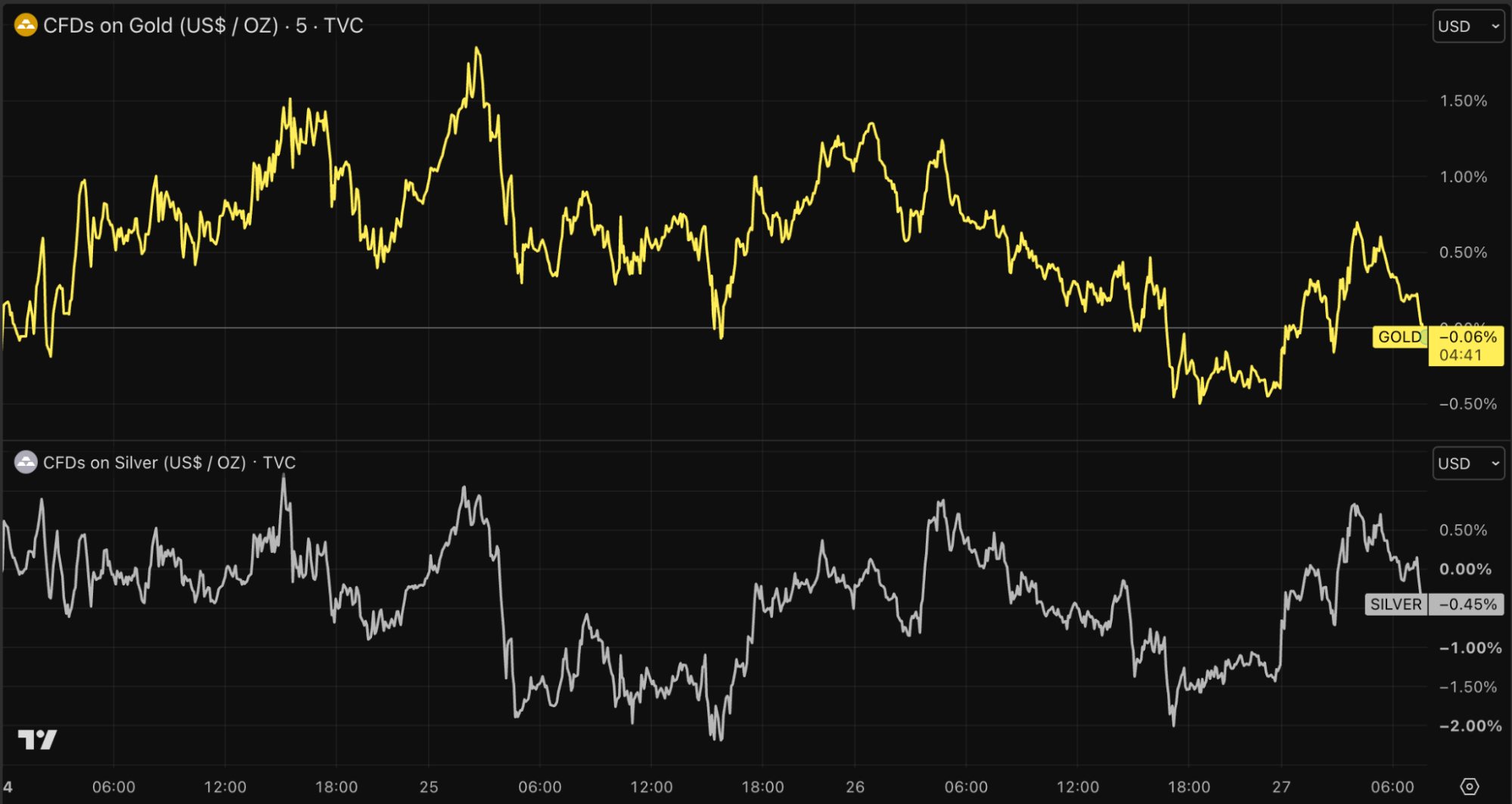
Wave movements are simply part of the rhythm of financial markets. No asset moves up or down in a straight line. Looking at the bigger picture, there is still, technically speaking — based on the charts, that is — a strong foundation for a new period of price gains.
A fundamental narrative for scarcity is returning
In addition, a fundamental narrative for investing in scarcity is starting to take shape again. Last week, after all, the US Treasury came out with a "this far and no further"-style message regarding the rise in long-term bond yields.
These yields are at their highest levels in around 20 years. Last week's actions made clear that the US government isn't entirely comfortable with this. These are, after all, the yields it has to pay on its $40 trillion national debt, but also the rates at which people have to take out mortgages and companies have to finance AI investments.
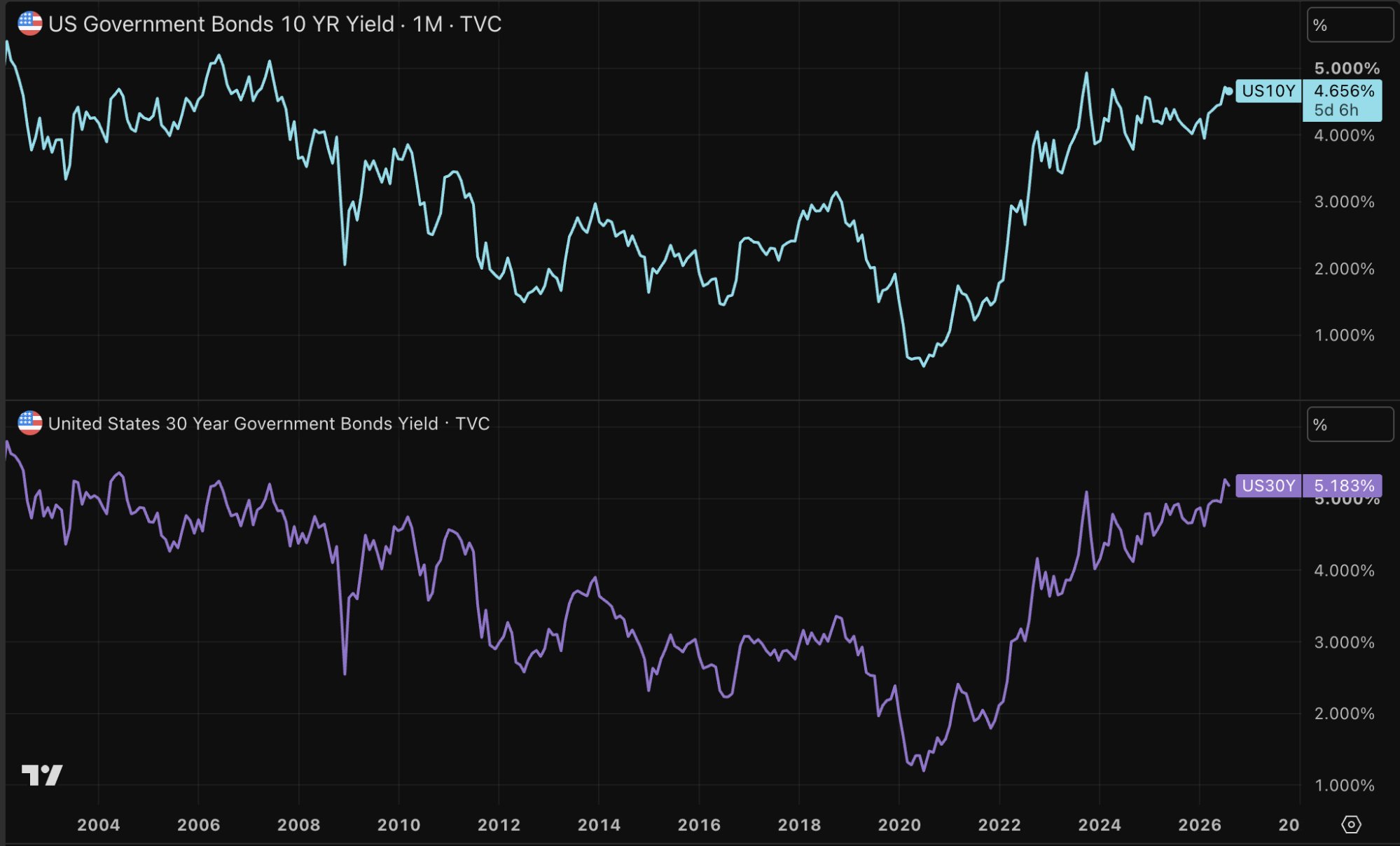
Essentially, the US government has two choices. It can leave yields entirely to the market, which will probably come at the expense of the economy and public finances. Or it can try to artificially push yields down, which comes at the expense of the US dollar.
All the actions we've seen so far suggest the US government has opted to sacrifice the dollar.
That means a narrative is cautiously re-emerging for assets that protect against inflation, such as gold and silver. This is only the beginning of a narrative, though, because we shouldn't overstate the steps taken so far. Long-term yields have only fallen slightly since last week.
Momentum is shifting from AI stocks to other assets
Even so, the conversation on Wall Street has turned back to the national debt and interest rates — a problem for which there is most likely no real solution, other than inflation. At the same time, we're seeing momentum in financial markets shift. Until recently, AI stocks were the fastest horses in the race. Now we're seeing other assets take the spotlight.
In the following chart, which runs from the start of July, we can see the chip index (SOXX) posted a negative return of almost 20 percent. Meanwhile, the rest of the stock market — represented here by the equal-weighted S&P 500 (RSP) — delivered a positive return of 4.23 percent. Investors haven't left equities entirely, then, but over the past two months they've opted for other sectors.
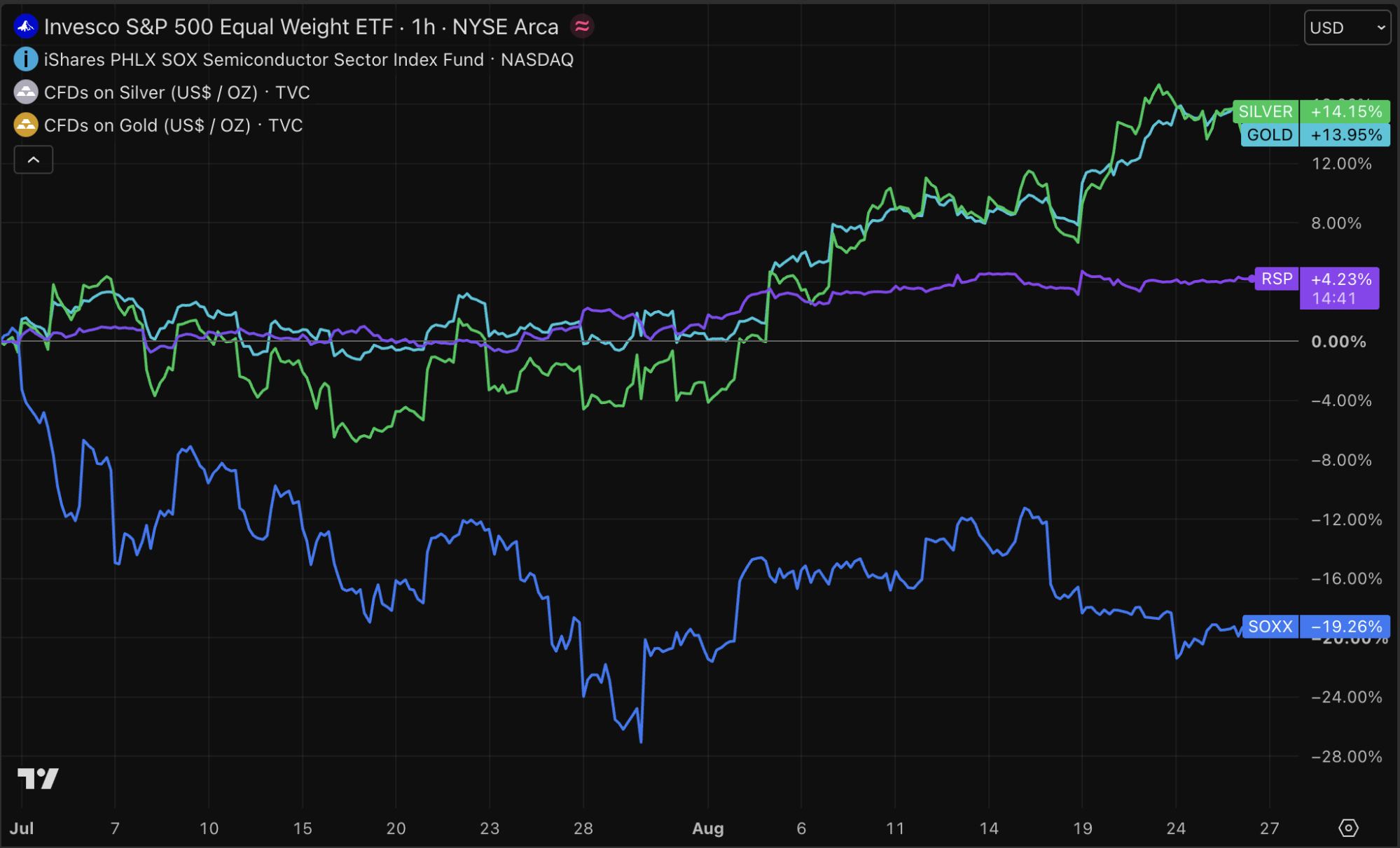
Over that same period, gold and silver performed even better than the equal-weighted S&P 500. Equal-weighted, incidentally, means every stock in the index receives the same weighting. A regular S&P 500 fund often uses a weighting based on market capitalization, in which large companies such as Nvidia and Microsoft therefore carry more weight.
Based on this price action, we can say that investors are less keen on AI stocks than they were a few months ago. That creates room for precious metals to build momentum again. Combined with the doubts surrounding US bond yields and the national debt, that makes for an interesting situation.
Earnings growth nears its peak, but Nvidia surprises
The doubts about AI stocks don't come out of nowhere. It also appears that the acceleration in earnings growth among listed companies is nearing its peak. Growth in earnings expectations has fallen from 35 percent to 33 percent, while expectations for Q3 and Q4 point to an even slower pace of growth.
In the chart from Jurrien Timmer, head of the macro department at trillion-dollar fund Fidelity, we can see this stalling acceleration in earnings growth reflected in the green bars.
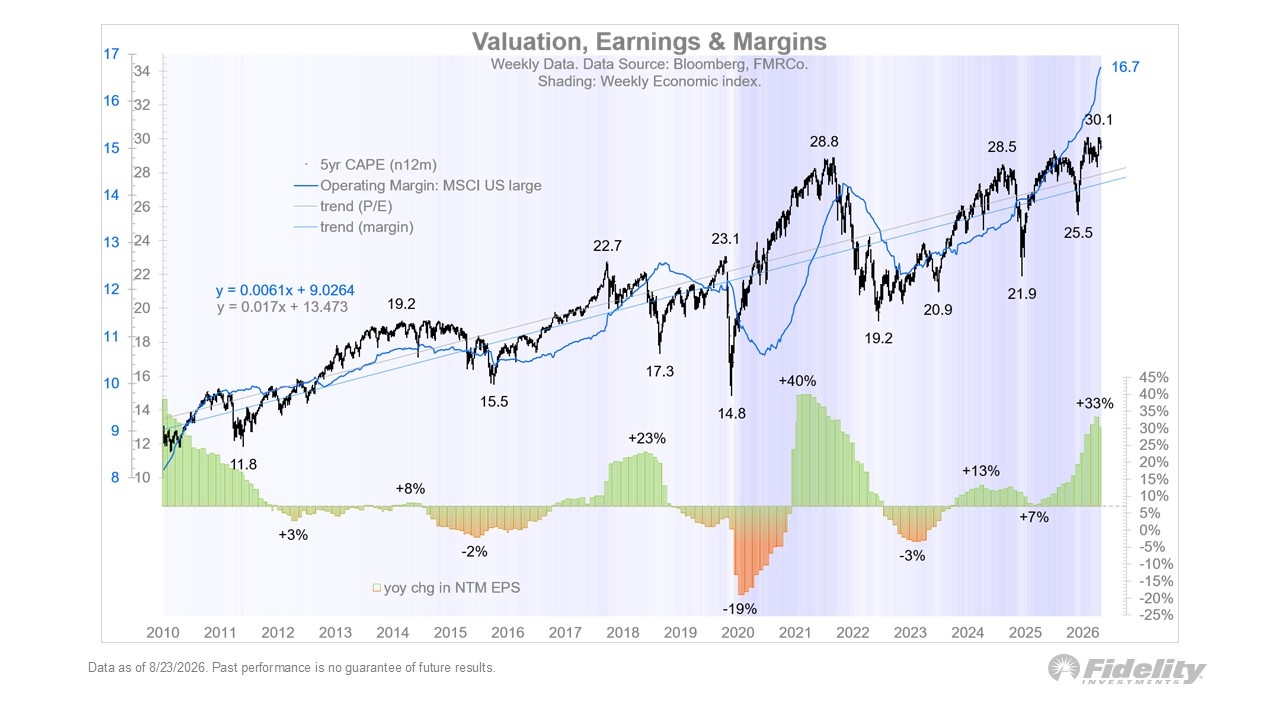
Although these figures are certainly not weak — quite the opposite, in fact — these are signals that the most extreme growth is behind us. For now, at least. That creates room for other assets to pick up momentum, and gold and silver could in theory benefit from that.
Nvidia also confirmed once again last night that the AI bull market is certainly not over yet, and that it's still too early to draw definitive conclusions. It was particularly the expected revenue growth of 70 percent for 2028 that stood out, coming in far above the 44 percent analysts had been counting on.
Nvidia beat expectations on virtually every measure, which sent the stock up more than 4 percent after the closing bell. Over the coming weeks, it will be interesting to see whether this gives the AI bull market fresh fuel, and to what extent that affects the renewed advance of precious metals.
For now, attention turns to the US central bank's Jackson Hole symposium, where chair Kevin Warsh takes to the podium on Friday. This is an event to which virtually every central banker in the world is invited, and where the US central bank often shares important information.
The hope for this year is that Warsh will reveal something of the US central bank's reaction function — that is, the way it will respond with rate hikes or cuts in various scenarios.
Gold and silver couldn't hold their momentum, yet are still up over 12% in 30 days. Why the investment climate remains supportive.

Thom Derks writes for GoldRepublic on gold, macro-economics and geopolitics. He studied Law in Leiden and Economics in Amsterdam. His personal fascination with scarcity and store of value through both bitcoin and gold brought him into the world of financial journalism. Through his own newsletter De Geldpers on Substack, he reaches over 5,800 subscribers with analyses on markets, geopolitics and the monetary system.