

The gold price is climbing again and this is why
The gold price is holding up remarkably well. Last week, gold suddenly began a small correction, but by now the price is back at $4,400 an ounce. The fact that we're seeing gold rise cautiously again from the $4,000-per-ounce level is notable, because yields on long-dated US government bonds remain at historically high levels.
Normally, that would represent a clear headwind for gold. After all, investors receive no interest on the precious metal, which makes government bonds more attractive as soon as their yields rise.
For several reasons, gold now appears to be shrugging that off:
- The economic data of recent weeks — a weaker labor market, lower consumer spending and cooler inflation figures — mean the likelihood of rate hikes by the US central bank has decreased.
- The US dollar is weakening because the market expects a less strict stance from the central bank.
- Gold ETFs are slowly but surely starting to generate capital inflows again.
Odds of a rate hike have fallen sharply
We're seeing a major shift in expectations around the US central bank's interest rate policy. In recent weeks, several US macro figures came in weaker than expected. The labor market cooled, the consumer is becoming more cautious, and inflation came in better than feared.
In July, for example, US retail sales fell by 0.6 percent. That was the first decline in nine months. At the same time, consumer confidence weakened. For the US central bank, those are reasons to be somewhat more cautious about any rate hikes.
For gold, that's a positive signal. Higher policy rates at central banks normally increase the appeal of interest-bearing government bonds, which gold and other precious metals compete with almost directly.
A weaker dollar gives gold extra support
In line with the declining odds of a rate hike by the US central bank, we also saw the dollar fall. For a long time, the US dollar was actually strengthening in 2026, but now the world's reserve currency appears to be cautiously losing steam. That, too, is favorable for gold.
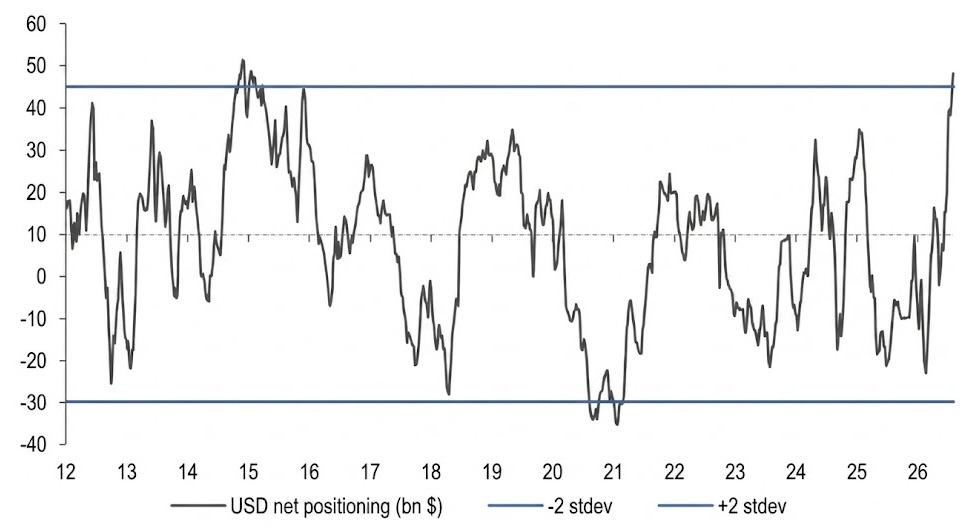
What's interesting is that we're seeing this weakness in the US dollar at a moment when positioning among professional investors is actually extremely optimistic. The chart above from Eliant Capital shows that positioning hasn't been this optimistic since 2015.
Typically, extremely positive positioning is also a signal for assets that a reversal is in the air. In this case, that appears to be happening, now that the US dollar is slowly beginning to lose momentum.
High bond yields remain the odd one out
There is, however, one striking exception in the wider story, namely the US bond market. Long-term yields remain exceptionally high, despite the weaker economic figures and diminishing expectations of rate hikes.
That probably has to do with the following circumstances or factors:
- The Iran war is still keeping oil prices relatively high. As a result, inflation could take off again over time.
- The enormous demand for capital via AI investments is pushing yields further up.
- Concerns about US government debt are flaring up again, partly because of the higher rates.
That's precisely where an interesting tension arises for gold. When bond yields rise because the economy is growing strongly, that's usually negative for gold. But when those same yields rise because of doubt and fear, that can actually create additional demand for gold.
Western investors are returning to gold
Another positive development is that demand for gold via ETFs is picking up again. Global gold ETFs saw roughly $3 billion of new capital flow in in July, equivalent to around 23 tons of gold. That brought an end to two months of outflows.
Interest is increasing on the futures market as well. That's important, because in recent years the gold market has been strongly supported by central banks and physical buyers from Asia. Now Western financial investors are starting to get more actively involved again too.
Meanwhile, demand from central banks remains solid. In the second quarter, they bought an estimated 289 tons of gold. That structural demand may partly explain why gold is managing to hold up so well despite high interest rates.
More and more investors are adopting the precious metal in their portfolio as a means of building diversification. The stock market is increasingly moving on a single theme, namely artificial intelligence, and buying gold is in theory a way of providing a counterweight to that.
The gold price has stabilised and is cautiously recovering towards $4,400. Why is gold rising now, despite historically high bond yields?

Thom Derks writes for GoldRepublic on gold, macro-economics and geopolitics. He studied Law in Leiden and Economics in Amsterdam. His personal fascination with scarcity and store of value through both bitcoin and gold brought him into the world of financial journalism. Through his own newsletter De Geldpers on Substack, he reaches over 5,800 subscribers with analyses on markets, geopolitics and the monetary system.