

Can gold prices escape technical no-man's-land?
Since its peak of around $5,600 per ounce in January, the price of gold has fallen by almost 30 percent. At the current price of $4,169, gold finds itself in technical no-man's-land.
On one hand, the price is still trading below the important 200-day moving average of $4,487. This shows that the recovery is not yet convincing. On the other hand, gold has climbed back above the 0.382 Fibonacci level, measured from the 2022 low to the 2026 peak.
Even so, constructive signals are starting to stack up for gold. There is clearly strong support for the precious metal between $3,900 and $4,100 per ounce.
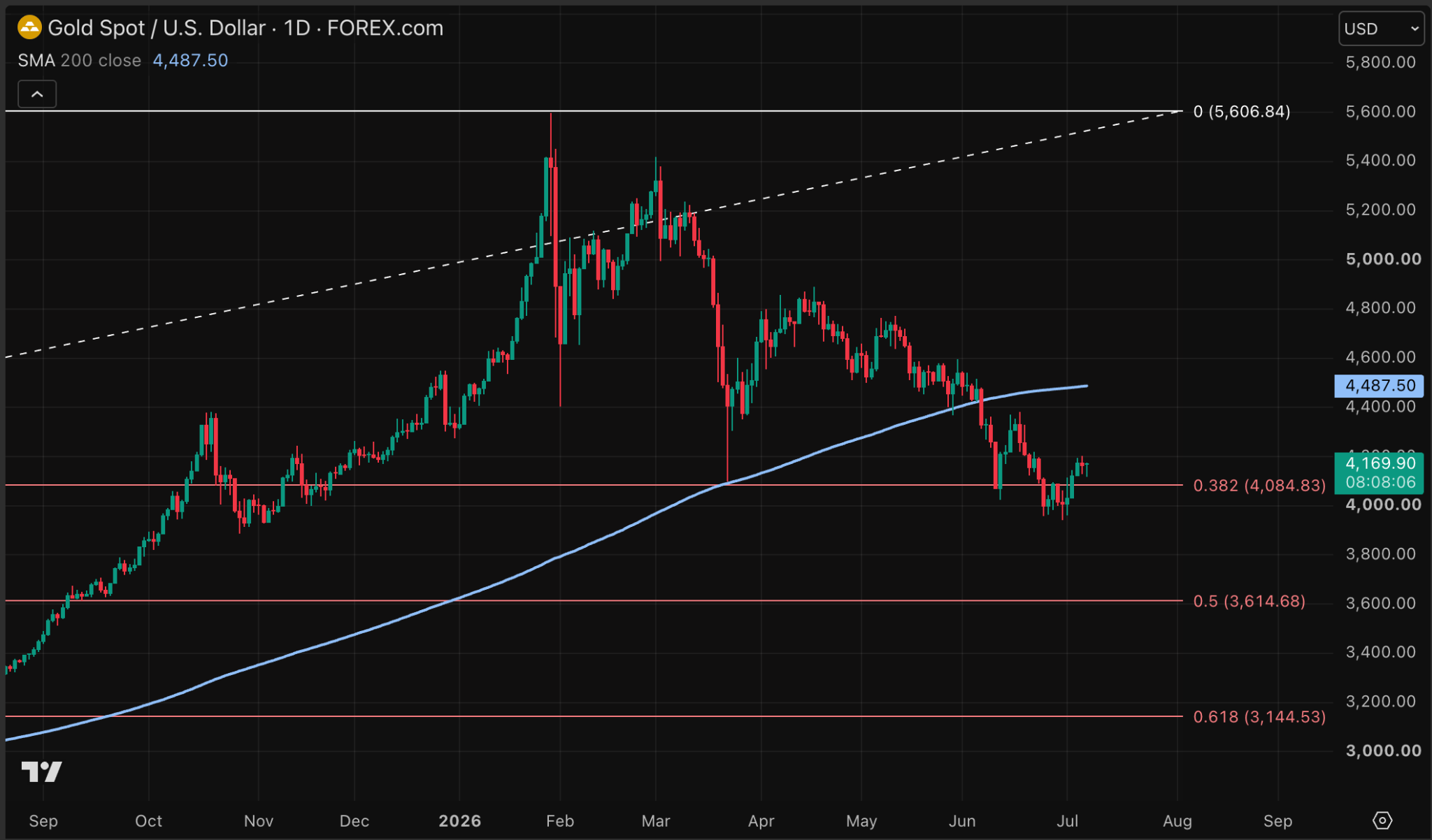
At the same time, a bullish divergence is forming on gold's daily chart. This occurs when the price makes a lower low while the RSI registers a higher low. Because the RSI is a momentum indicator, this suggests the most recent decline occurred with less force.
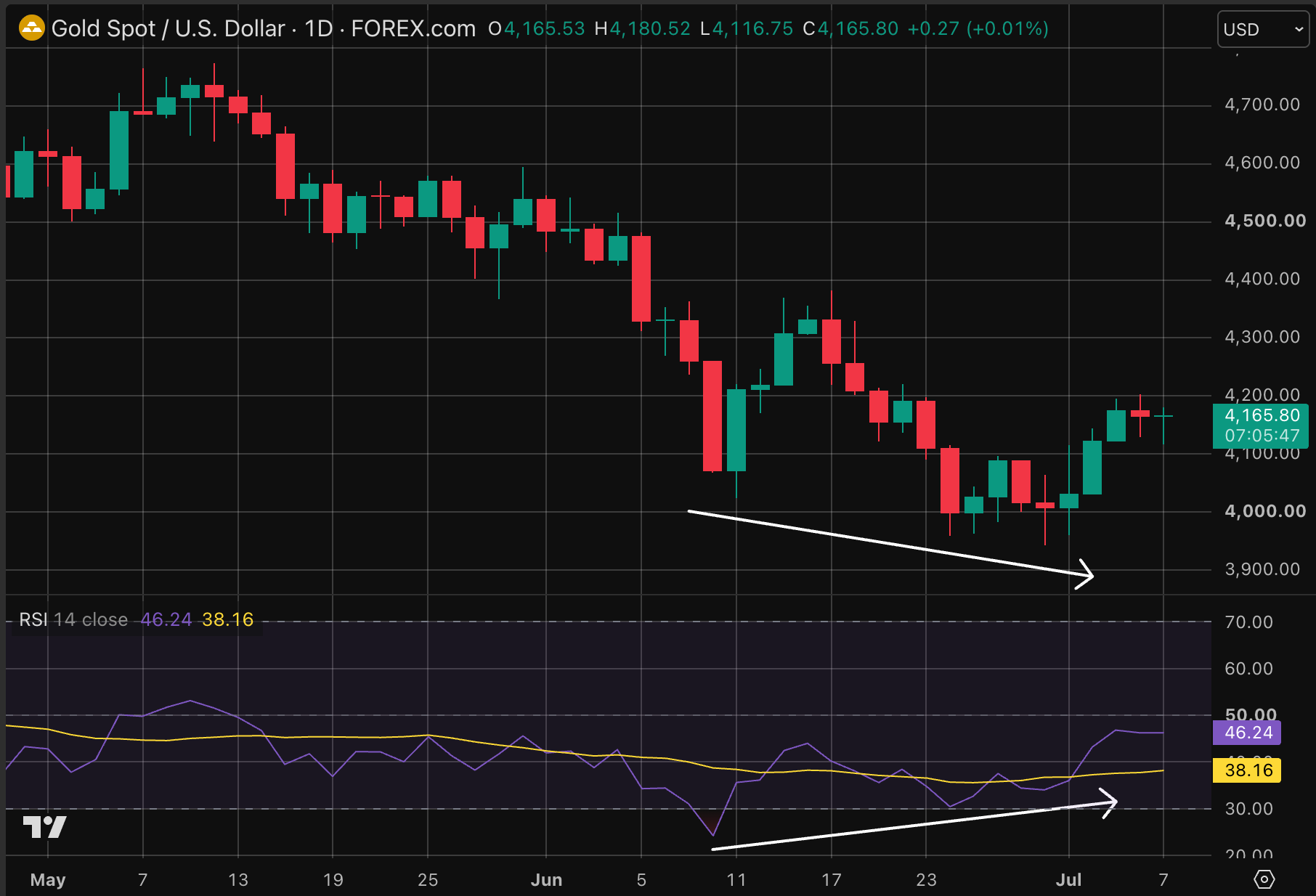
For gold, this means the lower price low was not confirmed by stronger downward momentum. Selling pressure therefore appears to be easing, even though prices remain under pressure. This is no guarantee of a bottom, but it is a constructive signal.
Combined with the recent recovery above the 0.382 Fibonacci level, this makes the technical picture somewhat more positive. However, as long as gold remains below the 200-day moving average, it's still too early to call a convincing trend reversal.
Technical recovery gains fundamental support
The constructive technical signals are currently also getting support from the fundamental side. Starting Wednesday, July 1, gold prices began a cautious recovery. That move followed remarks by Kevin Warsh, the new chair of the US Federal Reserve, at a European Central Bank gathering in Sintra, Portugal.
There, Warsh spoke positively about the decline in inflation expectations since the rate decision of June 17. That decision had been interpreted by the market as relatively hawkish. Initially, this led to higher rate expectations, a stronger US dollar, and pressure on gold prices.
In Sintra, however, Warsh emphasized that inflation expectations have cooled since that point. As a result, the market immediately priced in slightly fewer rate hikes for 2026. That was positive for gold, since lower rate expectations typically ease pressure on non-yielding assets.
A day later, this picture got additional support from the labor market. US job growth came in lower than expected, while the pace of wage growth also gave no clear reason to worry about renewed inflationary pressure.
Together, this created a more favorable environment for gold. The technical bottoming signals are therefore being supported by a macro picture in which rate expectations are cooling somewhat, the US dollar looks less powerful, and pressure from the labor market appears to be easing.
Momentum arrives at the right time for gold
Momentum plays a major role in financial markets. Investors often gravitate toward assets that are already rising strongly, especially once the move becomes visible to the broader market. That's only human. It feels unnatural to buy into a downtrend, while it's far easier to step into assets setting record after record.
This is exactly why markets regularly go through phases in which capital becomes increasingly concentrated in that moment's winners. Such a move can persist for a long time, but it becomes more vulnerable as expectations climb further and valuations leave less and less room for disappointment.
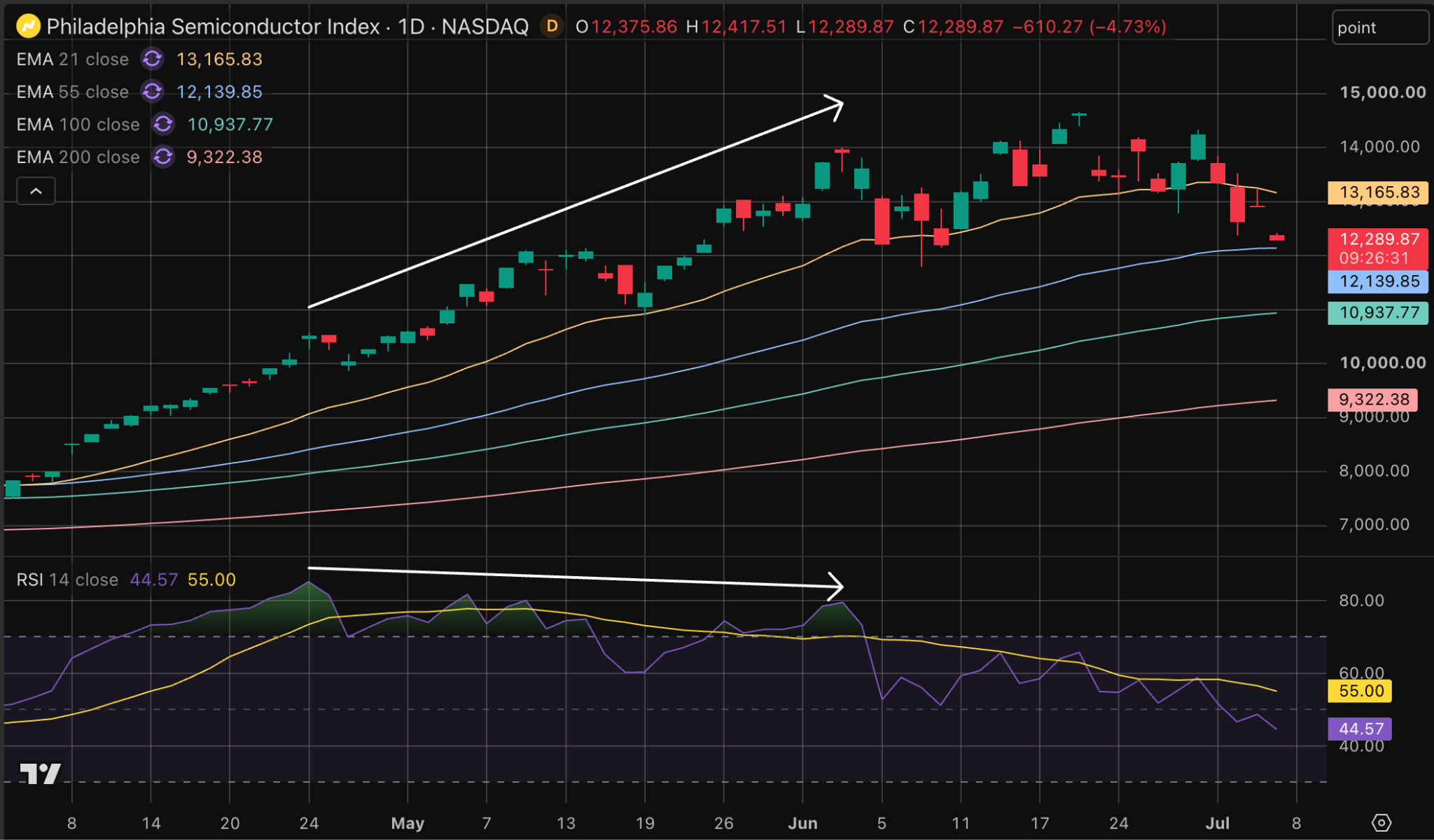
That dynamic now appears visible within the AI complex. The chip index (SOX) has lost more than 16 percent from its recent all-time high, while a bearish divergence is visible on the daily chart. This is, in effect, the mirror image of the bullish divergence currently forming in gold.
The price set a higher high for the chip index, while the RSI registered a lower peak. Reaching the interim all-time high came with less momentum. This suggests the AI trade is currently losing some steam.
For the SOX index, the price set yet another higher high, while the RSI registered a lower peak. In other words, the new record came with weaker momentum. This indicates that the AI trade is losing some steam in the short term.
Major names within the chip and memory sector, such as Samsung Electronics, SK Hynix, Micron, and ASML, have also performed less strongly in recent weeks. This doesn't mean the AI story is over, but it does suggest the market may be due for a breather.
This could be interesting for gold. If investors come to believe that AI stocks have temporarily run too far, capital may seek out alternatives that have lagged behind. In that scenario, gold gets room to pick up some of the momentum, especially now that the technical signals are also improving cautiously.
In theory, this could therefore be an interesting moment to cautiously start investing in gold again.
Gold is showing bullish signals as rate expectations ease. Is this the start of a technical trend reversal for gold prices?

Thom Derks writes for GoldRepublic on gold, macro-economics and geopolitics. He studied Law in Leiden and Economics in Amsterdam. His personal fascination with scarcity and store of value through both bitcoin and gold brought him into the world of financial journalism. Through his own newsletter De Geldpers on Substack, he reaches over 5,800 subscribers with analyses on markets, geopolitics and the monetary system.