Trade veteran: 75% chance that gold will reach a multi-year bottom this week
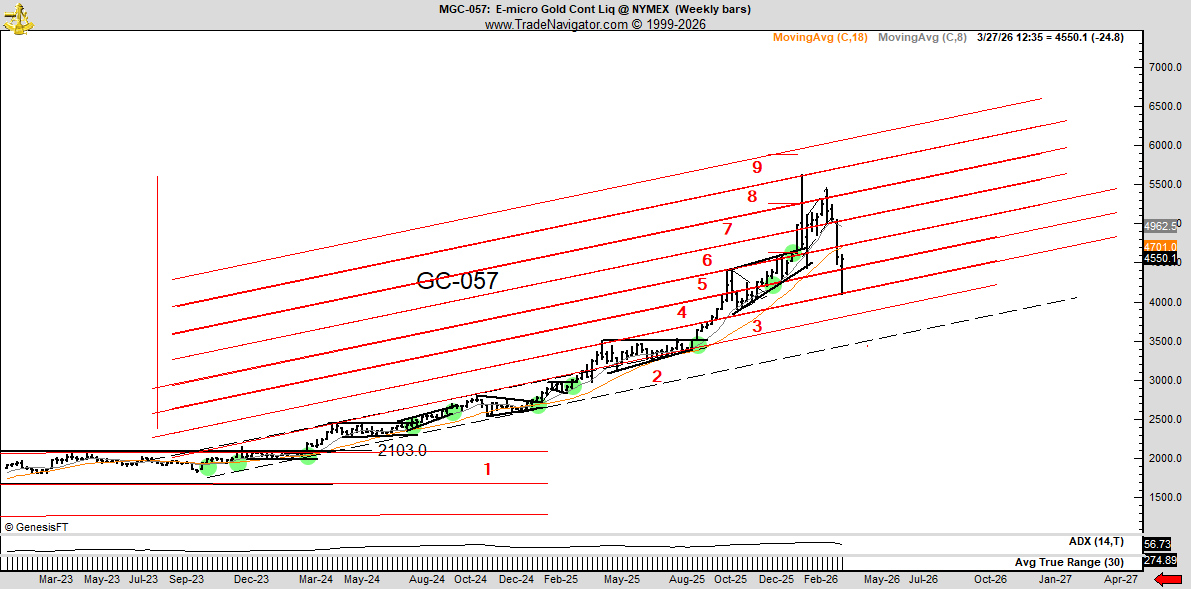
The gold price started 2026 with conviction and quickly rose to an impressive all-time high. From the end of January, however, a period of weakness, gold lost momentum and we saw the price fall sharply. According to trade veteran Peter Brandt, a technical analysis expert, there is a good chance that the gold price will reach a bottom this week.
Not just any soil, but a perennial soil. In other words, he expects with 75 percent certainty that gold will not fall below this week's price in the coming years.
Are central banks now a headwind for gold?
Although Peter Brandt thus outlines a relatively optimistic scenario for gold, the price has been under considerable pressure in recent weeks. The headwind for gold is not just the result of rising oil prices, the stronger US dollar and higher real interest rates. The behavior of central banks also seems to play a role.
Currently, the Turkish central bank is the main confirmed seller of gold. Reuters managed to reported that the Turkish central bank saw its gold reserves fall by almost 50 tons in one week. This marks the biggest decline since 2018.
Those sales would be a response to the financial stress surrounding the Iran war and the pressure on the lira. In addition, after the huge price increases, it was of course also a favorable time to sell for a central bank that has been accumulating for years.
This is important, because Turkey has actually been a regular buyer of gold in recent years. The World Gold Council wrote at the end of January that the Turkish central bank remained a steady buyer in 2025 and, based on data, had added 27 tons until the end of October. That makes the recent turn all the more relevant: a party that provided structural demand for years has now temporarily become a source of supply.
For Russia, the picture is more complicated, although analysts suspect that they too are currently sellers of gold. They are probably doing this to finance the war with Ukraine, which, according to the latest stories, is also starting to weigh considerably on the budget.
Although there is no recent data, Reuters previously knew telling that the Russian central bank had sold foreign currencies and gold on a net basis in 2025 on behalf of the sovereign fund NWF.
Nevertheless, central bank sales appear to be absorbed by Asian buyers. Additionally wrote Reuters in January that analysts expect central banks in emerging markets to continue buying an average of around 60 tons of gold per month this year, while retail demand in Asia has also remained strong.
This is in line with the view that countries such as China and India are using weakness to remain active on the buying side.
Vulnerable in the short term, solid in the long term
The sum is therefore as follows. In the short term, gold is vulnerable, especially as confirmed official sales from Turkey coincide with a stronger dollar and stress in energy and foreign exchange markets. As long as energy flows through the Strait of Hormuz do not stabilize, there is a good chance that countries will defend their currencies, need dollars and therefore gold will perform less well.
Despite that, the long-term picture remains solid for gold. Meanwhile, the price has fallen considerably from the all-time high. From that perspective alone, it is becoming more likely that the price of gold is at or around the bottom.
We are also seeing more positive resistance around current price levels. That means: sellers have more trouble pushing the price down even further.
The graph below shows that nicely. Gold seems to be gaining real support between the 200-day price average (blue) and the 200-day exponential price average (red).
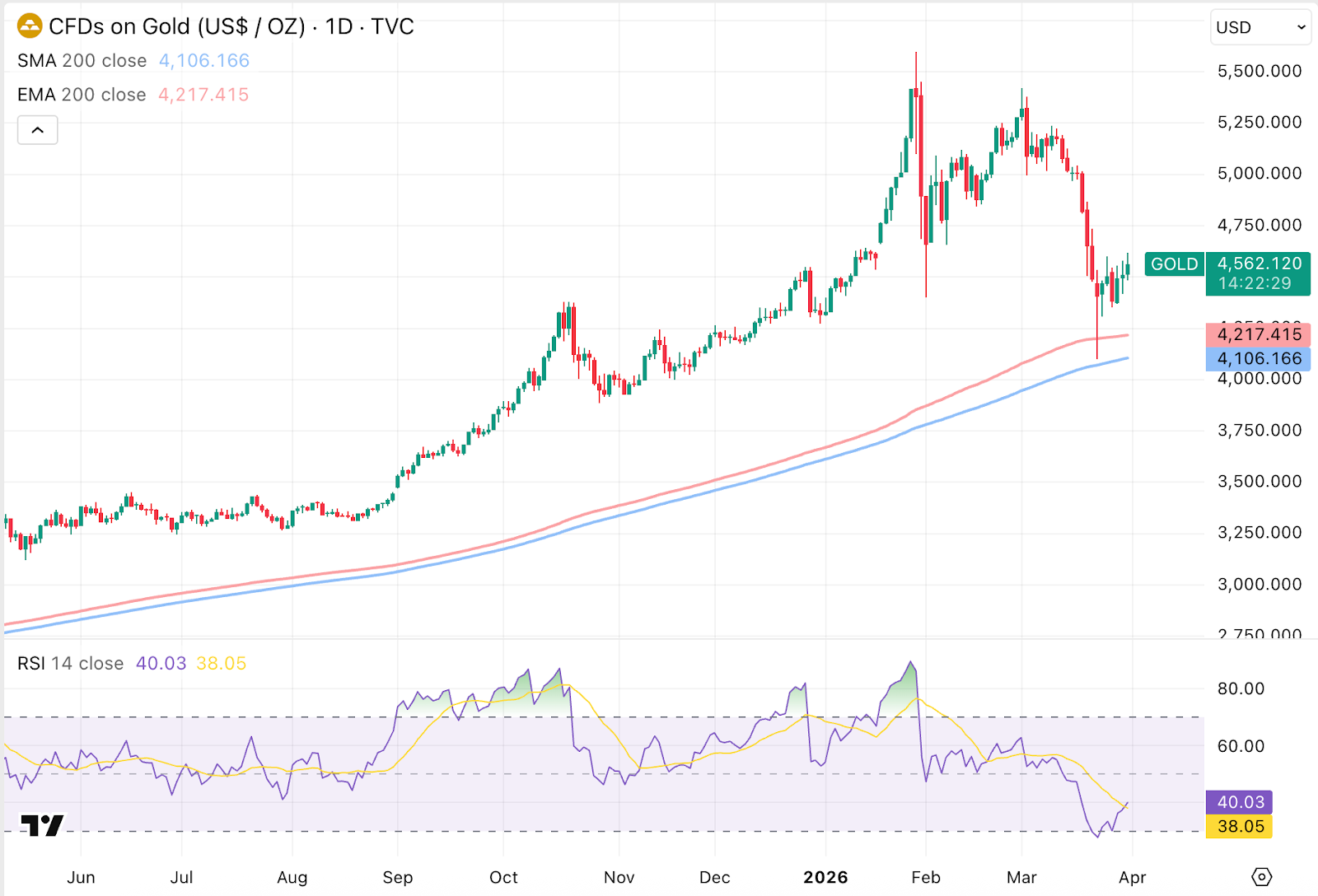
Furthermore, we see the RSI, an important indicator of momentum, jumping from the bottom. For that, see the bottom panel of the graph. This is usually also a strong signal for a price floor. For example, Peter Brandt may be right with his prediction of a perennial bottom for the gold price.
At the same time, all the world's uncertainty ensures efficiency. The war in Iran, for example, is an undeniable brake on global economic growth. In the short term, this causes a flight to cash, but in the longer term, central banks may have to intervene with support.
This will also be a positive signal for gold. In that regard, the long-term picture remains overwhelmingly favorable for the precious metal. However, you can never know for sure if investing in gold is a good idea at this particular time. For this reason, many people opt for a fixed monthly or weekly allocation.
Gold fell recently, but according to Peter Brandt, there is a 75% chance that a multi-year bottom will now be reached. Uncertain in the short term, but the long term remains positive due to strong demand and signals.

Thom Derks writes for GoldRepublic on gold, macro-economics and geopolitics. He studied Law in Leiden and Economics in Amsterdam. His personal fascination with scarcity and store of value through both bitcoin and gold brought him into the world of financial journalism. Through his own newsletter De Geldpers on Substack, he reaches over 5,800 subscribers with analyses on markets, geopolitics and the monetary system.


.jpg.jpg)