

Financial markets were rattled this week by a hot US inflation report. As a result, the market is suddenly pricing in three interest rate hikes from the US central bank by June 2027. That is currently providing a tailwind for the US dollar and bond yields, while making life harder for gold.
Yesterday, gold still managed to hold above the important $4,000 level. At the time of writing, however, that level has already been lost. In the early hours of Thursday morning, gold is trading just above the October low of around $3,850.
The zone between $3,850 and roughly $4,000 has been important for the gold price since late 2025. Every time the price falls back to this level, gold receives strong support from buyers.
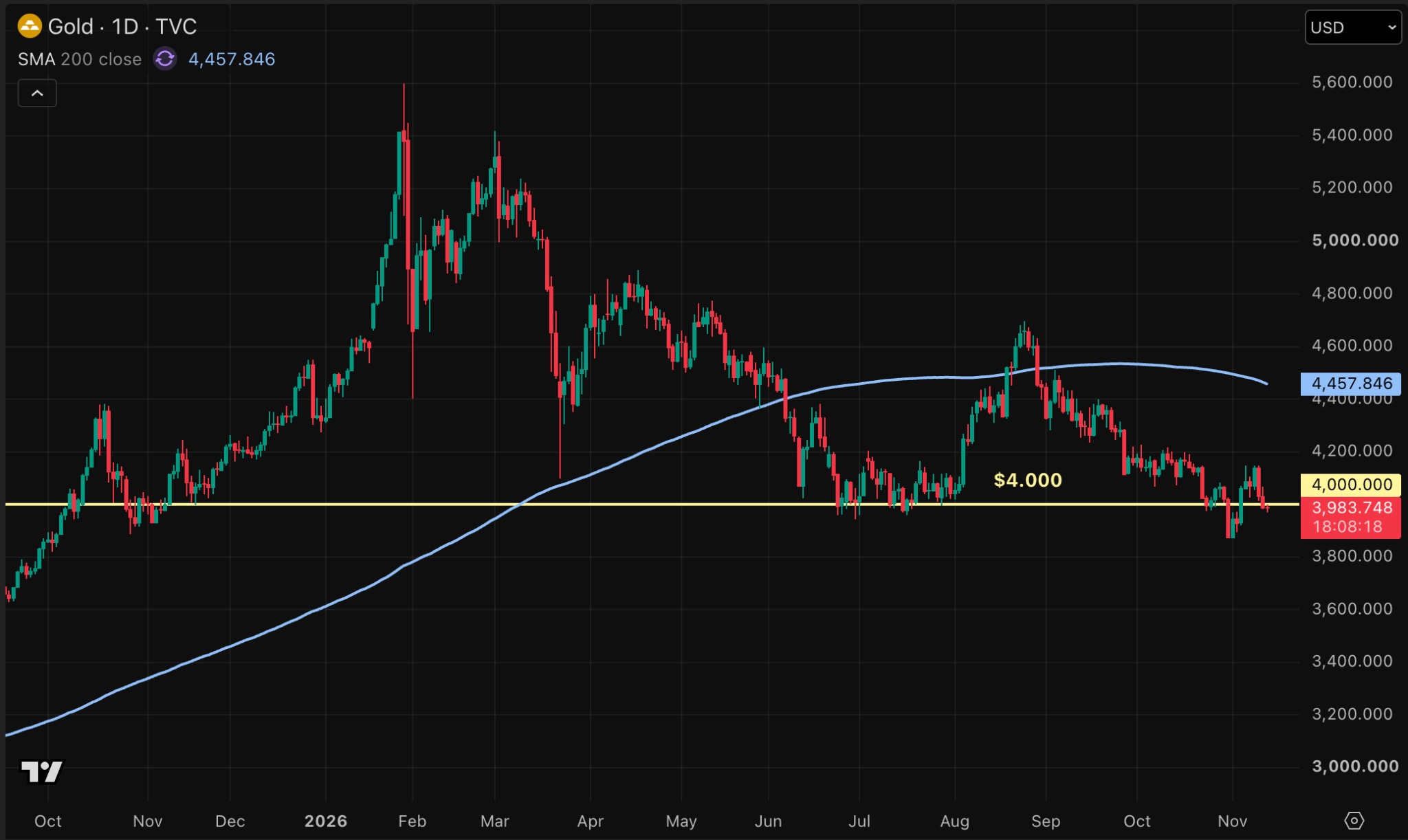
Even so, a lot needs to happen to truly reverse the momentum. For now, the downward forces appear too strong for a sustained recovery. Gold, for example, has been trading below its 200-day moving average since late August, which currently stands at $4,457.
These are the moving averages gold needs to reclaim to truly regain momentum. For now, that doesn't seem to be on the cards, particularly as the US dollar appears to be gaining strength again and expectations around the Federal Reserve's interest rate policy are becoming more hawkish.
The biggest challenge for gold
For the time being, gold is mainly struggling with momentum sellers. These are funds that base their gold strategy on the technical momentum of the gold price. As long as gold continues to trade below key moving averages, they will mainly use rallies to sell.
This, however, has nothing to do with investors who buy gold for the long term. In that respect, central banks and ETF investors remain important pillars of support for the gold price. At the moment, though, their buying power is not enough to offset the selling pressure from momentum sellers.
What you would like to see, for example, is gold trading above all the exponential moving averages in the chart below. At the moment, they are mainly acting as resistance for the gold price.
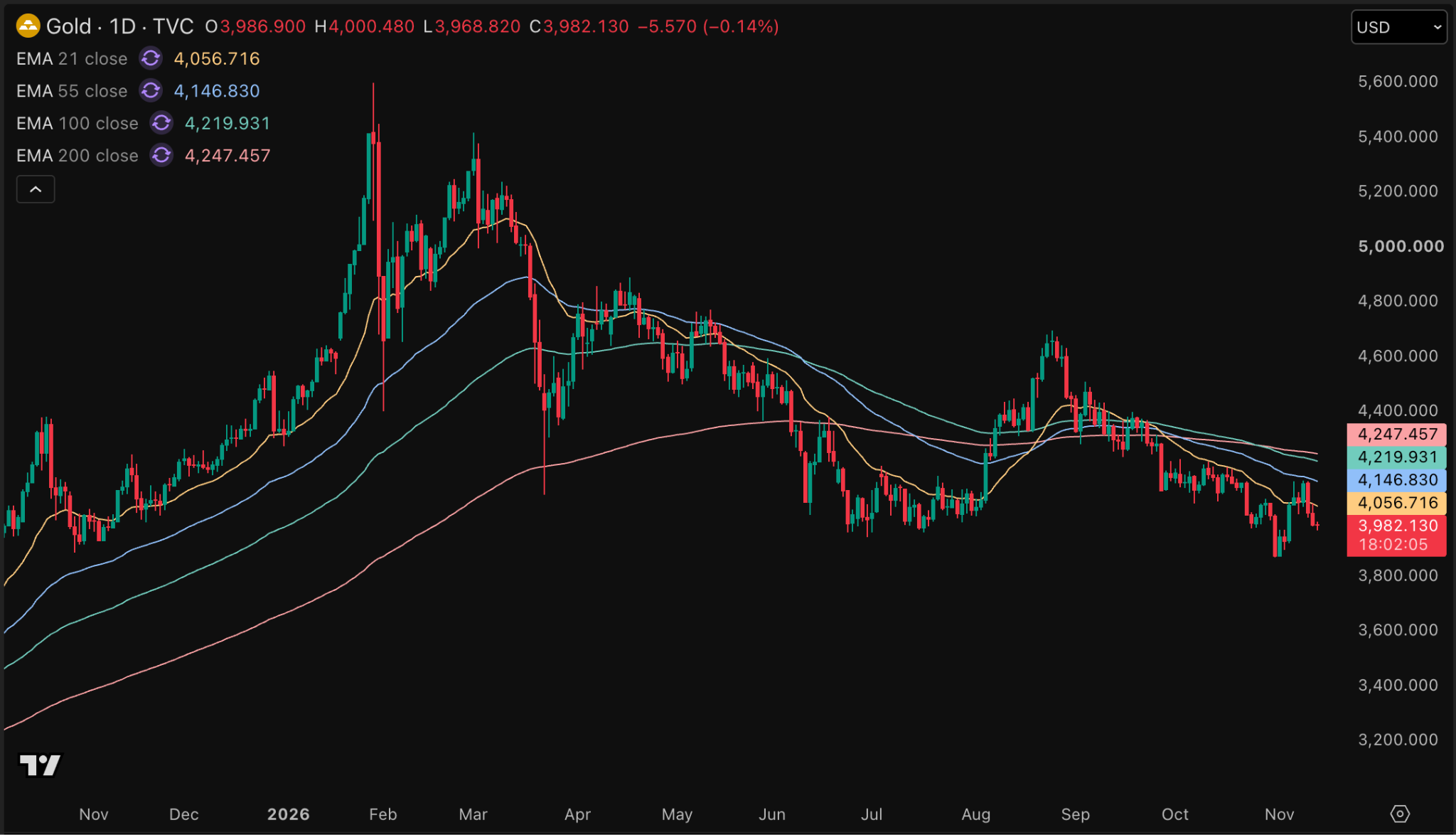
As long as that is the case, momentum sellers will use every rise to liquidate their gold positions. Ultimately, you want to see gold trading above all the averages in the chart, and for them to line up in a bullish formation.
The latter means that the shortest average is at the top, in this case the yellow 21-day exponential moving average, followed by the 55-day, the 100-day and then the 200-day.
Why? Because it shows that short-term momentum is stronger than long-term momentum. That is typically what you see during bull markets. Take, for example, the run-up to the January 2026 peak in the chart, where the moving averages were neatly in formation.
For now, however, that is not the case, and gold still has quite a bit of work to do.
Gold relies on central banks and ETF investors
As mentioned, the gold price is currently relying mainly on structural purchases by central banks and ETF investors.
The latest figures from the World Gold Council (WGC) show that central banks added around 321 tonnes of gold to their vaults during the third quarter of 2026. That marks an increase of 42 per cent compared with last year.
So far in 2026, central banks have bought 675 tonnes of gold. China remains a very important buyer. The People's Bank of China added 63 tonnes of gold to its reserves in the third quarter, and a further 25.8 tonnes in October. This means the Chinese central bank has now bought gold for 24 consecutive months.
Through these purchases, central banks are diversifying their reserves, reducing their dependence on, for example, the US dollar, and protecting themselves against geopolitical risks and potential sanctions. In this respect, we can see that increased uncertainty in the world is indeed driving higher demand for gold.
Alongside central banks, ETF investors are also continuing to buy. In the third quarter, they bought 211 tonnes of gold worth around $31 billion. Even in October, $2.7 billion worth of gold was added while prices were falling. This type of investor is clearly not guided by the price action of gold.
Where is the focus now?
The market is currently focused mainly on inflation, the US central bank, bond yields and the revival of the US dollar. Meanwhile, gold is struggling with momentum sellers, who will probably only turn around once the gold price is trading above key moving averages again.
One positive development is that the oil price continues to fall. Since late October, Brent crude has already dropped by more than 20 per cent. There are even cynical analysts who claim the fall in the oil price has something to do with Anthropic's stock market listing.
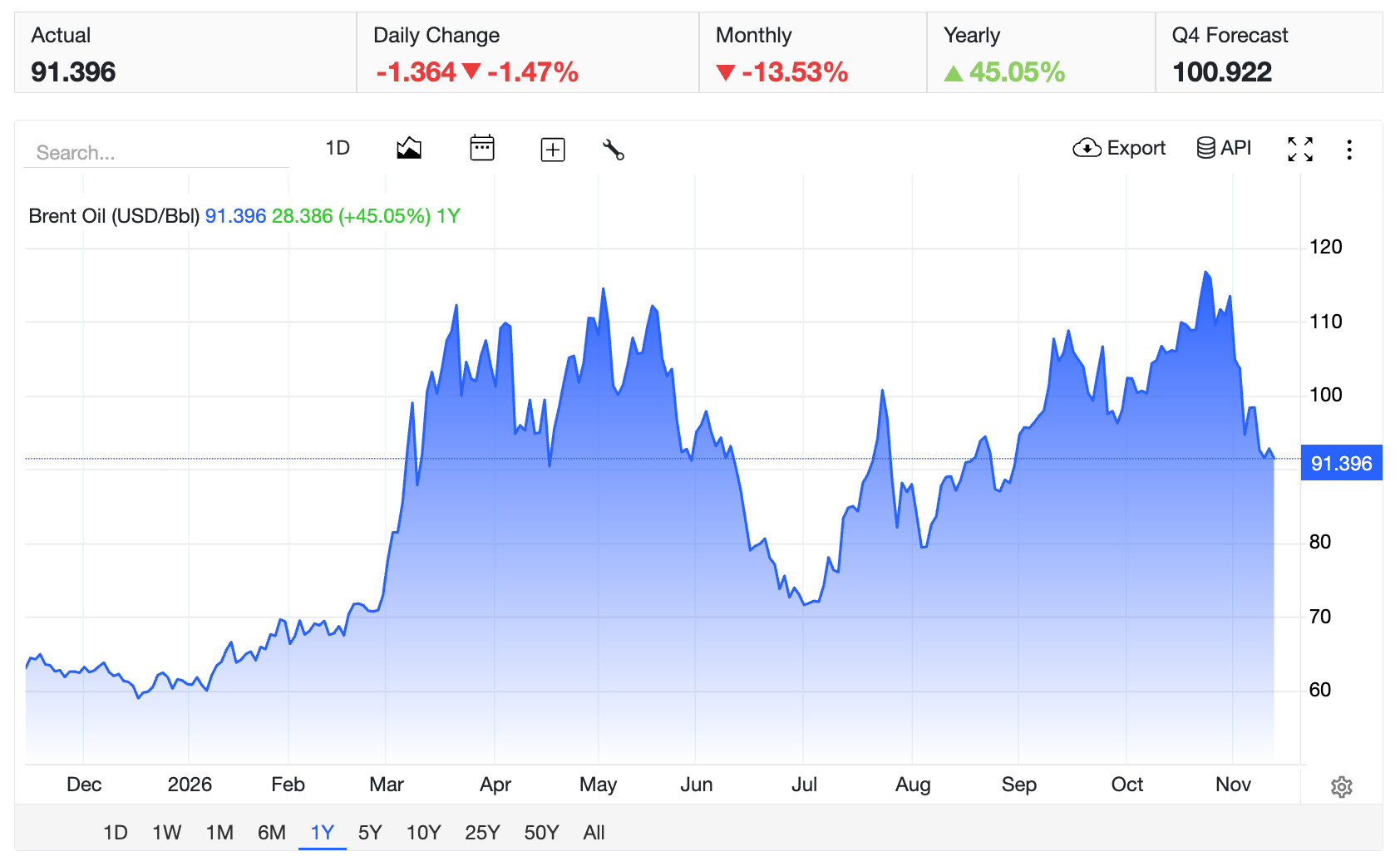
According to reports, Qatar has secured two extra weeks for diplomacy in an effort to prevent a new US attack on Iran. That could give the stock market some breathing room. And the gold price too, as oil has been an important source of inflation after months of relatively high prices.
However, it remains to be seen whether this will lead to a definitive agreement. We have seen this story many times before, and so far it has always ended in disappointment.
This month is, incidentally, a little unusual. After the October inflation report, the topic is firmly back in the spotlight. Yet the next interest rate decision from the US central bank is on 10 December, ahead of the November inflation report.
It is therefore possible that the fall in oil prices and any decline in inflation will come too late for the next interest rate decision from the US central bank. For the long term, however, the outlook for gold remains strong.
The gold price is under pressure once again, this time from rising bond yields, a more hawkish US central bank and a stronger dollar. Here's what you need to know about the current investment climate for gold.

Thom Derks writes for GoldRepublic on gold, macro-economics and geopolitics. He studied Law in Leiden and Economics in Amsterdam. His personal fascination with scarcity and store of value through both bitcoin and gold brought him into the world of financial journalism. Through his own newsletter De Geldpers on Substack, he reaches over 5,800 subscribers with analyses on markets, geopolitics and the monetary system.