


Shifting goalposts
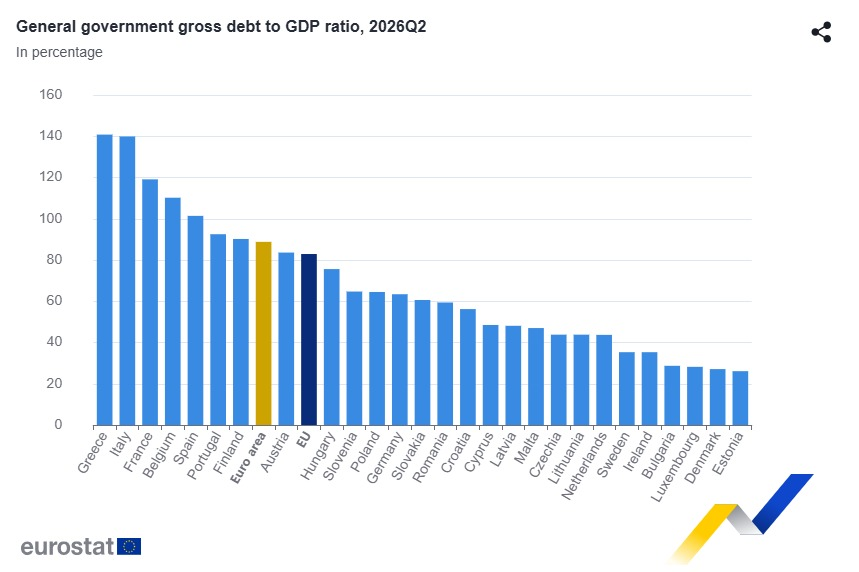
The latest European debt figures have been published again. And every time I look at them, I am amazed all over again. Not so much by the size of the debt mountains, because we know those by now. But mainly by how easily we seem to have cast aside the once so important European budget rules.
How did it work again? Under the Stability and Growth Pact, an EU country’s government debt may not exceed 60% of gross domestic product. The annual budget deficit may not be greater than 3%.
Do those rules actually still exist?
They certainly do!
So are we still doing anything with them?
Well, average government debt in the eurozone now stands at 88.8% of GDP. Almost 50% above the agreed limit. And debt is still rising.
So you may well wonder what that 60% limit is still worth.
Rules are rules. Right?
It is not as if Brussels is doing nothing at all. There is something called the Excessive Deficit Procedure (EDP).
When a country breaks the budget rules, the European Commission can propose opening such a procedure. The country concerned must then put its public finances in order along an agreed path. Spending limits, deadlines and extra supervision follow. And if the country does not cooperate sufficiently, fines can ultimately even be imposed.
That sounds pretty strict.
Ten EU countries are currently in such a procedure, seven of them eurozone countries: France, Italy, Belgium, Austria, Finland, Slovakia and Bulgaria.
But something strange is going on. The procedures focus mainly on annual budget deficits. A country with sky-high government debt can stay out of the procedure, as long as its deficit and agreed spending path are sufficiently under control. That does not quite square with the 60% limit.
Take Greece. With government debt of almost 141% of GDP, it is still Europe’s debt champion. Yet the country is not in the procedure. That is because Greek debt is falling sharply, while its budget is now in much better shape.
France in trouble
During the previous European debt crisis, almost all attention went to Greece, Italy, Spain and Portugal. Today, France is one of the biggest problem children.
French government debt has risen to over 119% of GDP. The budget deficit is far too high, at more than 5% of GDP, and political division makes it extremely difficult to change that.
France has therefore been in the Excessive Deficit Procedure since July 2024. But the country has until 2029 to bring its deficit back below 3%.
So three more years.
Meanwhile, investors are demanding ever higher interest rates to lend money to the French government. The spread with Germany has now risen to levels we know from the height of the European debt crisis.
Yet there is hardly any real panic in the financial markets.
How is that possible?
Who will rescue France?
The answer lies largely in the safety nets Europe has built since the previous debt crisis.
France could, for example, turn to the European Stability Mechanism, the ESM. That fund was set up to support eurozone countries with serious financing problems.
But that comes at a price. A country that receives support usually has to accept a reform program, with clear conditions and supervision. On paper, then, an even stricter program.
For France, that would be politically very painful. Paris would have to give up part of the control over its budget policy. Hardly desirable either, with the presidential elections coming up next year.
Moreover, only such a program can pave the way for bond purchases by the ECB through the so-called OMT program. That instrument requires an appropriate European support program.
But there is another route.
The ECB as a safety net
In 2022, the ECB introduced the Transmission Protection Instrument, TPI for short. It allows the central bank to buy government bonds when spreads within the eurozone rise in a way it considers unwarranted and disorderly.
TPI does not require an ESM program. Even the fact that France is in an Excessive Deficit Procedure does not automatically rule out support.
The ECB does have to assess whether the debt is sustainable, whether economic policy is sufficiently sound and whether France is taking the necessary budgetary measures. But in the end, the ECB has given itself a great deal of leeway.
This partly explains why investors seem relatively unconcerned for the time being. If the pressure on the French bond market really becomes too great, there is an instrument the ECB can use to intervene.
The central bank would then have to explain why France deserves help while it has failed to get its public finances in order for years. And that brings us back to the original budget rules.
What are agreements still worth?
We agree on a maximum government debt of 60%. Then debt in the eurozone rises to almost 90%. Countries that break the rules get years to repair their budgets. And when the bond market eventually has had enough, the ECB stands ready with a new safety net.
And yet there is hardly any fuss about it. Not even in those well-behaved countries, Germany and the Netherlands. Remarkable, especially now that the Netherlands and Germany are once again debating at length the European budget and how much each country should contribute to Brussels.
Why is there not much more talk about compliance with the agreements we have already made? After all, high debt is not a temporary problem. Aging populations, rising healthcare costs, defense spending and structural budget deficits will not disappear by agreeing on a new deadline.
And the financial markets know that too.
That is why my question to investors remains the same. In a world where governments are becoming increasingly dependent on low interest rates and central banks, why would you still invest a large part of your wealth in government bonds?
In practice, the European budget rules have been stretched further and further. Perhaps it is time for investors to take a fresh look at their traditional portfolios too.
Eurozone debt is far above the 60% limit, France is in trouble and the ECB stands ready as a safety net. What does this mean for investors?

Jeroen Blokland has over 20 years of experience as a professional investor and was formerly Head of Multi-Asset at Robeco, where he was responsible for a client portfolio of over five billion euros. After leaving Robeco he founded True Insights, an independent investment research platform, and has since built a following as a columnist, YouTuber and sought-after speaker. With over 100,000 followers on X, he is one of the most prominent voices in Dutch finance. For GoldRepublic he writes on macro-economics, markets and the role of gold in a diversified portfolio.