

Gold clashes with Fed rate decision
A lot of major forces are converging on the financial markets right now. The resumption of the Iran war is once again pushing up oil prices, reviving inflation fears, and lifting bond yields. At the same time, the market is having doubts about the enormous AI investments, resulting in sharp declines for chip stocks. On top of that, this week was largely dominated by the US central bank's interest rate decision.
Although the US central bank left rates unchanged yesterday, the decision did trigger a reaction relevant to gold, silver, and the rest of the financial market.
Bond yields tell the story
The first thing that stood out about the US central bank's rate decision was the disagreement within the rate-setting committee. The vote ended 9-3 in favor of holding rates steady. Not everyone, in other words, agreed with the choice not to raise rates.
That's a major difference from the US central bank under Jerome Powell. Under him, votes often ended unanimously at 12-0. Under Kevin Warsh, the new chair put forward by Donald Trump, there's more room for debate — debate that isn't hidden from the public.
Although Warsh reiterated at the press conference following the rate decision that controlling inflation remains an important goal, the market's reaction spoke volumes.
Long-term yields rose after the rate decision, while the 2-year yield — sensitive to the US central bank's rate policy — actually fell. Loosely translated, the market is saying: we don't think you dare raise short-term rates, and that's going to cause a lot of inflation in the long run.
The 30-year yield, for example, ultimately rose the most, to its current level of 5.228 percent. That puts it at its highest level since 2007, the year before the 2008 global financial crisis.
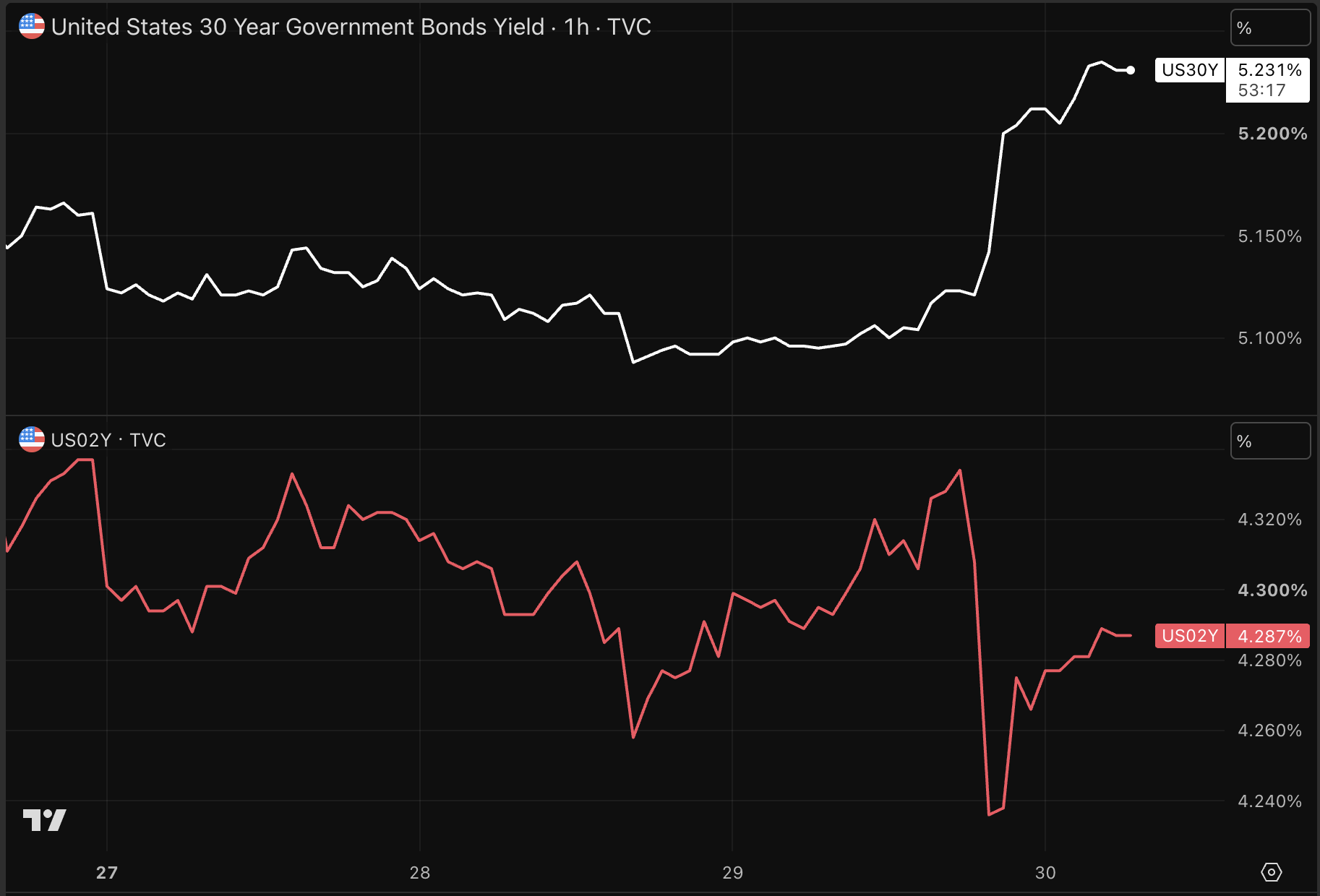
With this reaction — the rise in long-term yields — the market is essentially signalling that Warsh should have raised rates yesterday. While the market is growing more worried about inflation, the US central bank is choosing to wait until the next rate meeting in September to make a decision.
In the meantime, Warsh will be hoping that rising long-term yields do part of the work for him. For now, it remains to be seen what inflation will do in the coming months, partly as a result of the resumption of the Iran war.
Gold price reacts to rate decision
Initially, the gold price rose in response to the decision to leave rates unchanged. That was likely because the market had priced in roughly a 30 percent chance of a rate hike ahead of the meeting. Leaving rates unchanged wasn't a complete certainty, then, so removing that uncertainty initially triggered a price jump.
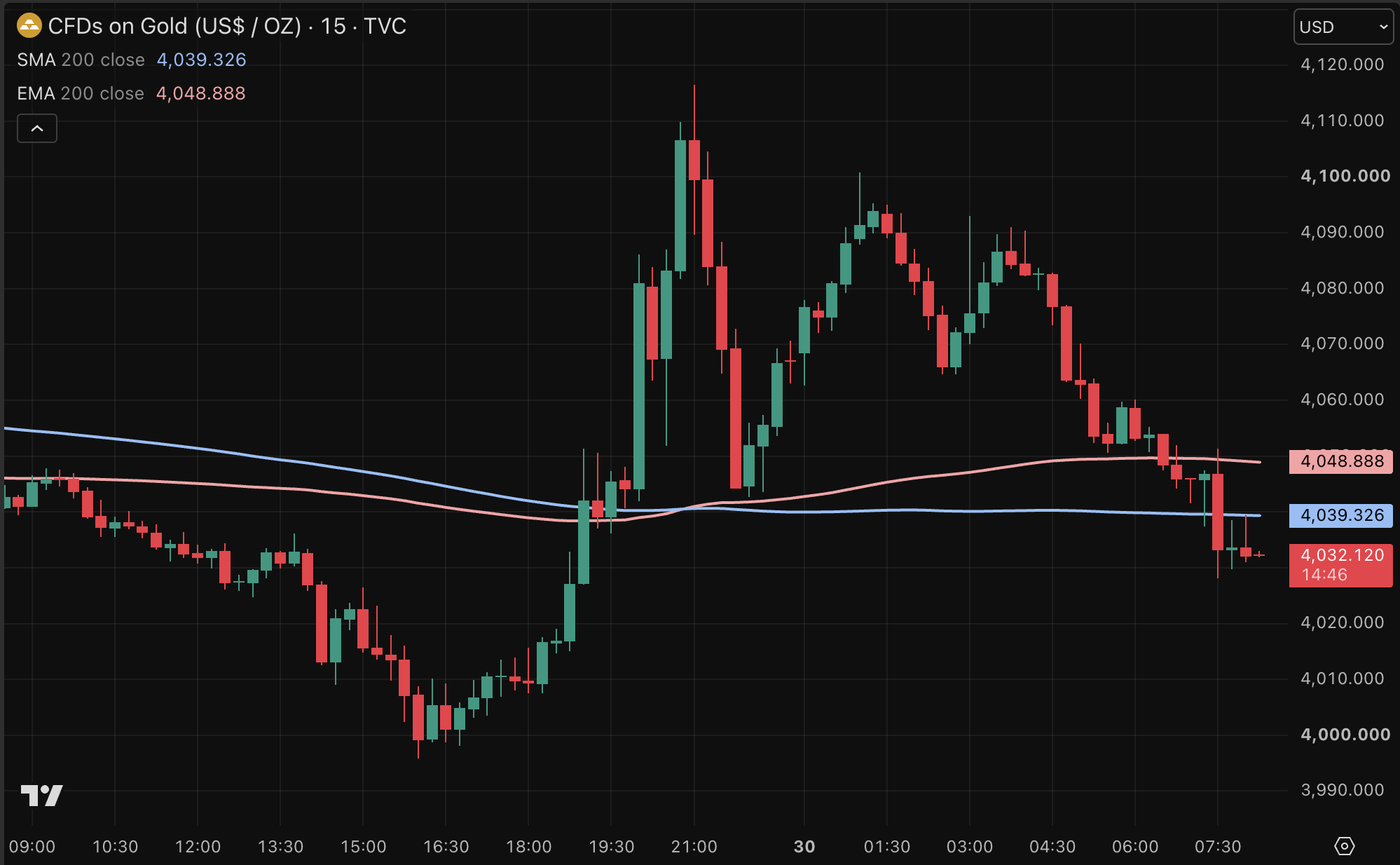
That rise, however, didn't last long. Shortly after the rate decision, long-term yields began to climb. Higher long-term yields represent direct competition for the gold price. Unlike dollar assets, such as US government bonds, gold, after all, pays no interest.
If 10- and 30-year yields then climb to higher levels, it becomes relatively more attractive for investors to park capital there instead. The current 30-year yield of around 5.23 percent means investors can, in theory, lock in the highest rate since 2007 for 30 years.
That creates a headwind for gold, for silver, but also for equity markets. For the AI cycle, rising rates are also bad news, since this means the cost of capital for the enormous investments in artificial intelligence increases further, just as investors are already starting to doubt the returns these investments will generate.
Gold finds support again at a key level
Although the gold price ultimately reacted to these developments with a decline, the price is once again finding support around the $4,000-per-ounce level, marked by the white line in the chart below. That zone around the $4,000 level acted as a support point in the fourth quarter of 2025, and has been doing so again since June 2026.
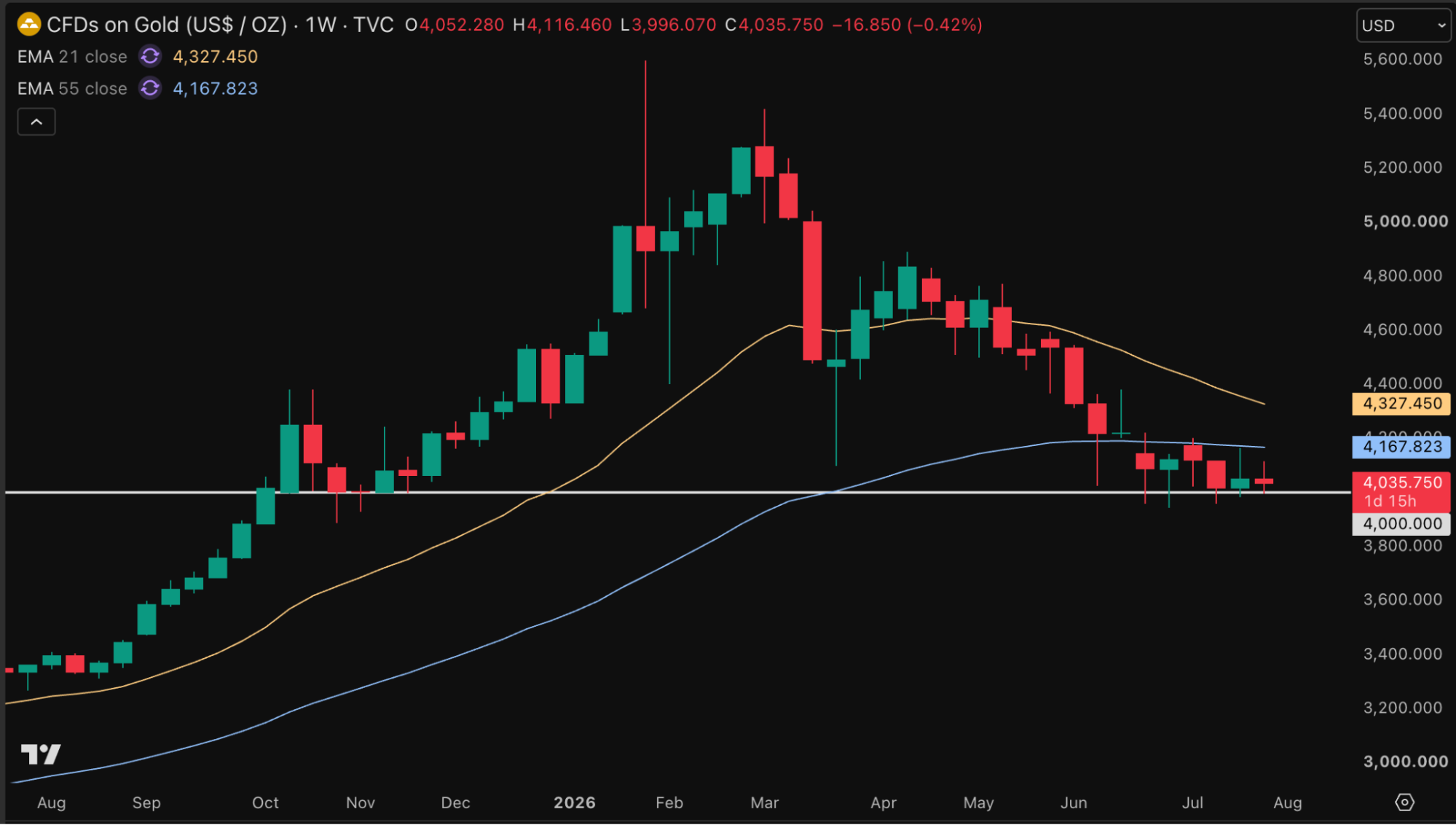
At the same time, the 55-week exponential moving average, shown by the blue line, forms an important resistance level for the gold price. Reclaiming that moving average would be a very strong signal for the precious metal.
To achieve that, there needs to be more calm on the fundamental front. In particular, the resumption of unrest in Iran, rising oil prices, and climbing bond yields aren't helping.
Even so, it's a powerful signal that the gold price keeps reacting around the $4,000-per-ounce level despite these fundamental headwinds. This price level apparently represents an interesting point for many investors to once again start buying gold for the long term.
If we look a bit further ahead than the current issues, there's also a solid explanation for this. Should bond yields remain at these levels or rise further, that would put the AI economy under severe pressure. In theory, that could trigger a recession — something neither the United States nor China wants to see during the AI arms race.
A recession carries the risk of losing the AI race, and with it, the central position of power on the geopolitical world stage. For that reason, there's a strong likelihood that central banks and governments will step in with support if the economy threatens to buckle.
That, in turn, is a scenario in which gold is most likely to move back into the spotlight.
The Fed held rates steady, but long-term yields rose instead. Discover what this means for the gold price and why $4,000 remains crucial support.

Thom Derks writes for GoldRepublic on gold, macro-economics and geopolitics. He studied Law in Leiden and Economics in Amsterdam. His personal fascination with scarcity and store of value through both bitcoin and gold brought him into the world of financial journalism. Through his own newsletter De Geldpers on Substack, he reaches over 5,800 subscribers with analyses on markets, geopolitics and the monetary system.


.jpg.jpg)