



We need to talk about France
The yield spread between France and Germany recently touched 100 basis points, not yet as high as the record 200 basis points reached in November 2011 at the height of the eurozone crisis, but still an important symbolic threshold, and a reason for concern.
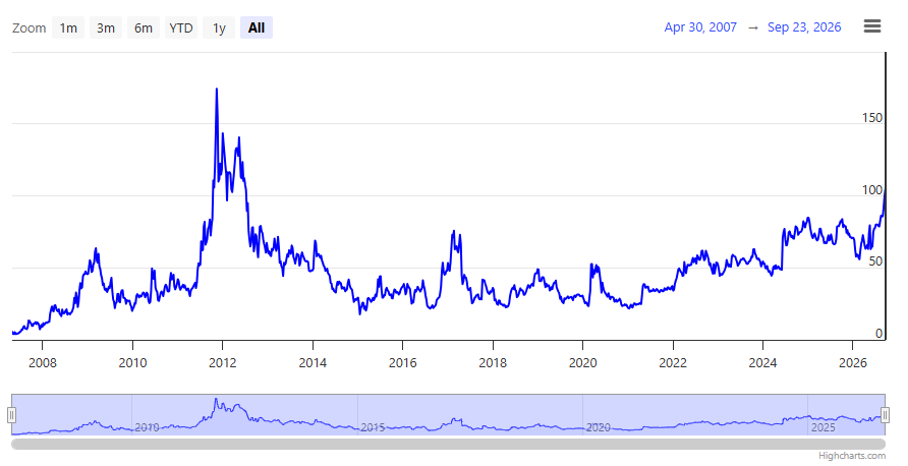
A historic distrust of French government debt
The widening spread fits with growing distrust among markets, the bond vigilantes, the watchdogs of the bond market, in the sustainability of government debt. It's also notable that the spread on French government bonds is now higher than Italy's (87 basis points). To France's great shame, even the Greek government (77 basis points) can now borrow more cheaply than France. The absolute level of French yields also deserves attention: the 10-year government yield is steaming steadily toward 5 percent.
France is the new financial problem child of the European [Monetary] Union, and for good reason. The numbers speak for themselves. The government deficit has climbed to more than 5% of GDP and government debt to 116 percent of GDP, in each case nearly double the Maastricht norms. France's Finance Ministry expects the deficit to rise to 5.6% this year and the debt ratio to 120%. That puts France uncomfortably close to Italy, which carries a debt ratio of 137 percent of GDP. But France can only dream of Italy's government deficit, an acceptable 3 percent.
A cultural problem: resistance to reform
France's biggest problem is cultural. A majority of the French population, and by extension their political representatives, the French Socialists chief among them, don't want their acquired social rights touched. At 62, France has the lowest effective retirement age in the OECD, while French life expectancy is among the highest. President Macron's 2023 reform was meant to gradually raise the statutory retirement age from 62 to 64, but ran into mass protest. He initially managed to push the measure through without a standard vote in the National Assembly, by using a legal loophole. Macron won a legal victory, but the political price was extremely high. Labor unions went into overdrive, organizing large-scale protests for months. In France, the French Revolution is never far away. And the street has learned that the state listens to them, which only increases the incentive to cause a ruckus. To make matters worse, Macron's camp no longer had a parliamentary majority after the 2024 elections. The new prime minister, Sébastien Lecornu, therefore needed support from other parties in 2025 to get a budget passed and keep his government standing. In exchange for that support, the Socialists demanded that further increases to the retirement age be halted. Lecornu caved, and the increase was frozen until January 2028, leaving the official retirement age stuck at 62 years and 9 months.
In this political context, the badly needed fiscal consolidation through spending cuts is almost unthinkable. France is therefore mainly reaching for new tax hikes, which only make the situation worse. The size of government, just as in Belgium, already exceeds half of GDP there: 57 percent. In some circles, this is referred to as a communist, apologies, state-run economy. On top of that, the French labor market is frozen by excessive social protection. Employer contributions in France run to 45%, and it's extremely difficult and extremely expensive to dismiss a French employee. Employers also have to navigate Kafkaesque social legislation. The annotated French labor and social security codes alone run to nearly 8,000 pages combined. The result is that French employers think twice before hiring anyone, and hundreds of thousands of French workers drift through uncertain temporary employment statuses.
Elections, Le Pen, and the road ahead
Two factors could break the current budgetary deadlock: new elections or a financial crisis. The two are closely linked. The next elections are the presidential elections in April (first round) and May (second round) 2027. Macron isn't entitled to a third term, so it's about his successor. The next parliamentary elections are due in 2029, but the new president (who appoints the prime minister) can dissolve the National Assembly to trigger early parliamentary elections, which will probably happen. Even then, a workable majority isn't guaranteed. A new president facing another divided parliament would inherit the same budgetary puzzle. With a majority from an opposing camp, France would find itself in a "cohabitation," the uncomfortable cohabitation in which the president and the prime minister come from different political families, which could lead to a fresh deadlock. Only if the new president secures a majority in the National Assembly can the government implement reforms more easily. Which reforms those would be depends on who wins.
According to a recent Ipsos election poll, Marine Le Pen of the far-right Rassemblement National would come out clearly on top in a first round, with 33 to 35 percent of the vote. Center-right Édouard Philippe trails far behind with 14 to 21 percent. In France, the second round is highly decisive, because coalitions are often formed to sideline the first-round winner, but the idea that the far right has the best chances by default is enough to further unsettle financial markets. Marine Le Pen claims she wants to cut spending, but ties herself into an impossible split by refusing to raise the statutory retirement age. She opposes Macron's increase to 64 and confirmed in August her proposal to return to 62, with the option of retiring from 60 for those who started working before turning twenty.
A far-right or far-left victory bodes poorly for the French budget. France is dancing on a volcano. In the meantime, French government yields keep climbing. The country is caught in a downward spiral: weak fiscal numbers feed higher risk premiums, higher rates make the budget heavier, and political division prevents a lasting solution. That's good news for gold, which more than ever can play its role as a safe haven away from unsafe government paper. In the end, it's also good news for France, because:
"People only accept change when they are faced with necessity and only recognize necessity when a crisis is upon them." - Jean Monnet
People only accept change when forced to, and only recognize its necessity once a crisis is upon them.
The yield gap between France and Germany has climbed to eurozone-crisis levels. Find out what France's budget crisis means for the gold price.

Jan Longeval is an author, speaker, independent advisor, and co-host of the GoldRepublic podcast. For GoldRepublic, he writes financial and economic analyses focusing specifically on Belgium within a broader European context. He has written several books on investing, gold, and bitcoin. With master's degrees in both economics and real estate, and as a certified financial analyst, adjunct professor of finance at Vlerick Business School, and former head of investments at Degroof Petercam, Jan is a sought-after speaker and independent advisor. He regularly keeps his many thousands of followers informed through highly analytical articles and blogs.





.jpg.jpg)


