



How the rise of AI is boosting demand for gold
The gold price dipped below $4,300 per ounce yesterday, after figures on US manufacturing and services activity came in stronger than expected. Input costs also came in higher than forecast. That left the market facing an unfavorable combination of a stronger economy and rising inflation expectations.
As a result, we saw gold and silver fall, but the exact same thing happened to equities and bitcoin. The odds of a Fed rate hike in October rose from 50 to around 70 percent, while the US 10-year yield jumped back above 5 percent.
In the short term, the situation remains hard to read. Bond yields have risen worldwide to levels not seen in decades in some cases, and central banks are running a stricter monetary policy.
Normally, those are conditions that don't work in gold's favor.
Yet demand for the precious metal remains remarkably strong. Gold ETFs bought around another 48 tons this month, while Chinese gold purchases in 2026 have already topped 1,000 tons, making them larger than for the whole of 2025.
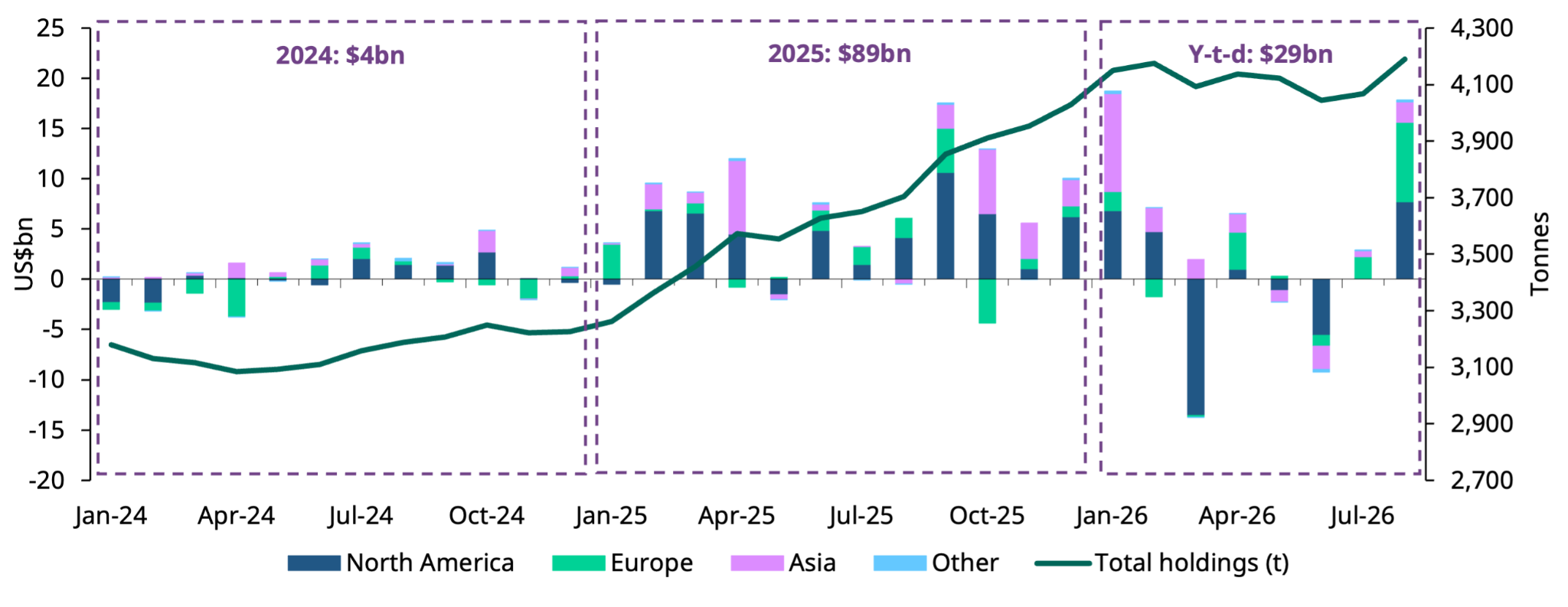
Gold also remains popular among wealthy investors. We previously wrote at GoldRepublic about UBS research among family offices, which found that the world's wealthiest families are increasingly using gold as a strategic part of their portfolios.
So the interesting question isn't just why gold is holding up despite high rates. It's more why so many investors want to own gold right now.
Four reasons gold is becoming more important
Much of the answer lies in the exceptional uncertainty investors currently face.
That uncertainty comes from several directions:
- Government debt: higher rates make it increasingly expensive for governments to finance existing debt.
- Geopolitics: wars, trade tensions, and a shifting balance of power between the United States and China are adding to uncertainty.
- Technology: artificial intelligence could transform large parts of the economy and put existing market leaders under pressure.
- Financing: the AI investment wave is becoming increasingly capital-intensive, pushing companies to turn to the bond market more often.
It's that last point in particular that's getting relatively little attention.
AI is making the future harder to predict
Virtually everyone can see by now that an AI revolution is under way. In recent years, that has driven enormous share price gains for chipmakers, data center companies, and large US technology firms.
But a technological revolution doesn't automatically make investing easier. Quite the opposite. The faster technology develops, the harder it becomes to predict which companies will be the winners in five, ten, or twenty years.
We saw the same thing during the dot-com era. Amazon eventually became one of the biggest winners of the internet age. Yet its stock fell from around $113 to $6 between 1999 and 2001, a decline of nearly 95 percent.
So an investor could be completely right about the future of the internet and still experience a massive price decline. That's an important lesson for today's AI revolution.
It's entirely possible that artificial intelligence will fundamentally transform the global economy. That doesn't mean, though, that every company benefiting from the hype today will end up among the winners.
Some of today's market leaders will disappear. Others will go through difficult years. And some of the biggest AI winners of 2035 probably don't even exist yet. The technology can be predictably successful while the investments in it are not.
Protection alongside growth
That's why choosing gold doesn't have to come at the expense of investing in technology. A portfolio can hold both.
Technology offers exposure to economic growth and innovation. Gold serves a different function. It can provide protection against scenarios in which the future unfolds differently than investors currently expect.
That makes gold interesting in a world where no one knows for certain:
- which companies will win the AI race;
- which countries will pull the world's economic center of gravity toward them;
- how high AI investment will ultimately climb;
- how much debt that will require;
- and which companies will earn sufficient returns on those investments.
Gold doesn't need to know the answers. The precious metal has existed as a form of wealth for thousands of years and isn't dependent on any single company, technology, government, or economic power bloc.
For gold, for example, it makes little difference whether the United States or China ultimately becomes the dominant power in artificial intelligence.
For a concentrated investment in US technology stocks, such a shift could have far bigger consequences.
AI is increasingly being financed with debt
On top of that, the way the AI revolution is being financed is starting to change. Until recently, large technology companies could fund much of their investment out of exceptionally strong cash flows. As investment amounts keep rising, external financing is becoming more important.
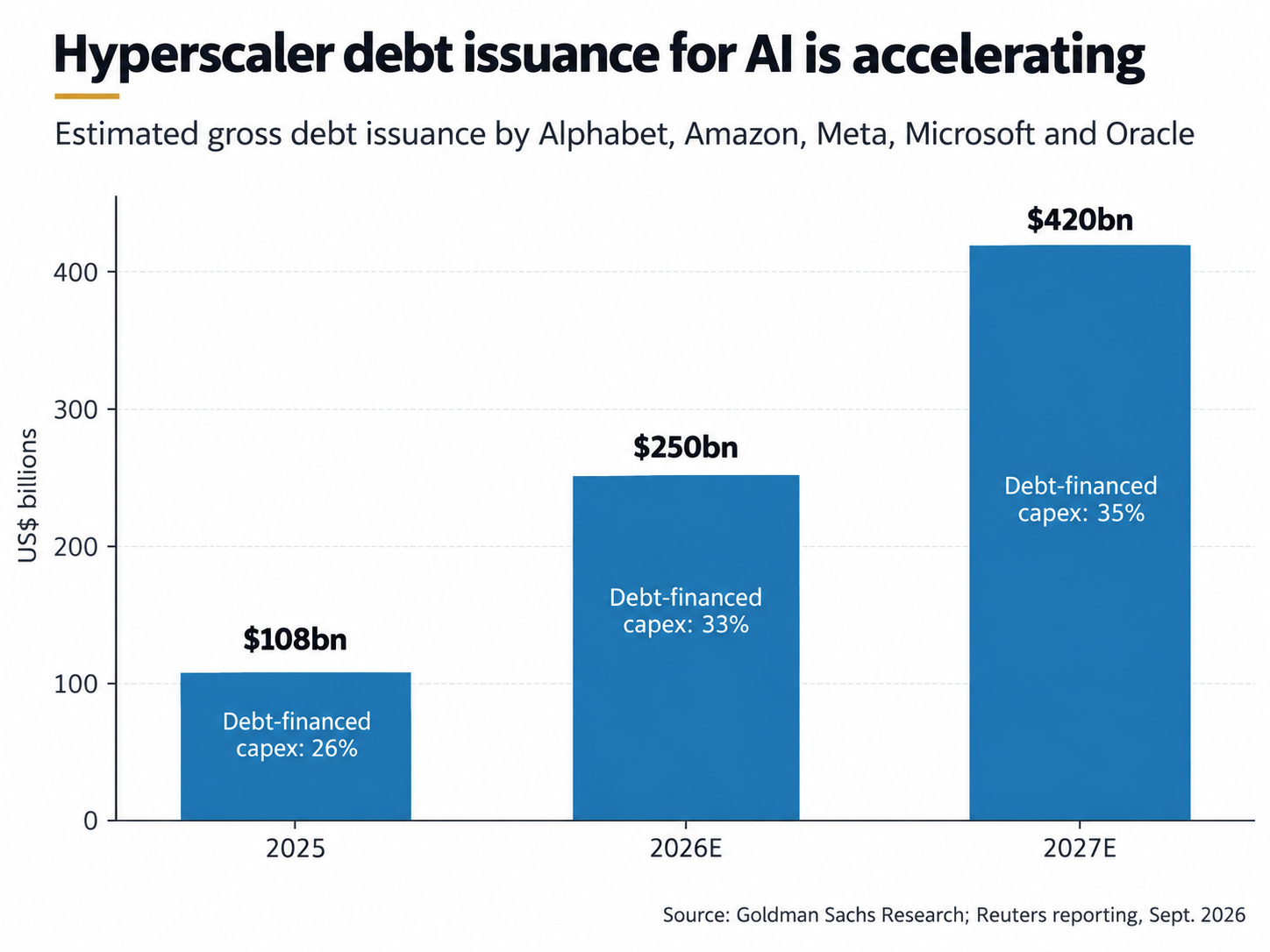
According to Goldman Sachs, Amazon, Meta, Oracle, Microsoft, and Alphabet will together issue around $420 billion in debt in 2027. That would be roughly 60 percent more than in 2026.
According to the same estimates, ultimately around 35 percent of AI investment would end up being debt-financed.
That doesn't automatically mean there's an AI bubble, or that the current investment wave is coming to an end. As long as the investments generate sufficient returns, debt financing can make economic sense.
But the math does change. The more companies borrow to build AI infrastructure, the more important it becomes that those investments actually generate enough cash flow to offset the higher financing costs. That makes the stock market more sensitive to disappointments.
Gold doesn't need to beat AI
That brings us to perhaps the most important point. Investors don't have to choose between optimism about AI and gold.
You can believe that artificial intelligence will become one of the most important technological developments of this century, while also recognizing that no one knows exactly which companies, countries, and investors will ultimately benefit the most.
It's precisely that uncertainty that increases the value of diversification. Gold doesn't need to deliver a higher return than Nvidia, the Nasdaq 100, or the next big AI winner to be worth holding.
It doesn't even need to benefit from the AI revolution at all. Gold's strength lies precisely in the fact that it requires very few assumptions about what the world will look like in ten years.
In a period where geopolitical relationships are shifting, government debt is climbing, bond yields are rising, and artificial intelligence could upend entire business models, that quality becomes increasingly relevant.
That helps explain why investors keep buying gold despite high rates. Not because they necessarily expect the global economy to derail, but because the range of possible outcomes is widening.
And the harder the future is to predict, the more valuable protection against being wrong can become.
The breakneck rise of AI is creating uncertainty about the future shape of the world. Who ends up in charge? Which companies come out on top? That appears to be helping gold.

Thom Derks writes for GoldRepublic on gold, macro-economics and geopolitics. He studied Law in Leiden and Economics in Amsterdam. His personal fascination with scarcity and store of value through both bitcoin and gold brought him into the world of financial journalism. Through his own newsletter De Geldpers on Substack, he reaches over 5,800 subscribers with analyses on markets, geopolitics and the monetary system.



.jpg.jpg)


