

The Silver Squeeze of 1980: what can we learn from it?
The Silver Squeeze of 1980 is considered one of the most extreme events ever seen in the precious metals markets. In a short period, the silver price rose from around $10 per troy ounce to a peak of $49.50. For investors looking at silver today, this period offers valuable lessons about risk, market dynamics, and trust.
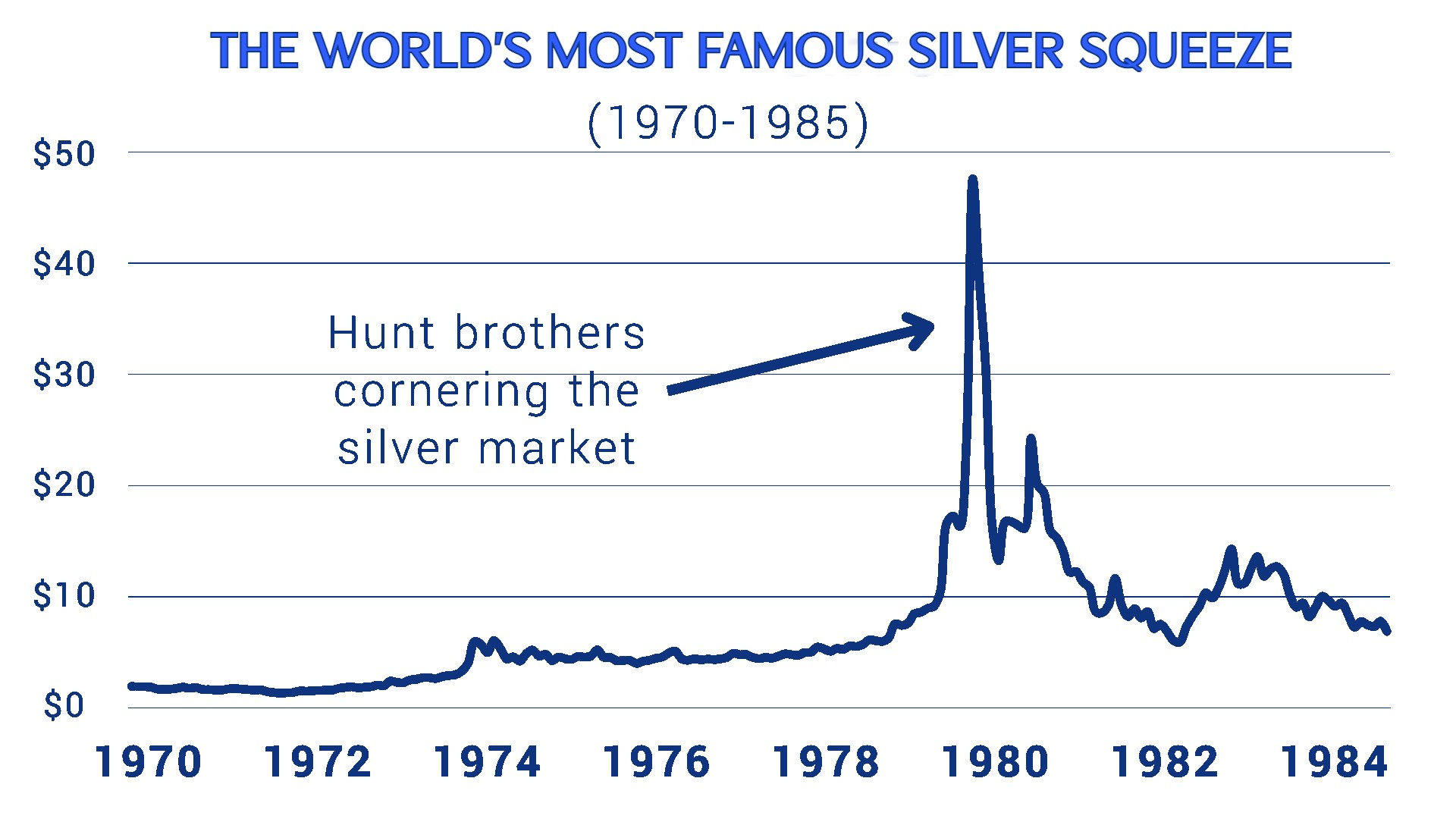
What happened to the silver price in 1980?
In the late 1970s, the world was experiencing high inflation, geopolitical tensions, and declining trust in banks. Investors sought refuge in tangible assets, such as precious metals. Silver became a popular alternative to gold. And because silver supply was limited (production was constrained), while demand rose sharply, pressure on the silver price built up.
The role of the Hunt brothers
The Hunt brothers played a major role in the Silver Squeeze. Nelson and William Hunt, two extremely wealthy Texan businessmen, built up enormous positions in both physical silver and silver futures on the Comex exchange in New York. Their massive investment significantly increased demand. Their goal was to drive up the silver price so they could ultimately realize a huge profit on their positions.
The Hunt brothers' strategy proved successful. The silver price shot up, and panic broke out among investors holding short positions. They were forced to buy back silver at ever-higher prices, which further reinforced the rise in the silver price.
The situation eventually became so unstable that the Comex exchange intervened and decided to temporarily halt trading.
This was the turning point; the silver price fell sharply in a short period. Many investors suffered heavy losses during this 1980 silver crash, including the Hunt brothers themselves. This event shows how quickly a market can turn when trust disappears and liquidity dries up.
What lessons can investors draw from this?
The Silver Squeeze of 1980 teaches us a number of fundamental things:
- The dangers of market manipulation: The Hunt brothers' actions show that a small group of individuals can dramatically influence the price of an investment product, with major consequences for the market.
- Liquidity is crucial: In markets with low liquidity (such as the silver market), the price can be extremely volatile.
- Speculation increases risk: Leveraged products and short positions make investors vulnerable to sudden market movements.
- Physical ownership differs from paper: Physical silver carries no counterparty risk, unlike derivatives.
Is the next Silver Squeeze coming?
In times of economic uncertainty, high inflation, and geopolitical instability, such as we've experienced in recent years, the question arises whether we can expect another so-called "silver squeeze."
Although silver supply is still relatively low, and a structural silver shortage is expected in the long term, conditions in the silver market look different today than in the past. Regulation, for example, has become considerably stricter. In January 2025, for instance, Norwegian regulator Finanstilsynet imposed a fine of around 50 million Norwegian kroner — roughly $4.4 million — on Danske Bank for market manipulation surrounding the issuance of a government bond in February 2023. The regulator concluded that the bank had artificially driven up the swap rate during pricing, resulting in a higher effective interest rate and a benefit to the bank itself. Danske Bank acknowledged shortcomings in its approach and has since implemented improvements.
In addition, there's now more transparency, more competition, and better risk management at exchanges and other market participants today.
An exact repeat of the extreme Silver Squeeze of 1980 therefore seems unlikely. Something similar did happen in February 2021, however, when a large group of retail investors organized via the Reddit platform WallStreetBets. By collectively buying the same stocks (such as GameStop), they tried to squeeze large hedge funds that had bet heavily on falling prices. This coordinated action led to extreme price swings and made headlines around the world.
Although the situation isn't directly comparable, this example shows the impact that collective action by retail investors can have on financial markets — and makes the topic all the more relevant and compelling.
A form of Silver Squeeze also took place at the end of 2025. During that period, the silver price doubled within around six months. Although this move differed from the one in 1980 and was more structural in nature, it once again underscores that silver is known as a volatile precious metal that can react strongly to changes in demand, supply, and market sentiment.
Silver as part of a balanced portfolio
For many investors, investing in silver isn't about speculation and quick returns, but about diversification and a valuable addition to an investment portfolio. Precious metals such as silver and gold are seen as a safe haven in times of economic uncertainty and crisis. Where the value of some stocks falls precisely during times of crisis, the value of precious metals often rises.
At GoldRepublic, you can invest in high-quality physical silver. The silver goes straight from the refinery into the vault, with independent management by renowned external parties. You can buy silver from as little as €50 or 1 gram. Investing in silver periodically and fully automatically is also possible with our Silver Savings Plan.
That way, you don't need to speculate, and you buy silver at a fixed moment (every week, every two weeks, or every month) at the current price.
The Silver Squeeze of 1980 caused the silver price to explode. Discover what happened, what role the Hunt brothers played, and what lessons investors can draw from it.

Rika Zaat is host of MacroCheck at GoldRepublic, where she translates macro-economic topics into clear and accessible videos. She is also responsible for marketing, productions and events, including large live evenings with speakers such as Willem Middelkoop and Peter Schiff. Rika graduated cum laude from Nyenrode Business University with an MSc in Financial Management (GPA 8.2).